
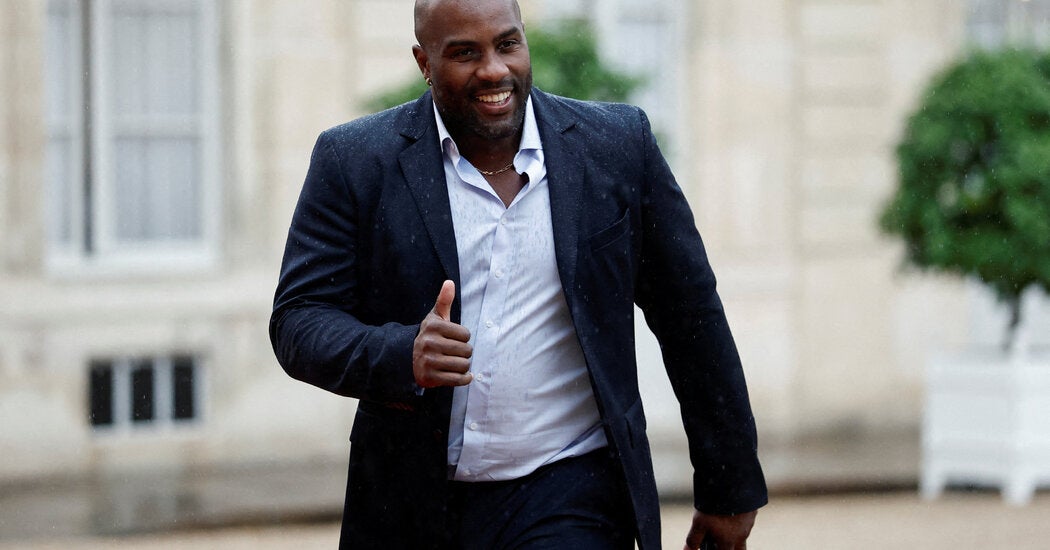
AdvertisementSKIP ADVERTISEMENTCentrists want alternatives to a matchup between the far right and far left in the 2027 presidential election. Teddy Riner, the judo champion, is in, while Christine Lagarde is less likely.Teddy Riner, a judo champion, in 2025. Mr. Riner, one of France’s most popular athletes, announced on Monday that he would run for president. Credit...Benoit Tessier/ReutersNov. 13, 2026, 12:01 a.m. ETWhen Teddy Riner, a judo champion and one of France’s most popular athletes, announced this week that he would run for president, it was less a game changer than a welcome diversion. For all of his appeal, Mr. Riner, 37, is unlikely to win the race to replace President Emmanuel Macron next spring.Yet his quixotic candidacy reveals a hard truth about France’s presidential campaign. Five months before voters go to the polls, many are eager, even desperate, for a fresh face to upend a race that looks increasingly as if it’s on a glide path to the election of France’s first far-right government since World War II.The main far-right candidate, Marine Le Pen, has held a commanding lead over all her rivals for months — a lead that has only been reinforced by weeks of protests, marred by violence, that have shaken France. The most prominent center-right candidate, Édouard Philippe, has faded in the polls as the unrest has sharpened the appeal of far-right calls for law and order and left-wing calls for social justice.Another beneficiary of the upheaval is a far-left firebrand, Jean-Luc Mélenchon, who now appears to be the likeliest candidate to advance into a second round against Ms. Le Pen in France’s two-round system. As things currently stand, French voters would be confronted with a choice between two poles of the political spectrum.Centrist voters are “afraid of being confronted with a duel between Marine Le Pen and Jean-Luc Mélenchon,” said Jean-Daniel Lévy, deputy director of Toluna France, a polling firm. These voters, he said, are an “orphan electorate,” lacking an inspiring candidate, and are “still looking for someone.”Raphaël LLorca, an analyst at the Jean-Jaurès Foundation, a left-leaning research group in Paris, said the search for a white knight showed “the panic of the centrist bloc.” He added, “It is clear that the election is slipping away from them.”ImageMarine Le Pen, third from left, standing with other candidates for the French presidential elections during a debate in August. Credit...Thomas Samson/Agence France-Presse — Getty ImagesMr. Riner’s name is not the only one tantalizing frustrated centrists. Christine Lagarde, a French lawyer and former finance minister, announced her resignation as president of the European Central Bank last month, saying she wanted the freedom to weigh in on political debates. She has ruled out a run for the presidency, but that hasn’t stopped French newspapers from speculating that she might still join the race.Dominique de Villepin, a former foreign minister and prime minister who declared France’s refusal to join the American-led invasion of Iraq in 2003, is weighing a bid. So is François Hollande, a center-left former president who left office in 2017 with the lowest approval rating of any president since France’s current system of government, known as the Fifth Republic, was founded in 1958.Among declared candidates, two other fresh faces have recently spiked in the polls: David Lisnard, the mayor of Cannes, a socially conservative free marketeer with a slick social media profile; and Raphaël Glucksmann, a left-leaning member of the European Parliament, who recently won a primary among candidates on the center left.What they have in common is that neither worked for Mr. Macron, who, in his waning months in office, is rivaling Mr. Hollande for unpopularity. The three most established center-right candidates — Mr. Philippe, Gabriel Attal and Bruno Retailleau — all served in top jobs in Macron governments. In an election driven by change, analysts say, they are tarnished by that association.“David Lisnard and Raphaël Glucksmann are not accountable for the past,” said Mr. Lévy, deputy director of the polling firm.Mr. Lisnard, a onetime journalist who is the son of a professional soccer player, was a vice president of the main right-wing party, the Republicans, and started his own party, New Energy, in 2021. Mr. Glucksmann, a former documentary filmmaker whose father, André Glucksmann, was a famous philosopher, ran for office on a list of Socialist candidates. But he has never been a member of the Socialists, having started his own party, Place Publique, in 2018.In the most recent poll by Ipsos, Raphaël Glucksmann drew 13 percent, equal to that of Mr. Philippe but behind Mr. Mélenchon, at 17 percent, and Ms. Le Pen, at 33.5 percent. Mr. Lisnard drew 6.5 percent; in other recent polls, he has been as high as 9 percent.Both men face an uphill struggle, according to analysts: Mr. Lisnard, because he is jostling in a crowded center-right field; Mr. Glucksmann, because the center left has all but withered as a political force in France.Analysts are also skeptical about a Lagarde candidacy — and not just because she told the French paper La Croix in September that running “would not be a good idea at all.” She cited her age, 70, and the demands of the job.ImageChristine Lagarde, a French lawyer and former finance minister, announced her resignation as president of the European Central Bank last month, but ruled out running for the French presidency. Credit...Bernd Von Jutrczenka/DPA, via Associated Press Philippe Marlière, an expert on French politics at University College London, said Ms. Lagarde’s technocratic style and pro-European tilt would be a liability in an election fueled by populism and nationalism. “This speculation tells us more about the crisis of the French center right,” he said.Thierry Breton, a former commissioner at the European Union whose name has also come up as a potential candidate, said centrists were struggling because voters were turned off by conventional politicians, with detailed policy agendas, and seemed “willing to vote more and more for a figure or character.”Enter Mr. Riner, a five-time Olympic gold medalist in judo who has never held elected office. He was born in Guadeloupe, a French territory in the Caribbean, to parents who moved to mainland France in the early 1990s. Mr. Riner has cast his life story as a testament to France’s greatness and vowed to be a unifying force. While his policy positions are a work in progress, he bills himself as a candidate of “neither the right nor the left.”On paper, he would appear an even longer shot than Ms. Lagarde. But Mr. Lévy noted that Mr. Riner would appeal to younger voters flocking to Mr. Mélenchon, the far-left leader, who has been a fixture at student-led protests. Certainly, none of the candidates can match Mr. Riner’s outsider status.“I hear anger, which some people echo with a lot of negativity, and from the mouths of people who no longer have ambition or the desire to think big,” Mr. Riner said in an interview with the French paper Le Parisien. “But France is a great country. It allowed me to become the person I am.”Among those who welcomed Mr. Riner’s campaign was Mr. Macron, who famously emerged as a fresh face midway through the 2017 election. Speaking to a French broadcaster, he said he was “very happy” that Mr. Riner was joining the fray.“It can only benefit the country,” Mr. Macron said.Ségolène Le Stradic contributed reporting.Mark Landler is the Paris bureau chief of The Times, covering France, as well as American foreign policy in Europe and the Middle East. He has been a journalist for more than three decades.Related ContentAdvertisementSKIP ADVERTISEMENT
In French Election, Centrists Eye a Judo Star and a Central Banker
Full Article
Original Source
Read the full article at Nytimes →KhanList aggregates and links to publicly available news content. We do not host full articles from third-party sources. Always verify important information with original sources.