
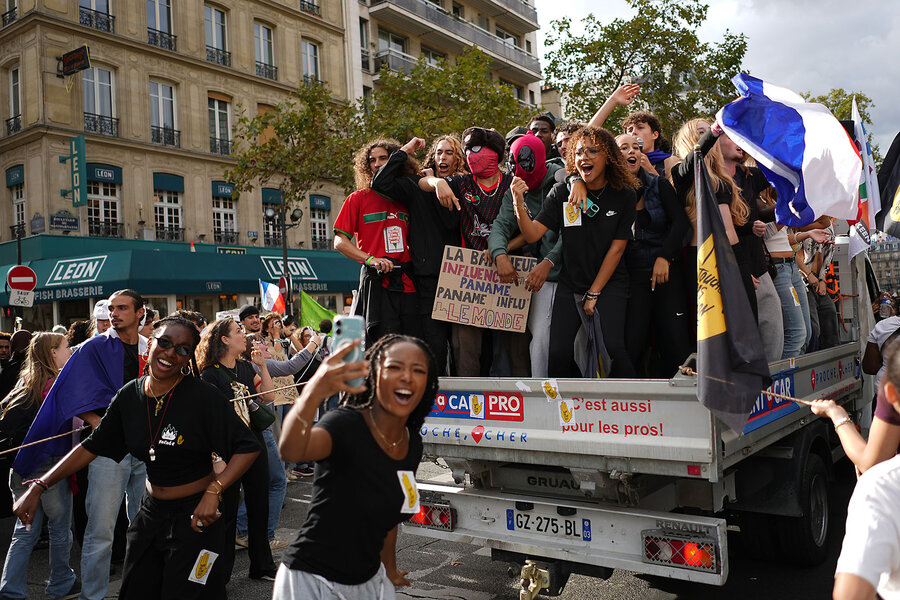
Normally, on an average day in mid-October, Lise Bourrée would be in school. Her parents, Dominique and Lucien, would be on her back if she weren’t.But Lise, who is 15 years old, hasn’t gone to class for a week. Instead, she’s been barricading the front entrance of her high school in central Paris along with her classmates, brandishing protest signs that call for change. For now, her parents are OK with that.“Young people just want to be taken seriously,” says Mrs. Bourrée. Her husband agrees and says, “The situation has become unmanageable.” French students are protesting about what they see as a failing education system – overcrowded classrooms, crumbling buildings, a lack of substitute teachers – and a government they feel doesn’t listen to them.It’s a situation that brought Lise and thousands of her peers – including Swedish activist Greta Thunberg – out onto the French streets again on Tuesday, for the second nationwide strike in seven days. The student movement is now stretching into its fourth week. Sarah Meyssonnier/ReutersProtesters react as French police use water cannons amid clashes during a demonstration by high school and university students in Paris, Oct. 13, 2026. Such is the strength of feeling that many are drawing parallels with the country’s pivotal May 1968 student revolution. Back then, French youths famously pulled up cobblestones and hurled them at riot police in their calls for an overhaul of the rigid university system.Millions of French workers joined the protests, halting daily life for nearly two months and piling pressure on President Charles de Gaulle’s government. For generations, the French have romanticized May ’68 for its ability to break the system and create radical change for women and the working class. Lawmakers have long feared a repeat.This time, the growing movement is uniting families like the Bourrées around the dinner table, with parents, teachers, and even local lawmakers joining the protests.“We just want jobs, opportunities, a future,” says Lise. “Our generation, and the next one, depends on us.”Anger boiling overWhile many of the latest demonstrations have been peaceful, anger has boiled over. Rioters have smashed storefronts and set garbage cans alight. At least 24 of the country’s 3,700 high schools have been set on fire or ransacked, according to France’s education minister.French President Emmanuel Macron has condemned the violence as “unacceptable,” but his government has reason to worry. There are calls for other protesters, worried about wider cost-of-living concerns, to join the student movement in a larger demonstration on Saturday.Gas prices have reached nearly $9 per gallon, and the cost of household goods has risen by 3%. Families like the Bourrées are feeling the pinch. “There is a general feeling of, ‘We are fed up,’” says Mr. Bourrée.To add to that, the French government last week submitted a 2027 budget proposal, which aims to make around €54 billion ($60 million) in public spending cuts. Part of that would include eliminating 1,588 teaching posts. The government cites a decline in student numbers.“It is not clear where this is all heading”Mr. Bourrée is worried, like many French voters, that the moment will be ripe for Marine Le Pen to step in. The far-right National Rally leader is ahead in opinion polls for this spring’s presidential election.“It is not clear where this is all heading, but French society is clearly polarizing,” says Hall Gardner, professor emeritus of political science at the American University of Paris.Some French youths, like Lise, are concerned that all the talk about politics or references to the past take away from the present, and dilute the focus of student demands.Thus far, the French government has offered stopgap measures, such as sending 3,000 substitute teachers into empty teaching posts around the country. But many students see those types of measures as merely “sprinkling breadcrumbs.” Lise and her classmates want structural changes to make school days easier. She goes to class from 8 a.m. to 6 p.m. most days, with three-hour gaps between lessons. Most of her classes contain 35 students, and when France was hit by consecutive heat waves this spring, her classroom didn’t have fans.For French families like the Bourrées, these are not big requests, but they do demand political will to make concrete changes. And this, say Mr. and Mrs. Bourrée, is where the French government consistently fails to make decisions and pushes them on to the administration that comes after it. Deepen your worldviewwith Monitor Highlights.Politics with respectGet political stories with respectful analysis.There‘s a world of new ideas in everyBooks newsletter.There‘s more to life, enrich yours withCulture & Learning weekly.Follow humanity‘s discoveries withScience & Nature stories in your inbox.Gain a spiritual perspectivefrom the stories in your inbox.Want to understand the deeper impact of critical events? Learn the Monitor‘s insight.Already a subscriber? Log in to hide ads. Not anymore, hopes their daughter.“Generations before us may have accepted what’s going on, but we won’t,” says Lise. “Those who come after us are depending on what we do now. And we need to fight.” ALREADY A SUBSCRIBER? LoginReal news can be honest, hopeful, credible, constructive.The Christian Science Monitor was founded in 1908 to lift the standard of journalism and uplift humanity. We aim to “speak the truth in love.” Our goal is not to tell you what to think, but to give you the essential knowledge and understanding to come to your own intelligent conclusions. Join us in this mission by subscribing.
In France, student protests bring echoes of the past
Full Article
Original Source
Read the full article at Csmonitor →KhanList aggregates and links to publicly available news content. We do not host full articles from third-party sources. Always verify important information with original sources.