
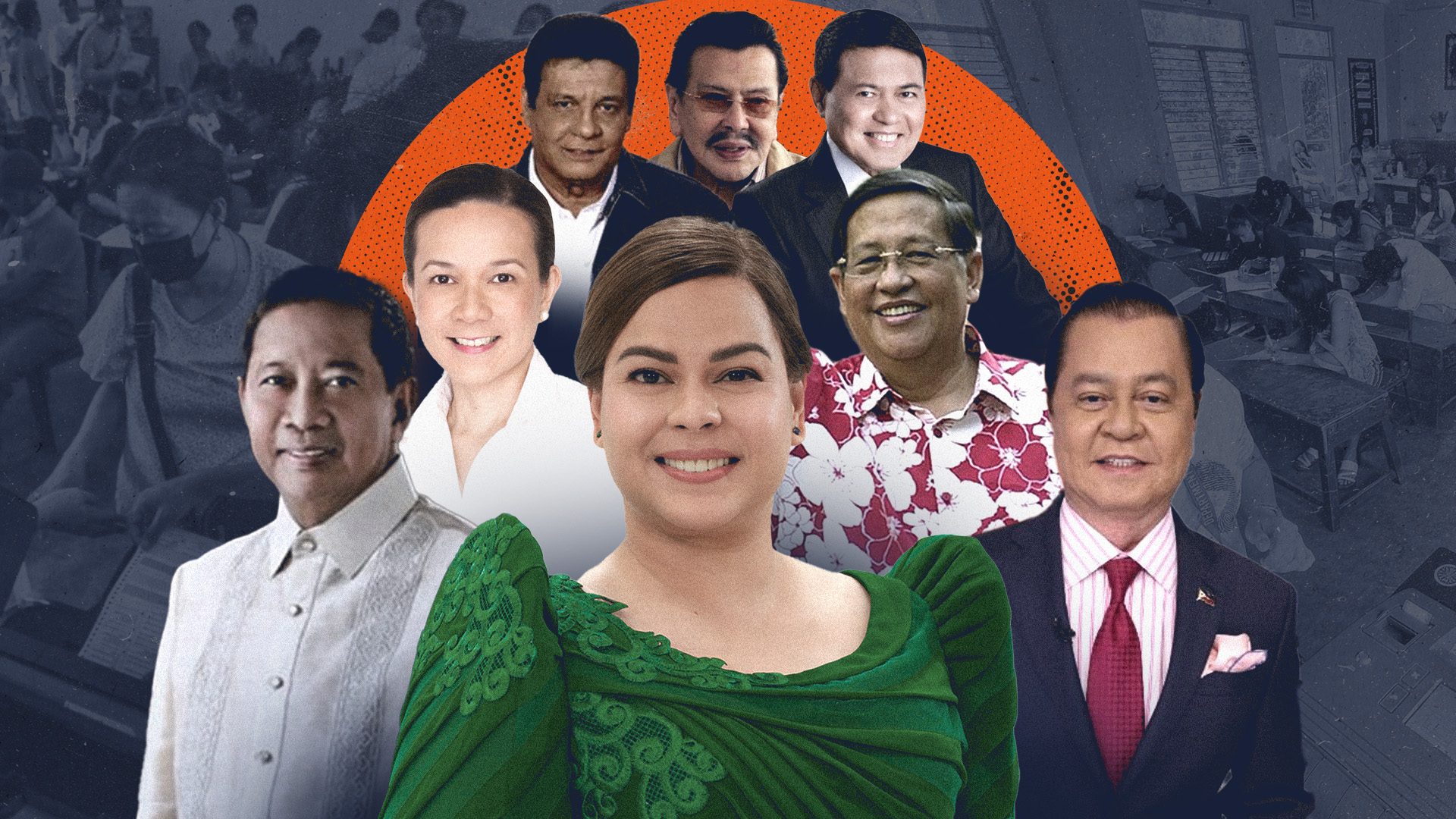
A little less than two years ahead of the 2028 presidential elections, Vice President Sara Duterte is a clear front-runner in election surveys — and by a wide margin. The data may seem like the future is set in stone, but a look at how early election surveys done in the past matched up with their final election results tells a different story. Four out of the five past presidential elections saw early survey front-runners fall from grace. What does that mean for Vice President Sara Duterte? Here are the numbers from past presidential elections. 1998 elections The 1998 election is the only one in the past decade to have the initial survey leader eventually win the final poll. Two years before the national election, then-vice president and former actor Joseph “Erap” Estrada took an early, but thin lead, alternating with then-senator Gloria Macapagal-Arroyo and “undecided” options. Arroyo initially considered a presidential run, but eventually decided to seek the vice presidency as the running mate of another presidential aspirant, then-House speaker Jose de Venecia Jr. This led to Estrada widening his lead, which he managed to maintain until the official election, where he got 39.86%. Arroyo also won her vice-presidential bid, where she got an even higher vote percentage than Estrada at 50%. 2004 elections Despite serving as vice president and inheriting the presidency from Estrada after his ouster, Arroyo was not the survey front-runner in the lead-up to the 2004 elections. In fact, she was not even one of the top contenders at first. Broadcast journalist Noli de Castro, the late senator Raul Roco, and actor Fernando Poe Jr. (FPJ) were the ones duking it out for the top spot. At this time, Arroyo was still sticking to her own pronouncement in December 2002 that she would not seek the presidency in 2004. Still, a little less than a year later, in October 2003, Arroyo changed her mind and announced her presidential candidacy. But even then, she didn’t take an automatic lead. It was a relatively slow climb back up to the top of surveys, helped along by a fall in survey results for two of the previous front-runners. At the time, De Castro announced he would run for vice president instead, while Roco’s health issues prompted him to seek medical treatment abroad. In the end, it was neck-and-neck between Arroyo and FPJ even up to election day. Arroyo eventually won, but it was a race that was marked by cheating accusations against her. This happened especially after the 2005 “Hello, Garci” scandal, where recordings of a conversation between Arroyo and then-Commission on Elections director Virgilio Garcillano were leaked. 2010 elections Benigno “Noynoy” Aquino III, the eventual winner of the 2010 elections, did not even figure in any of the early election surveys. Initially, it was a close race between business tycoon Manny Villar, ousted president Estrada, then-senator Chiz Escudero, and De Castro. But just when Villar began taking the lead, former president Cory Aquino died in August 2009, just nine months before the 2010 presidential elections. Her son, Noynoy, declared he had decided to run for president a month later, prompted by a public clamor. (READ MORE: Remember when Noynoy Aquino declared he would run?) The younger Aquino immediately took an overwhelming lead in the election polls, which he would maintain until eventual victory in 2010. 2016 elections Like Noynoy Aquino, then-Davao City mayor Rodrigo Duterte was not even mentioned in early election surveys. But unlike Aquino, there was no dramatic event that catapulted him to the top of polls. For a good while, then-vice president Jojo Binay was the clear front-runner. Before Duterte eventually debuted in the surveys, he had languished for months at the bottom of the polls, though at the time, he had still been making repeated pronouncements that he would not seek the presidency. When Binay dropped in the polls following corruption allegations related to the overpriced Makati City Hall Building II, it was Grace Poe who took the lead. But Poe herself had been facing disqualification cases over her citizenship and residency as a result of her foundling status and oath of allegiance to the United States. The issues slowly chipped away at her early lead. Meanwhile, Duterte had been building his own popularity not only through a hard-line, bloody stance on drugs, but also through the deployment of an army of trolls to spread fake news and propaganda in his favor. (READ MORE: Propaganda war: Weaponizing the internet) When he eventually announced his presidency in November 2015 and substituted PDP-Laban’s withdrawn presidential candidate Martin Diño, Duterte slowly but surely made his way up the ranks until he won the 2016 elections. 2022 elections Ferdinand “Bongbong” Marcos Jr.’s road to the presidency did not start with an early survey lead. It was a subsequent commanding surge that delivered him to Malacañang. In the early surveys of 2020 and early 2021, his running mate, Sara Duterte, was actually the undisputed front-runner for the presidency. It was only after she decided to slide down to the vice-presidential race in late 2021 that Marcos consolidated the fragmented numbers into their Uniteam alliance. From that point on, he took a dominant lead in the polls, maintaining it all the way to a landslide victory in May 2022. What this means for Sara Duterte Dr. Jose Ramon Albert, senior research fellow at the Philippine Institute for Development Studies (PIDS), told Rappler that the past five elections show that there are a few “recurring factors” when it comes to early front-runner momentum: 1 Name recall versus deeper convictionEarly leads are often built on familiarity, family political brand, or media visibility rather than settled voter preference. But that kind of support is the most volatile because it has not yet been tested against an actual choice among named alternatives. 2 Entry of a “consolidating alternative”This is what happened with Arroyo’s reversal in 2004, Noynoy Aquino’s late entry in 2010, and Duterte’s emergence as a consolidating anti-establishment vote in 2016. They show how front-runner status can evaporate once undecided or fragmented opposition voters coalesce around a single credible challenger. 3 Width of the early fieldThis is a statistical point as much as a political one. The more candidates there are splitting the vote early on, the more mechanically unstable the front-runner position is, since even a modest consolidation among trailing candidates can flip the lead. 4 Exogenous shockThis can cut either way: whether by boosting a candidate through sympathy, as in the case of Noynoy Aquino after his mother’s death, or controversies that damage reputation, as in the case of Binay. 5 Campaign organization and resource depthWhile more mundane, this is still important, since leads built on name recognition alone tend to be more fragile than those backed by ground machinery. “Like Estrada in 1998, she (Sara Duterte) is leading comfortably in a fragmented field, and unlike the leads that collapsed in 2004, 2010, and 2016, hers has been unusually durable across many independent survey houses over an extended period, which statistically is a meaningful signal of underlying support rather than a momentary blip,” Albert said. But he also said that what makes her situation entirely different from previous front-runners is the active impeachment trial running in parallel with her candidacy. “How that resolves, and how the electorate metabolizes it, is simply not something historical front-runner patterns can predict,” he said. The Vice President’s national lead relying heavily on overwhelming support in Mindanao may also become a deciding factor, according to Albert. He said broad-based national leads tend to be far more resilient than those anchored primarily on a specific region. So will Sara Duterte’s lead hold? – Rappler.com Coding for this layout was done with the assistance of AI.
IN DATA: The fates of early election survey front-runners
Full Article
Original Source
Read the full article at Rappler →KhanList aggregates and links to publicly available news content. We do not host full articles from third-party sources. Always verify important information with original sources.