
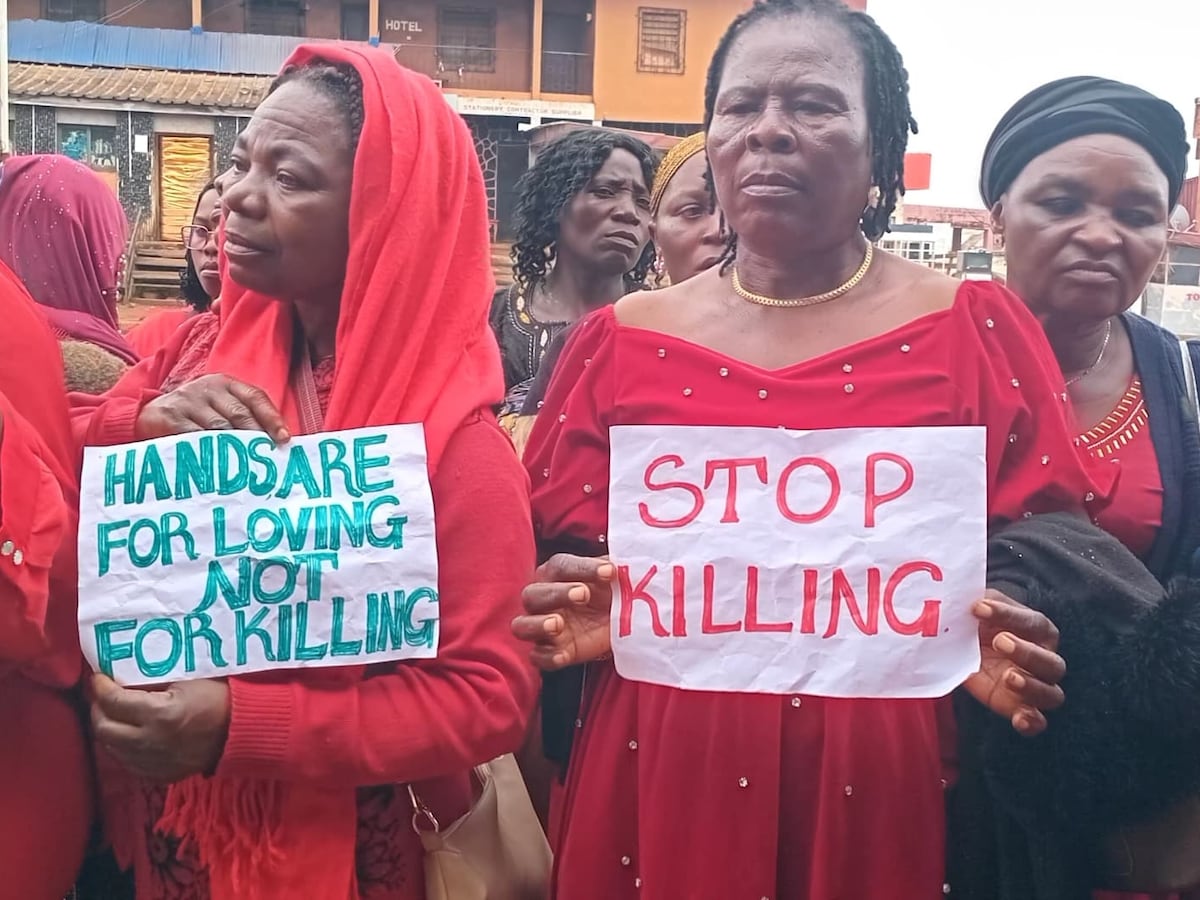
Two months after her death, 18-year-old Courage Anushini is still struggling to come to terms with the loss of his mother, Geraldine Achiah. Memories of their time together remain vivid. Her presence continues to haunt his dreams. Geraldine was an elementary school teacher in her 30s when she was reportedly beaten to death by her husband, Manfred Amambua, on September 8, 2026. She was a resident of Yaoundé, the capital of Cameroon. The murder took place just two months after their marriage. “It’s very difficult for me to move on and concentrate on my studies, because her memory is with me every day,” Anushini tells EL PAÍS in a WhatsApp message. “I try not to isolate myself. Talking to family and friends is the only thing that helps me ease the weight of grief and cope with the pain.”Achiah is one of nearly 80 women who have been murdered in Cameroon since January of this year. This is the grim result of gender-based violence: at least eight women were killed during a single week this past August. Following the recent wave of murders in Cameroon, civil society organizations and human rights groups have organized protests to denounce the violence and demand swift government action.Since August, activist Laura Sen has been leading a national public awareness campaign known as the “Red Friday” movement, which calls for the legal recognition of femicide as a specific crime in Cameroon. Every Friday, participants wear red clothing or accessories as a visible symbol of solidarity with the victims. They stand together against violence. “We don’t claim that a demonstration will make femicide disappear; that would be unrealistic. But we can create mechanisms that allow us to identify high-risk situations earlier, [in order to] better protect the women who are in danger and intervene before violence causes irreparable harm,” Sen explained to this newspaper via WhatsApp. The latest figures point to a steady increase in the number of women murdered in Cameroon over the past three years: 50 in 2023, 67 in 2024 and 77 in 2025. This is according to government data. However, human rights organizations and activists warn that these figures likely underestimate the true number, as many other femicide cases, especially those in rural areas, go unreported.The Ministry of Women’s Empowerment and the Family (MINPROFF) attributes the rise in violence against women in Cameroon to several factors: misogynistic social norms that perpetuate the belief that men have the right to use force and that their actions will go unpunished; institutional impunity, reflected in loopholes in the legal framework; as well as widespread poverty, alcoholism and drug use. Many men look down on women and treat them like slaves. In some cases, women who decide to leave their abusive husbands are hunted down and killed. “Our country is going through crises in some regions, particularly in the Far North [region, with the Boko Haram insurgency], and [the armed conflict] in the Northwest and Southwest regions, and this has contributed to the lack of respect for human life,” said Minister of Women’s Empowerment Marie-Therese Abena Ondoa, in an interview with state media this past September.“Fear of retaliation, stigmatization and judicial procedures, which can be extremely long, [mean that victims] get discouraged. Some couples choose to resolve domestic violence cases privately, for fear of being judged by society, while others lose faith in the justice system when abusers go unpunished,” Abena Ondoa noted. She added that the country’s precarious economic situation exacerbates the problem, increasing many women’s economic dependence on their spouses and limiting their ability to leave abusive marriages — something which can have deadly consequences. Half of the world’s femicides happen in AfricaThe recent wave of femicides in Cameroon reflects a broader problem affecting the entire continent. Since the beginning of this year, hundreds of women have been murdered in South Africa, 569 of them between April and June alone. In Kenya, a report published by Amnesty International in April of 2026 indicated that, on average, one woman or girl is murdered every day, which equates to approximately eight reported cases of femicide each week. This figure brings the number of women murdered in the country over the past decade to more than 1,000. In Zimbabwe, thousands of cases of gender-based violence are recorded every year. One in three women has experienced physical violence, while nearly 40% of women between the ages of 15 and 49 have been victims of violence at the hands of their partner. The 2026 Femicide Brief, published by the U.N. Office on Drugs and Crime (UNODC) and U.N. Women just before November 25, the International Day for the Elimination of Violence against Women, estimates that, in 2025 alone, some 47,000 women and girls worldwide were murdered by their partners or family members. Africa recorded the highest number of victims, with 22,100, followed by Asia (15,100), the Americas (7,400), Europe (2,100) and Oceania (300). The African continent also had the highest regional rate of femicide, with 2.9 victims per 100,000 women and girls.Eyole Nganje Monono is a sociologist and professor at the University of Buea, in Cameroon. She states that the main social and structural causes of femicide, such as patriarchy, partner retaliation and institutional inaction, are common throughout Africa, although the implementation of laws with a gender perspective varies from country to country. “The phenomenon of femicide can be attributed to the overlap of weak laws, cultural impunity and the deterioration of social norms,” explains Monono in a WhatsApp exchange.Along with Cameroon, most African countries still consider murder to be a crime that doesn’t distinguish between men and women. “Beyond legal shortcomings, the rise in femicides cannot be explained as an isolated act of individual deviance. Rather, it’s the predictable result of systemic gender inequality, institutional deficiencies and the cultural normalization of violence,” the professor notes.Viviane Tathi Yende is the coordinator of #StopFemicides237, an organization founded in 2023 by feminist activists to monitor and document femicide cases in Cameroon. She states that the group has identified a particularly disturbing factor behind these murders that sets the country apart from other parts of the continent: ritual killings.“Local cultural beliefs often give a lot of power to women’s bodies, especially their intimate parts,” Tathi explains to EL PAÍS. “When these beliefs intersect with human trafficking networks, we see ritual killings that primarily target women and girls in Cameroon.”“However,” she clarifies, “we’ve concluded that, while cultural factors may vary from one place to another across the continent, the underlying structural causes remain the same.” Lack of legal protectionUnder the umbrella of the Association Sourires de Femmes (ASDF), a Cameroonian feminist non-profit organization founded to combat violence against women and girls, Tathi and her team organize awareness campaigns in Yaoundé.Dozens of women, most of whom have suffered some form of gender-based violence in their homes, participate in these meetings. One of them, Genevieve, is a farmer who lives on the outskirts of Yaoundé. She says that her husband has beaten her at least five times, even when she was pregnant, after disagreements about dividing the income they made from selling cocoa beans.“I left the marriage three times, but I went back each time for the sake of my children,” the 46-year-old mother of seven tells EL PAÍS, while showing the scars that the violent attacks left on her hand. “My husband is very violent. Every time we had a disagreement, he chased me with a machete.” Cameroon’s Penal Code specifically punishes crimes such as forced or early marriage, rape and torture, but it does not recognize femicide as a specific crime. Recently, the government announced it was working on a bill to criminalize femicide as a standalone offense and strengthen legal protections against gender-based violence. The initiative is expected to be presented to Parliament during the current November legislative session.For human rights activists, the absence of a law is just one of the many obstacles to ending the murders of women in the country. Cases can be delayed for various reasons, including intimidation of victims and witnesses, as well as corruption and procedural errors, which can lead to reduced charges or even acquittals. This was the case of Diane Yangwo, a teacher whose killer avoided prison after receiving a suspended sentence in 2025. “A stronger judicial system, with a functioning chain of justice capable of responding swiftly and recognizing the urgency of violence, would allow us to prevent these crimes more effectively, especially those that occur within intimate partner relationships,” says Tathi. Monono believes that the rise in femicides cannot be addressed solely through legislative measures. She describes femicide as the “deadly culmination” of a long process of abuse, the complexity of which demands a multifaceted approach. “That’s why we need to move beyond the current cycle of repression and awareness-raising. While both measures are necessary, they’re fundamentally reactive; they don’t address the root of the problem,” she warns. “We need to adopt a comprehensive approach that involves moving beyond awareness-raising to the creation of prevention structures and institutions and to socioeconomic empowerment,” she adds. “Strengthening legislation should be the result of a national consultation that incorporates a wide range of opinions and secures communities’ commitment to abide by legal provisions. A strong law is a fundamental tool, but it is useless without community acceptance, a functioning judicial system, an open-minded culture and society, and the financial resources necessary to keep a woman alive as she flees a situation of violence.”Courage Anushini, the son of Geraldine Achiah, is now studying Computer Engineering at Bamenda University after failing the entrance exam for the Mechanical Engineering program, which was his first choice. He took the exam just one day after burying his mother, on September 19. While anxiously awaiting the outcome of the legal proceedings surrounding his mother’s death, Anushini is struggling with the desire for revenge against his stepfather, who has denied committing the crime. He’s currently in pretrial detention, accused of murder. “If I had the chance to speak to him today, I would simply tell him, with a heavy heart, that, with his own hands, he destroyed my entire life in a single day,” he says. Translated by Avik Jain Chatlani. Sign up for our weekly newsletter to get more English-language news coverage from EL PAÍS USA Edition
In Cameroon, women lead the ‘Red Friday’ movement against femicide: ‘My husband chased me with a machete’
Full Article
Original Source
Read the full article at English →KhanList aggregates and links to publicly available news content. We do not host full articles from third-party sources. Always verify important information with original sources.