
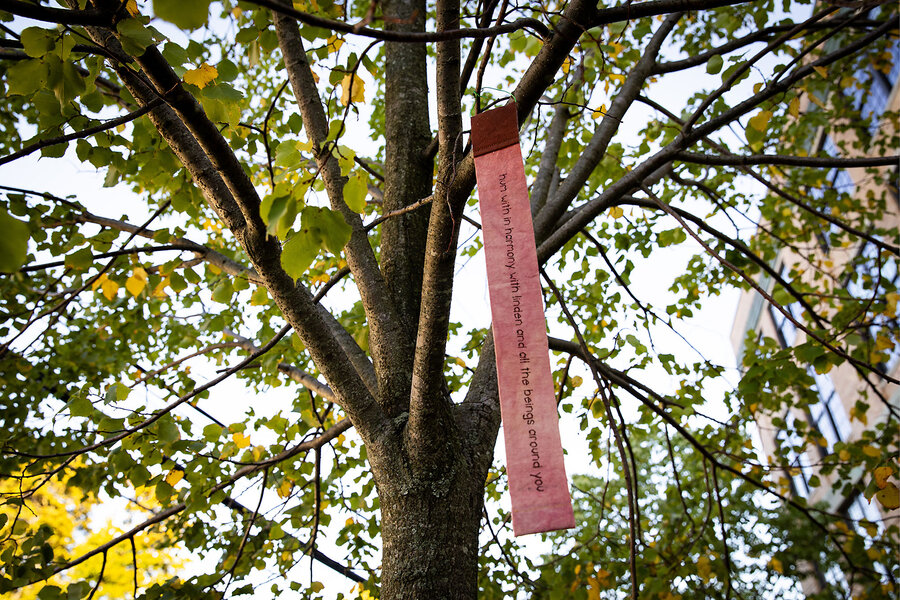
Boston | Oct. 08, 2026, 2:23 p.m. ET | 5 min read Jane Marsching, swathed in a deep-blue apron printed with white leaves, hums beneath a linden tree. Above her, a cloth tag twirls in its branches, printed with the words: “Hum in harmony with linden and all the beings around you.” Eleven people gathered in a circle, tentatively following her lead. A red SUV pulls to the curb, its radio pumping a dance beat. Down the street, metal striking concrete rattles the air as a repairman unloads a ladder.This is communing with nature in an urban setting and the current focus of artist Ms. Marsching’s latest work, Tree Care Hyde Park, an interactive community art project that includes gatherings, walks, plantings, and writing workshops. Each workshop focuses on a different tree, but this evening it is the linden with its heart-shaped leaves.Lindens, across many cultures, have provided places of congregation. The Celts and Germans claimed that the sweet fragrance of its flowers influenced judges, so that truth and justice emerged in its shade. During the French Revolution, lindens were among the tens of thousands of trees planted across the country to symbolize liberty. Today, college campuses and city parks are full of them. “So the quality of connecting, we’re reaching for that, through humming and harmonizing with each other,” says Ms. Marsching. Melanie Stetson Freeman/StaffA tag, made with tree ink, hangs on a chestnut tree near the public library in Hyde Park, Massachusetts. It was in the stillness of walks around the Hyde Park neighborhood with her dog, devoid of people during the pandemic, that she became aware of the sycamores, maples, hemlocks, and beeches with boughs stretching over the rooftops, their leaves sounding a soothing hush.Then reality hit.“I think in my block alone, in the last two years, 50 trees have come down. That’s a lot,” says Ms. Marsching, who is also an instructor at Massachusetts College of Art and Design. Studies of Boston’s urban canopy show Hyde Park experiencing tree loss at a higher rate than other Boston neighborhoods. Urban tree canopies have long been recognized as essential to city life. They help cool “heat islands” – neighborhoods made hotter by asphalt and concrete – filter air pollution, and make streets more inviting. But for some residents, they are seen as a nuisance, with unwieldy roots or too many leaves to rake up. Mature ones can also become vulnerable when longtime residents sell their homes, and new owners have a different vision for the yard.Ms. Marsching, whose work has focused on climate and the environment for two decades, saw an opportunity to remind her neighbors that paying attention to urban trees can invite reflection and wonder. Melanie Stetson Freeman/StaffArtist Jane Marsching, founder of Tree Care Hyde Park, poses with a wheelbarrow filled with supplies to make tags for trees, in the Hyde Park neighborhood of Boston, Oct. 6, 2026. “I have moved in the last decade or so to projects that really address our local ecologies, places that we live in or are familiar with, and places that we love,” she says. “I try to connect people to what’s happening ... not just challenges, but what are the beautiful opportunities?”Through her initiative, supported by a grant from the Boston Public Arts Triennial Accelerator Program, she aims to highlight the groups that plant and preserve the city’s canopies and to address concerns about their stewardship. She also hopes to use art to help her neighbors forge a bond with the towering sentinels around them.At the project’s launch in the Hyde Park Public Library’s garden in September, neighbors and advocates checked out Ms. Marsching’s handmade wheelbarrow outfitted with tags, inks, rollers, and trays of wooden letters.Boston Parks and Recreation Department is one of the project’s partner organizations. Todd Mistor, the director of urban forestry, tells the crowd that they oversee 42,000 trees and maintain an inventory across 300 parks. He encourages residents to consider planting “street trees” at the city’s expense and responsibility. Melanie Stetson Freeman/StaffJane Marsching pushes her cart down the street to a tag-making event in Hyde Park, Massachusetts, Oct. 6, 2026. Studies have shown that Hyde Park is experiencing tree loss at a higher rate than other Boston neighborhoods. “We can partner with you to have that tree survive and thrive and have a healthy life,” he says. Visitors to the library garden pause to ponder messages affixed to nearby barks. A stately elm bears a tag reading, “finding your elm stance, clear-cut the air around you, breathe and release.”Ms. Marsching has created her own online field guide for Hyde Park’s trees. She spent a year observing each one’s unique qualities, and then penned a few lines, or “scores,” to help residents connect with the trees beyond scientific studies or Latin names. Not all are native to the area, and some are unwelcome. But the artist has made a point of including black locust, buckthorn, and tree of heaven, plants identified as weeds in Massachusetts.“These are trees that are just not in an aligned relationship in our ecosystems [but] they are actually to be admired because they are so fierce and so hardy and so productive,” says Ms. Marsching, who admits her own bias against them when she encounters one sprouting in her garden. Melanie Stetson Freeman/StaffTools for making tree tags hang on Jane Marsching’s cart. The cloth tags include poetic lines stamped in ink made from trees. During her workshops, she prompts people to consider the quality of a tree and then reflect on their own lives. For example, oak trees, which can live for over 500 years, invite people to recall their own stories of endurance. Collectively, the participants come up with a score to handstamp on strips of cloth that they take home and fasten to a tree in their yard, with a bit of twine, for others to discover. Ms. Marsching records each location. The project aims to place 1,000 tags. Deepen your worldviewwith Monitor Highlights.Politics with respectGet political stories with respectful analysis.There‘s a world of new ideas in everyBooks newsletter.There‘s more to life, enrich yours withCulture & Learning weekly.Follow humanity‘s discoveries withScience & Nature stories in your inbox.Gain a spiritual perspectivefrom the stories in your inbox.Want to understand the deeper impact of critical events? Learn the Monitor‘s insight.Already a subscriber? Log in to hide ads. At a local senior residence center this week, the participants hummed with lindens and then headed into the art room to reflect on paper, using sepia-brown linden ink. Resident Carolyn Cronin admitted she was humbled to learn that the four saplings growing in a row along the wrought-iron fence outside were lindens. She delicately crafts her thoughts with a wooden dip pen: Let’s be quiet together, listen to the wind. What have you seen? What have you heard?“It just shows the power of nature to pull you out of your element and explore something new,” says Ms. Cronin. “It made me think about the future. Do we have room for these trees to grow? I can see them providing shade as they get big.” ALREADY A SUBSCRIBER? LoginReal news can be honest, hopeful, credible, constructive.The Christian Science Monitor was founded in 1908 to lift the standard of journalism and uplift humanity. We aim to “speak the truth in love.” Our goal is not to tell you what to think, but to give you the essential knowledge and understanding to come to your own intelligent conclusions. Join us in this mission by subscribing.
In Boston, an artist invites neighbors to speak for the trees
Full Article
Original Source
Read the full article at Csmonitor →KhanList aggregates and links to publicly available news content. We do not host full articles from third-party sources. Always verify important information with original sources.