
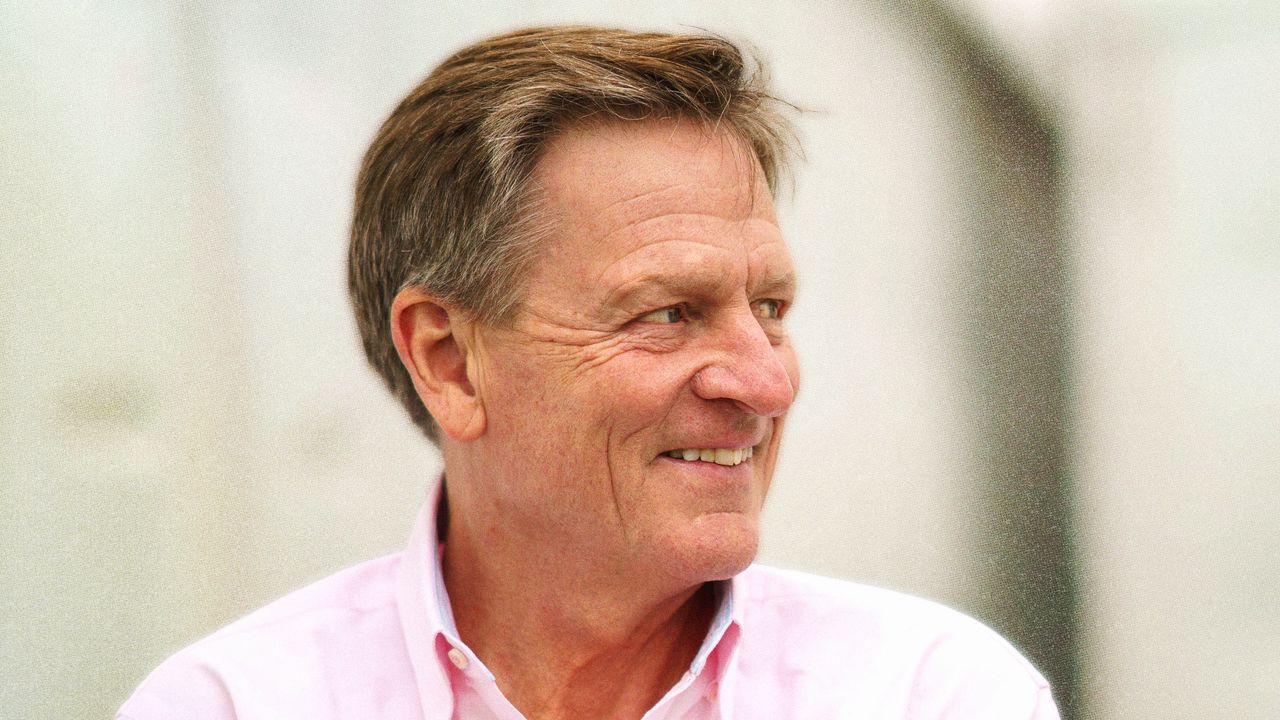
The Moneyball author's new book follows six civil servants who resisted the encroachment of Elon Musk. His next project? An Off-Broadway play.Getty Images; GQPerhaps more than any other contemporary nonfiction writer, Michael Lewis has earned a living making esoterica not only legible but riveting. In his hands, the particulars of subprime mortgages and collateralized debt obligations (The Big Short), of baseball's sabermetrics revolution (Moneyball), and of global financial crises afflicting Greece and Iceland (Boomerang) become the stuff of best-seller lists. “I think being fresh to the understanding helps," he says of his journalistic interventions, comparing himself to a parachutist. “If you're explaining something to the reader, it really helps to have to explain it to yourself first.”In 2025, shortly after Elon Musk convinced Donald Trump to let him snuff out waste and inefficiency across the federal government, Lewis airdropped himself into the bowels of American bureaucracy just as it fell under siege. The result is his new book, which tells the dramatic and sneakily poignant stories of six public servants who resisted the encroachment of DOGE, or the Department of Government Efficiency. “Blockers,” Musk called them, though here they register more like exemplars of civic duty. There's Alexander Maranghides, a fire protection engineer with the National Institute of Standards and Technology, and Kathleen Walters, a privacy officer at the Internal Revenue Service who was ordered, by the slimy Musk sycophant Gavin Kliger, to hand over confidential information on millions of American taxpayers.Before setting off on a 20-city book tour, his largest one to date, Lewis confessed to feeling “a little nervous.” But he doesn't read reviews anymore, as he told GQ, and he's already thinking about his next undertaking: a play, if you can believe it, set to open at New York's Cherry Lane Theater next spring.GQ: Your new book, Blockers, is out this week, and in it you’re quite critical of the second Trump administration. How do you think it’s going to land?Michael Lewis: I've already got some sense of how it's going to play, and I feel great. I can't really think of a book I've published that didn't trigger some anger. I don't know why they do it, but they do. But that has not really materialized… yet. It's an interesting exercise in becoming the lone personal publicist for the American bureaucracy.Did you reconcile yourself long ago with the idea that your work might ruffle some feathers? Or does that still unsettle you a little bit?It's not my natural state. I don't move through the world trying to piss people off, but Liar's Poker was my first real taste of it. And Billy Beane was just furious with Moneyball when it came out. So you don't know how people are going to respond to how you've portrayed them. And then some of these books become movies and people get very sensitive. So I have become a little bit inured to it, but not completely.I've tried to pay attention to what it's like bringing out a book. It's this message in the bottle phenomenon. I have my editor, my copy editor, and they're doing their best to stop me from making an ass of myself. But we don't really know from their response what the larger world's response is going to be. And there's also that thing like, Is anybody going to read it? Am I just going down some rabbit hole that nobody else wants to go?What’s your relationship to criticism? Do you read reviews?No. I just have a rule.When did you institute it?It was when I read the review in The Wall Street Journal of Liar's Poker saying it was a boring book, and I thought, "I know there might be problems with this book, but it's not a boring book." I vaguely knew the writer, and I knew he was a mediocrity and I was an innocent. I was 28 or whatever. I didn't know the field. What I sensed, and this is not true of all reviews, is that a lot of times the review is telling you more about the reviewer than it is about the book—their neuroses, their problems, their insecurities, their frustrations, whatever. And I just didn't want to have that picture in my head of other people. I have broken the rule a couple of times when the writer is someone I greatly admire, but just a couple of times. I really don't read the reviews, mainly because I don't want to just walk around feeling hostility or, for that matter, debts. So I don't participate in the afterbirth. It just doesn't teach me anything.Just two days ago I was on the phone with my father and he says, "What's your book tour like?" And I said, "It's like 40 days and 20 cities." He goes, "Why?" And I said, "Because I think this could be important and I want to get this out there, get it into the bloodstream of the country and all that." And he goes, "I don't know how much of a market there is for this kind of thing. I don't think anybody's going to really care." I said, "Thanks, Dad."Who needs to read a bad review when you’ve got your pops?Yeah, that's exactly right. And there are people out there—I won't name names—who will take money from a hedge fund manager to trash a book. And when you see the contract, as I have, you kind of go, "Really? That exists?"I've never been offered money to pan a book.You could have been. Actually, I'll give you advanced warning on my next book and you can go see what you can get for it.There we go. Let’s talk about this book specifically. Your last book, The Fifth Risk, told the story of the first Trump term and the hubris with which they approached the transition in particular. So I'm curious at what point it occurred to you that the saga of Elon Musk’s DOGE could be a 200-something page book and, also, a sort of metonym for this second term?It was instantly clear to me that whatever they said they were doing, they weren't doing. Either he was just a total ignoramus, which seems highly implausible, or he was saying one thing and doing another, which seems more likely. You could not cut $2 trillion out of the deficit if you weren't going to touch military expenditures and entitlements and interest on the debt.So I started paying attention because, I swear to you, there was a moment where I thought, "This could work." It's weird and it's hostile, but these people, they know tech. And one of the government's big soft spots is tech. It needs an upgrade. The whole thing needs to be rebooted. And I thought, “Maybe they'll come in and they'll do something useful.” So that engaged me, but what really engaged me was when they started going into places like the Institute of Peace. They probably didn't even know what that was, and I didn't know what it was, and now they want to run it? What the hell?So that was the beginning of a frame: "Okay, they're going to grab control of anything they can grab control of.” And for me, with books, the hardest part is not the writing of it, not the reporting of it, but the framing of it, figuring out what the book's really about. And [the framing] here is, the executive branch is going to be a different habitat than it was before. Species are getting kicked out. They don't know they're going extinct. Once I had that, then I was kind of on my way with a book. And DOGE was only part of it. DOGE was one of the instruments for changing the habitat, but it wasn't the only one. It was the nature of the people they put in charge of the agencies. It was Russell Vought and Project 2025. It was Trump himself.I find it fascinating, the actual guts of the government. And I swear to you, every time I go in I find a character. We did this piece of stunt journalism, kind of, in the Biden administration with my friend David Shipley, who was then the op-ed editor of The Washington Post. We parachuted writers into different parts of the government and said, "Find a story." And it was proven true over and over. Trump has made this possible. The hardest part, in ancient times and also during the Biden administration, was getting access. Nobody wanted you to talk to these people. But Trump has blown up so much that they're kind of scattered or unemployed. So now, they'll talk.Let’s talk more about that approach. You do tons of research, I imagine, but you’re not a DC insider, you’re not a beat reporter. What do you find are the advantages and disadvantages of parachuting in as a curious outsider?Well, if you're explaining something to the reader, it really helps to have to explain to yourself first. If you learned all this 20 years ago and you've become this expert in the world you're describing, you sort of forget what it's like not to know. So I think being fresh to the understanding helps. The enthusiasm that comes from recent acquisition of knowledge—that's an advantage.The disadvantage is possibly that you don't actually know what you're talking about, which would be a problem. [Laughs] But what newspaper reporters can't do is let people in scenes breathe. There are no scenes. A scene can take pages, and you can look for different kinds of material, you can look for character, you can look for the kinds of things a novelist would look for. All my books are that way. I mean, in theory, I didn't really know anything about baseball when I dropped into the Oakland A's. But it's not that hard to learn. This is not physics. So I think fresh eyes are incredibly powerful. I mean, consultants make their living off this kind of thing. When you roll in, you just see things that the people there have taken for granted or never noticed, and I think that can be very helpful.In this instance, you swooped down into the bowels of bureaucracy as it was being kind of dissembled. What surprised you most?How emotional it was, and also the odd interconnections between the antagonists and the protagonists. Alex Maranghides figuring out why the World Trade Center fell, and Howard Lutnick being someone who was maybe more affected than anyone walking the earth by that. Or Francis Collins, they're finding the gene for cystic fibrosis and Russell Vought being the prime suspect of the person who whacked him. The friendship drama inside the IRS between the woman who decided that she was going to help out DOGE and then gets herself very compromised. All that stuff—material just falling into place. Generally, if I'm on the right path with a story, I start to get really lucky and things happen.I love nonfiction challenges. This book reminded me so much of The Big Short. I knew that there were people who could teach the reader a piece of a thing. In this case, the categories were science and the things the government did that were going to be affected: public safety, data collection, fairness, referee function, all that stuff. Just as I knew, with The Big Short, that people had figured out how to get the right answer when Wall Street got the wrong answer. So I went out of the world and I cast it. I just found the people who got across the gist of the thing best and, as in that case, I was spoiled for choice. Each bucket, there were three other people I could have used. So these non-fiction challenges are a gas. I find them really fun. And if you push on the world hard enough, it'll eventually give you the story.What was most challenging, then? Did anyone try to sabotage or block your reporting along the way?Well, Elon Musk wouldn't talk to me. I tried really hard, and I have his number. I went down to Austin and I loitered in his vicinity.Where did you loiter?Where the illegal immigrants were being rounded up, which is very near his compound. It's just a few miles away. I ended up talking to a fair number of the DOGE people, including a half-dozen in the GSA [U.S. General Services Administration], but that was all very skittish. It was a “please don't quote me" kind of thing. But that was hard, because I had to assemble a portrait of what had happened without anybody, with most people not wanting to be quoted. So I had to do it in my own voice.It always helps to be able to get into the buildings, and the buildings were shut down. I couldn't get into the Institute of Peace. I was staring through the window and the guard would come out and say, "What are you doing here?" I did sneak into the IRS, which was kind of great. I wandered all over the IRS and that was really helpful. They wouldn't let me into NIST [The National Institute of Standards and Technology]. The public gets tours of NIH, and they barred me from coming on campus. So that was a little irritating. But I mean, nothing huge. I didn't have that feeling of, "Oh, someone's watching my computer." I didn't feel like anybody was scared of me. It's a book. I mean, I don't think they think books change anything.Well, they don't read them.They probably don't read them. [Laughs] He doesn't read them. It's not a TV show, so there isn’t a camera. And I think they're much more sensitive to what happens with a camera than with a pen.So, what strange world will you embed yourself in next?Well, I'd be amazed if I go back into the government for another book. I'm optimistic by nature, and I smell a bounce. I smell a bounce in a different direction. I had a senior member of the House, someone who was in a position to do something about it, asking me, should the Democrats get a hold of the House Oversight Committee, if I could help him stage hearings. Not “gotcha” hearings, but explanatory hearings where I could bring in my characters and Kathleen Walters, for instance, could explain what just happened in the IRS. And you'd do it in such a way that's fun and nobody feels threatened and nobody's trying to get each other. You put them on TV and it's a civics lesson.So I could be wrong about this, but you know when you fish and you catch something and you feel this jolt? And you go, “This thing is maybe too big for what I have"? I feel that now. I feel this deep, sincere interest in this subject, and it's coming from ordinary people, people who know someone who works in the federal government, people who worry about whether or not they can eat lettuce. But who knows? I'm not going to be writing about it. The next thing I'm doing is a play. There's a play that opens at the Cherry Lane Theatre in April that I wrote, so I'm moving into theater.What's the play about?I'd rather keep it a secret, but it's called How to Be Lucky. They just made the website public today, and they're going to start selling tickets in the next couple weeks.Sign up for Manual to receive useful advice on style, health, and more, six days a week.Jake Nevins is GQ's Senior Culture Editor. You can reach him at jake_nevins@condenast.com. ... Read More
In Blockers, Michael Lewis Tells the Inside Story of Elon Musk and DOGE
Full Article
Original Source
Read the full article at Gq →KhanList aggregates and links to publicly available news content. We do not host full articles from third-party sources. Always verify important information with original sources.