
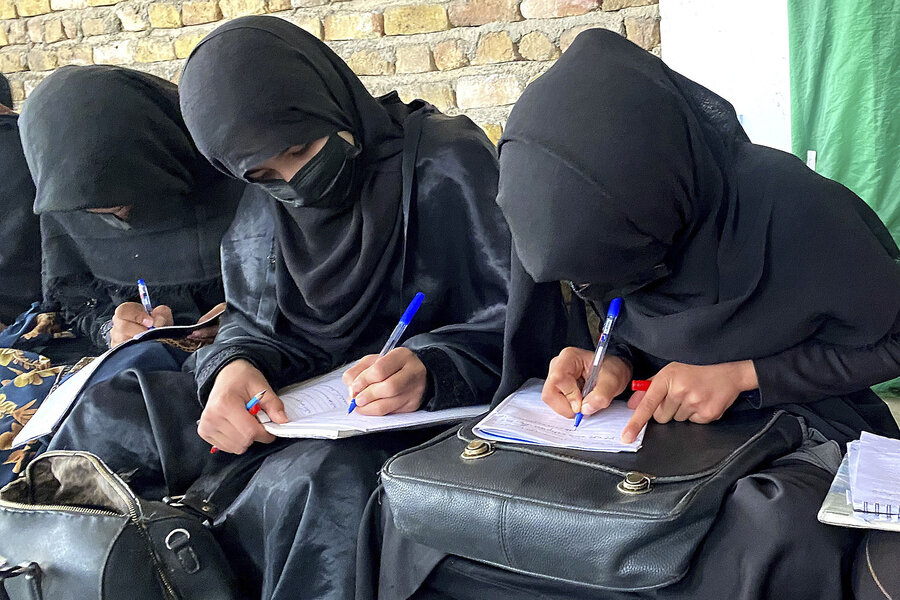
Across Afghanistan, in basements and storefronts promising sewing classes, a hidden rebellion is taking place. Five years after the Taliban swept back into power, the ban on girls’ education past sixth grade remains perhaps the movement’s most visible act of repression. Afghanistan is the only country in the world where girls are legally prohibited from continuing their education beyond primary school. Yet in secret, women are educating themselves, their schoolbooks hidden inside sewing bags as they listen closely for an unexpected knock at the door. The backroom courses in English, math, or nursing are no substitute for those shut down by the government. Women remember with heartache the day those closures took effect, but they have not yielded. Some 40% of Afghan women “still imagine a future where change and equality are possible,” according to a 2025 survey by UN Women. The underground education networks across the country are a testament to that hope.At 23 years old, Arghawan says she should be finishing medical school right now. (As with all women interviewed for this article, her name has been changed and her location withheld to protect her from retaliation.) Instead, she’s taking clandestine classes in the basement of a vocational center.It’s a dark, sparse, and bitterly cold space once winter sets in, lit by weak solar lamps whenever the power cuts out. If someone spots the morality police approaching, English lessons are wiped from the whiteboard in seconds, and notebooks are replaced with needlework. But when she’s there, the memory of the life she once had – and she hopes to have once again – flickers into view.“I feel as though I am back in my school classroom,” she says. “I feel as though I am alive again.” Ebrahim Noroozi/AP/FileAn Afghan girl writes on a board as girls attend class on the first day of the school year, in Kabul, March 25, 2023. High school remained closed for girls for the second year after the Taliban returned to power in 2021. ‘Like a funeral’Polls are clear. Afghans overwhelmingly want to educate their girls and young women. The UN Women report found that 92% of respondents in a national door-to-door survey said it was “‘important’ for girls to continue their schooling.” Support was no lower than 87% among both men and women, in both rural and urban areas.The Taliban banned women from secondary education in 2021 and college education in 2022. Those moments remain seared into the collective consciousness of women nationwide.Arghawan was 17 then, in the 11th grade, with plans to become a doctor or a prosecutor. She remembers the morning being sunny and the market a little quieter than normal. She had no idea the walk to school that day would be her last.Taliban vehicles were already blocking the gate when she arrived. When she asked why, a man who called himself a qari – a Quran reciter – told her and her classmates they were “stupid and irrational,” and asked whether girls like them were supposed to be the ones who built the nation. Once through the door, she says, she found her classmates and gripped their hands tightly. It felt as if letting go might mean losing each other forever. “Unfortunately, our school has been closed,” a teacher said, turning to the blackboard so the girls wouldn’t see her wipe her face. “It was truly like a funeral,” says Arghawan.The Taliban ordered everyone out. Students who resisted were beaten back with sticks.At another school nearby, girls were lined up in the schoolyard and told that anyone above sixth grade could no longer come to class. Some teachers tried to record the moment on their cellphones, but within the hour, the Ministry of Education called the principal and warned that anyone caught filming would be detained. The teachers deleted their videos in front of their students and the Taliban fighters standing at the gate.“We kissed the girls on their faces and sent them home,” says Fazilah, a former math teacher and administrator at the school, “all of them in tears.” Five years later, however, Fazilah is still teaching as best she can. Eleven girls, all former students, now come to her basement to learn English, math, chemistry, and physics. If anyone asks, they are there to learn sewing.Fazilah charges next to nothing, just enough to cover supplies. “I love teaching,” she says. “I believe teaching girls is my right.” Ebrahim Noroozi/AP/FileAfghan boys attend class on the first day of the school year, in Kabul, March 25, 2023. She knows the risks. An earlier class she ran – better equipped and teaching English and computer skills more openly – lasted four months before the Taliban found it. She was interrogated and warned that a second offense meant prison. She also knows the threat is real. A colleague was once arrested and released only after community elders intervened, forced to sign a pledge never to teach again.Encounters with the TalibanRana had a year of engineering left when the Taliban closed her college. By the end, there were signs of what was coming. One professor routinely exhorted the class to give up and get married, saying none of them would ever be permitted to work in their chosen field anyway.Today, she teaches at a vocational center where the front door advertises sewing. In the back rooms, Rana teaches mathematics for free, alongside women running secret lessons in English and computer skills under cover of sewing and beadwork.The center has already been raided once, on a tip, Rana says. Staff hid the books and the handful of computers, leaving only sewing patterns chalked on the board. She suspects some of the center’s staff might be informants.She also knows girls whose relatives work for the government, quietly attending the secret classes without disclosing it, and has learned not to say an ill word about the Taliban.But not all encounters with Taliban officials have been catastrophic. Arghawan recalls the time officers walked straight into her classroom without warning. “It was one of the most frightening moments of my life,” she says. “I thought they were going to take us to prison.” They said that they had only come “to advise these women,” she recounts, then delivered a lecture on hijab, prayer, never leaving home without a male guardian, obeying husbands and in-laws, and marrying because it was “God’s command.” Then, they thanked the women in the room for their time and left. Melanie Stetson Freeman/Staff/FileWomen who weren't allowed to go to school when younger take a literacy class at Showra Qurbonian center in Kabul, Afghanistan, April 11, 2012. The center offers classes for women in literacy, English, the Quran, and math. Surviving today and preparing for the futureArghawan had tried to stay at home in the years after her high school was closed, but she says she felt “like a prisoner,” unable to move freely even to go to the market. Research by UN Women suggests that fewer than half of Afghan women (41%) leave their homes at least once a day, compared with 88% of men. Some 14% of women leave their homes only once a week.Arghawan waited a year for the closure to lift. It didn’t. An online English class filled seven months until it, too, fell apart. Arghawan says she slid into a depression severe enough that she eventually saw a mental health professional, who told her to hold onto small routines: study, family time, a walk outside when she could manage it.Today, when she leaves for her classes, Arghawan tells her family she’s going to study the Quran. She must wear a black hijab, gloves, and a niqab, leaving only her eyes showing. On one scorching afternoon, she began to collapse from heat exhaustion and was rushed to a hospital.Rana, the former engineering student, carries nothing but a pen and a scrap of paper to her lessons. She has heard what happens to women caught by the morality police on similar pretexts: arrests, days in custody, mistreatment, and in some cases, assault. “I keep my eyes on the road, so that no one pays attention to me.” she says. “But inside, I am afraid.”Afghanistan has been here before. When the Taliban first took Kabul in the mid-1990s, they enacted a similar ban on women’s education, which has since been blamed for many of the country’s problems, including its high maternal mortality rates. Back then, Fazilah’s family fled to neighboring Pakistan, returning only after the Taliban were ousted in 2001. Now she’s thinking ahead to a future where Afghanistan realizes, once again, that it needs female doctors, judges, and engineers. And as a former administrator, she has a clear sense of what young women need to prepare for these roles. They need money for informal schooling, sent through channels that won’t let it be skimmed off along the way. They also need curriculums for compressed, internationally recognized degrees, to make up the time they have lost. And they need scholarships abroad, on the condition that they return home once they’re qualified. Deepen your worldviewwith Monitor Highlights.Politics with respectGet political stories with respectful analysis.There‘s a world of new ideas in everyBooks newsletter.There‘s more to life, enrich yours withCulture & Learning weekly.Follow humanity‘s discoveries withScience & Nature stories in your inbox.Gain a spiritual perspectivefrom the stories in your inbox.Want to understand the deeper impact of critical events? Learn the Monitor‘s insight.Already a subscriber? Log in to hide ads. "If girls' education continues to be limited … this society will fall into ruin,” she says. This story was reported and co-written by Mark Sappenfield and an Afghan journalist who will remain anonymous, because of the fear of retribution by Taliban authorities. ALREADY A SUBSCRIBER? LoginReal news can be honest, hopeful, credible, constructive.The Christian Science Monitor was founded in 1908 to lift the standard of journalism and uplift humanity. We aim to “speak the truth in love.” Our goal is not to tell you what to think, but to give you the essential knowledge and understanding to come to your own intelligent conclusions. Join us in this mission by subscribing.
In backroom ‘sewing’ classes, Afghan women stitch together an education in secret
Full Article
Original Source
Read the full article at Csmonitor →KhanList aggregates and links to publicly available news content. We do not host full articles from third-party sources. Always verify important information with original sources.