
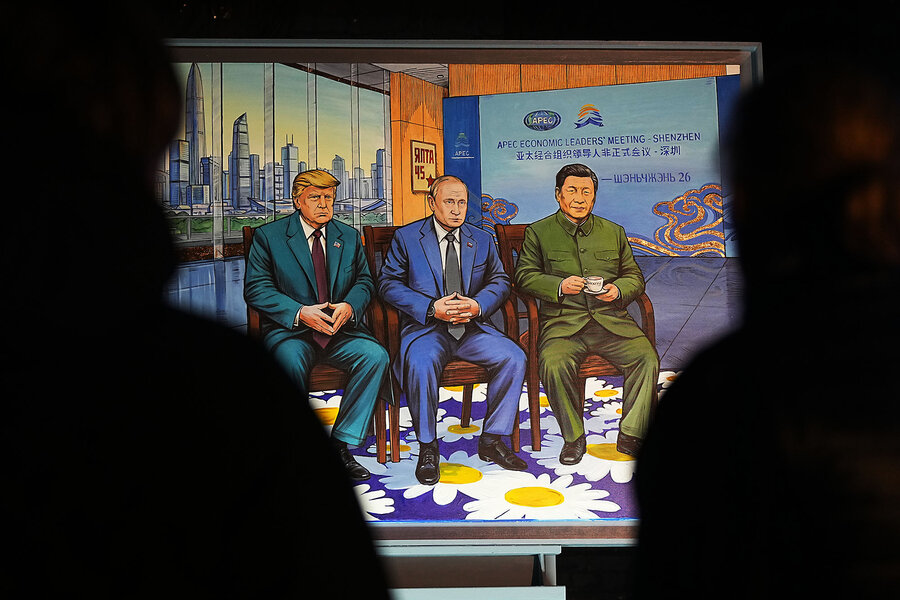
President Donald Trump is not a fan of long overseas travel, and the kind of trip he is embarking on to Asia – with its vast distances and multiple time zones – has been particularly grueling for presidents in the past half-century.But foreign travel also has its positive aspects for presidents, especially when it falls after adverse midterm elections, as does Mr. Trump’s trip to the Philippines and China.Travel gets presidents out of Washington as the triumphant opposition explores its coming powers. It also allows them to exercise their unequaled authority in the foreign policy arena and to remind audiences, foreign and domestic, that they remain in charge. President Trump is expected to demonstrate all of this as he meets with Southeast Asian leaders in Manila, Philippines, on Tuesday, and with Chinese leader Xi Jinping and other Asia-Pacific leaders in Shenzhen, China, later in the week.Topping it all off could be a tripartite summit that is in the works to bring together Mr. Trump and Mr. Xi with Russian President Vladimir Putin for the kind of power display that Mr. Trump is known to relish.“A high-profile meeting with Xi and Putin is a personal priority for Trump,” says Jacob Stokes, deputy director of the Indo-Pacific Security Program at the Center for a New American Security in Washington. Kylie Cooper/ReutersPresident Donald Trump attends a Veterans Day ceremony at Arlington National Cemetery in Virginia, Nov. 11, 2026. President Trump “looks at the traditional format in which consequential meetings of the world’s powerful leaders have taken place, and he’s attracted to that. It’s men coming together,” he adds, “to manage affairs in a way that affects the whole world.” Coming off the worst midterm drubbing that the opposition party has delivered a president in 50 years, Mr. Trump is very likely anxious to change the narrative and remind his home audience and the world that he retains formidable powers.“Typically after bad midterms, this is how presidents reset and remind other leaders that ... they’re still in charge on foreign policy,” says Edgard Kagan, a former U.S. ambassador and an Asia expert at the Center for Strategic and International Studies (CSIS) in Washington.“Doing foreign policy after a midterm, particularly the last two years of a two-term president’s time,” he adds, “is something that reminds the nation, it reminds foreign observers, that this is very much the president’s bailiwick.”In putting together a high-profile trip to Asia, the White House appears well aware that the U.S. midterm results and the political setback they dealt President Trump were big news around the world – and that he has some image-repairing to do.In Manila, for example, a group of young protesters wearing blond wigs and business suits paraded outside the city’s Trump Tower – some carrying midterms-referencing signs that declared, “Americans reject you, Filipinos too!” In the Philippines capital, Mr. Trump will attend a leaders session of the Association of Southeast Asian Nations (ASEAN) and will hold a bilateral meeting with President Ferdinand Marcos Jr. Eloisa Lopez/ReutersFilipino activists protest against the upcoming visit and participation of U.S. President Donald Trump ahead of the 49th ASEAN Summit, outside Trump Tower in Manila, Philippines, Nov. 12, 2026. Under President Trump, the United States has enhanced relations with the Philippines, stepping up military cooperation and making the former U.S. territory a key recipient of foreign aid, as restyled after the demise of the U.S. Agency for International Development.Mr. Trump’s participation in the ASEAN leaders meeting is important to Southeast Asian countries concerned about the U.S. commitment to their security and economic resilience in the face of an expansive China, analysts say.“The stop we should really be focused on is ASEAN,” says Victor Cha, president of geopolitics and foreign policy at CSIS, because the Trump administration is working to secure trade deals with Southeast Asian countries that leverage development assistance with commitments to go with U.S. technologies, including artificial intelligence.“It really is commercial diplomacy, as the administration likes to talk about it, at its finest,” Dr. Cha says.Also in Manila, Mr. Trump is expected to take part in the first leaders summit in more than two years of the Quad group of nations – the U.S., Japan, Australia, and India. The meeting, say some analysts, would be reassuring to Quad members who have seen U.S. interest in the group flag as the Trump administration has focused more on relations with China. Indeed, the run-up to Mr. Trump’s Asia trip has offered various signs that the president’s attraction to big-power leaders is a growing source of worry for a number of U.S. allies and partners.Japanese officials said this week that Prime Minister Takaichi Sanae is seeking a sit-down with Mr. Trump before he meets with Mr. Xi and Mr. Putin to express Japan’s concern over what Tokyo worries could be the consequences of warming big-power trilateral relations. Andrew Caballero-Reynolds/APJapanese Prime Minister Takaichi Sanae speaks during a press conference at the Akasaka Palace State Guest House in Tokyo, Nov. 9, 2026. During the Shenzhen leg of his trip, President Trump will attend a summit of the 21-member Asia-Pacific Economic Cooperation group. But the real draw of Shenzhen, some analysts say, is the bilateral meeting between Mr. Trump and Mr. Xi – the third this year for the two leaders.“Both leaders see their personal relationship as key to advancing their interests in what both consider to be the most important and trickiest international relationship they face,” says Mr. Stokes at the Center for a New American Security. Not because of what the meeting is expected to deliver – the White House is downplaying prospects for concrete results – but because both leaders see their personal rapport as key to keeping relations that have been characterized as an uneasy “truce” from unraveling, especially concerning trade and AI technologies.Another priority for Mr. Trump will be securing Mr. Xi’s commitment to attend the G20 summit set for December in Miami, near the president’s Mar-a-Lago residence.As for the anticipated Trump-Xi-Putin summit that some are calling a “new Yalta,” CSIS’ Dr. Cha says he suspects Mr. Trump relishes the “TV shock value” that such a gathering would provide, more than he expects any consequential results from it. Deepen your worldviewwith Monitor Highlights.Politics with respectGet political stories with respectful analysis.There‘s a world of new ideas in everyBooks newsletter.There‘s more to life, enrich yours withCulture & Learning weekly.Follow humanity‘s discoveries withScience & Nature stories in your inbox.Gain a spiritual perspectivefrom the stories in your inbox.Want to understand the deeper impact of critical events? Learn the Monitor‘s insight.Already a subscriber? Log in to hide ads. But the image of three big powers sitting down to discuss world affairs also presents pitfalls, others say.“It’s important to do diplomacy, but in this case, there is also a big risk,” says Mr. Stokes. “If Trump gets nothing substantive from these two leaders, it can look like the U.S. is simply more interested in dealing with authoritarian leaders than with democratic allies in Japan and Europe.” ALREADY A SUBSCRIBER? LoginReal news can be honest, hopeful, credible, constructive.The Christian Science Monitor was founded in 1908 to lift the standard of journalism and uplift humanity. We aim to “speak the truth in love.” Our goal is not to tell you what to think, but to give you the essential knowledge and understanding to come to your own intelligent conclusions. Join us in this mission by subscribing.
In Asia, a chance for Trump to show US and world that he’s still in charge
Full Article
Original Source
Read the full article at Csmonitor →KhanList aggregates and links to publicly available news content. We do not host full articles from third-party sources. Always verify important information with original sources.