
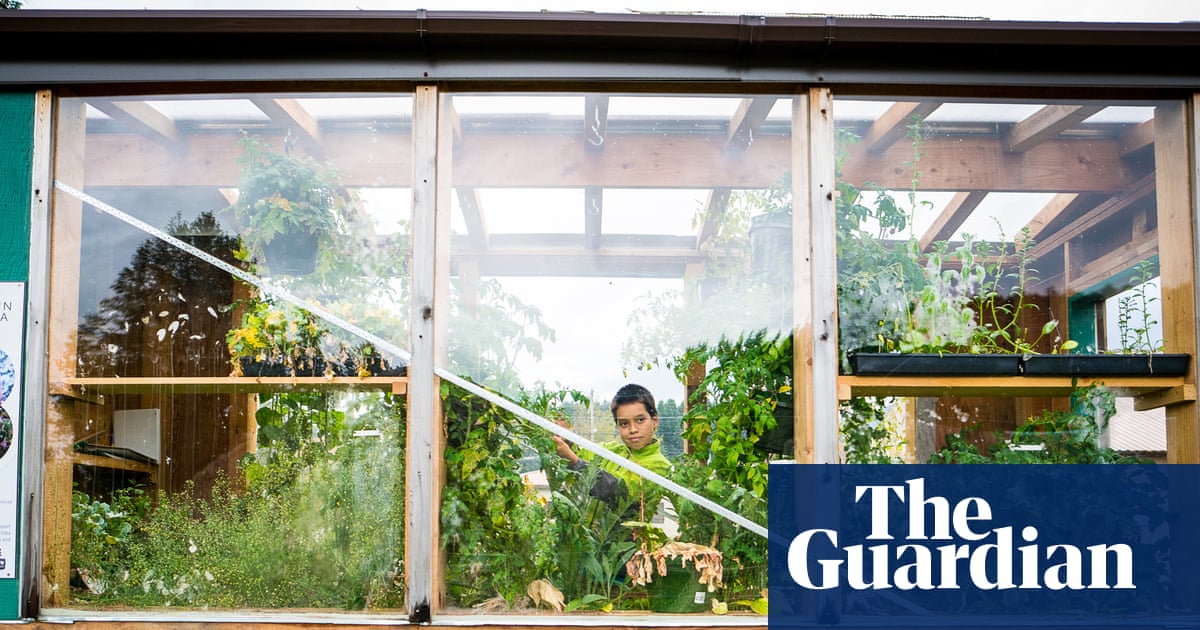
Forty miles north-west of Alaska’s capital, the highway just ends.At Glacier Highway’s most northern point, the pavement turns to gravel, the gravel widens into a turnaround and the tire tracks curve back the way they came. At the far end, the woods begin, a narrow hiking trail slipping toward the southern end of Berners Bay.Locals call this stretch “out the road”. It is the only road that reaches Juneau, population 35,000, and that means virtually everything arriving in Alaska’s capital comes by water or air.Meghan Stangeland meets vehicles coming off the Alaska Marine Highway ferry to offload boxes of cabbage. As south-east food systems manager at Ecotrust, a non-profit based in Portland, Oregon, working from California to Alaska, she runs its Salt and Soil program, part online farmers’ market, part food hub. In a state capital that has no weekly farmers’ market, the farmers and processors in its network get each order to Juneau however it works for them: often by barge, sometimes by seaplane and even by air.One figure follows Alaska food coverage everywhere. The US Department of Agriculture (USDA) cites it. So do journalists, policy researchers and anyone making the case that Alaska is vulnerable to supply chain disruption. When the state created an office of food security in 2022, the governor’s announcement led with it, even though, as KTOO reported, no one has ever traced the number to a verifiable source. “Alaska imports 95% of the product that it purchases,” Stangeland says, repeating the often-used number.“I always caveat that with: that is the product that we purchase. We share so much food, there’s so much subsistence. So it’s not 95% of the food that Alaskans are consuming. There’s so much food economy in the state of Alaska that is not economically transacted.”That figure cannot measure how Juneau feeds itself, sharing and harvesting from the land. Alaskans took in roughly 46m pounds of wild food in 2014, the state’s most recent comprehensive estimate; in rural areas, that works out to about 275lbs per person per year.A commercial fishing boat entering the harbor in Valdez, Alaska, near the Chugach mountains, on 23 August 2023. Photograph: Michael Siluk/Universal Images Group/Getty ImagesRicardo Worl recalls about the villages of south-east Alaska: if one person is going hungry, so are their relatives, because everyone shares. Worl, who is Tlingit and from Juneau, is the senior communications officer at Sealaska Heritage Institute, and he describes a regional economy that the import figure only partly captures. About 14 communities dot the region, reachable only by boat or plane. A village of a few hundred people supports only a handful of formal jobs, Worl said, and in the mixed economy that results, cash serves the subsistence harvest, not the other way around.“Subsistence harvesting in the rural areas is not just culture,” he said. “It’s survival. When we harvest, even if it’s only a couple of fish, we’ll share the best parts, like the heads and the bellies, with grandparents or elders. It’s never just for ourselves.”Inside Juneau, however, not everyone holds what Stangeland calls the privilege of a boat and a freezer, the space and equipment that processing that volume demands. Worl said that if there is an informal processing center in a community, “it’s going to be in some auntie’s kitchen”.A family processing food here isn’t just stocking their own pantry for the winter. The food that moves through these networks is hunted, fished, gathered and shared. Growing it commercially in Juneau is a different problem.Limited farming, abundant sharingThe drive to Joe Orsi’s property heads “out the road”, past the Auke Bay neighborhood north-west of downtown. His steep driveway curves up a hillside through a thick wall of evergreens, revealing how scarce flat agricultural space is in Juneau.Orsi, a 67-year-old retired research fishery biologist for the National Oceanic and Atmospheric Administration, is one of the few farmers supplying Juneau residents and restaurants with locally grown produce. He cultivates a third of an acre with terraced garden beds, endless rows of rhubarb and a large hoop house up the slope behind his home.It’s a challenging environment for farming. Finding flat, non-marshy land is rare here, and the naturally acidic soil requires improvement. At the height of summer, south-east Alaska gets up to 18 hours of daylight, but the growing season runs only from May through September. Orsi has spent years working out what garlic can actually do in this specific environment. Over time, he tried roughly 45 varieties, paying close attention to what could withstand these soil conditions and that short window.On paper, the farm provides a modest living, but that is not the point for him. “I may make $20,000 a year. That’s it, not much for all the work I do,” he said. “But I just feel blessed to be able to work the land.”Some of Orsi’s harvest ends up at Juneau Greens, a hydroponic operation and retail storefront run by John Krapek. Krapek started the business in 2017 with 18 grow beds. Today, he operates 100 in his own retail space. Competing with cheap California produce proved impossible, and wholesale demand from restaurants swung week to week. “When you’re at our scale, we really have to sell every piece of lettuce to make it work,” Krapek said.A worker tends hydroponic grow beds at Juneau Greens, which has expanded from 18 beds in 2017 to about 100 today, on 23 June. Photograph: Stephanie GravaleseHis workaround was a weekly subscription model, now 425 residents strong, which stabilized demand enough to open a storefront in 2024. He stocks produce from Orsi and other local vendors alongside his own greens. Krapek said scaling up was never the goal. “It’s really nice to actually know your customer, know the chefs who we deal with,” he said. When subscribers picked up orders at a separate location, the communication was mostly over email. The storefront changed that, he said: “That’s what has been so cool is, like, actually getting to work for this.”Operations like Krapek’s and Orsi’s can’t feed a community on their own. Stangeland has spent years watching what works in this unique space: a deeply embedded culture of mutual provisioning.Asked whether that sharing had shifted with rising grocery prices, Stangeland said that’s just always been the way of life: “It’s always been the water that south-east Alaskans have swam in.” She pointed to practices that predate any marketplace, like the first harvest going to elders. “There’s still so much of that that happens in our communities,” she said. “It’s the way it’s always been and continues to be.”For Worl, the harvest is never individual. “We’re members of a clan, we’re members of a specific community, extended families,” he said. “It’s not going to be: ‘OK, I’m going to process all of this jam, but I’m going to put it on the shelf. Maybe I’ll give some away at Christmas.’ We’re always thinking: ‘Oh boy, there’s a ku.éex [ceremony],’ there’s a payoff party coming, and we better set a case aside, or two aside, to share with them, so there’s that community, the sharing, the responsibility beyond yourself.”Back at Salt and Soil, Stangeland runs into a different structural gap: federal nutrition programs are designed for farmers selling their own product or stores that buy and resell. A consignment marketplace like Salt and Soil fits neither definition. In 2019, the non-profit created its own program, Healthy Foods = Healthy Families. “We don’t have to jump through the bureaucratic hoops,” Stangeland said. “It’s a much more streamlined initiative to get local food to those who wouldn’t otherwise be able to access or afford it.”Downtown Juneau, Alaska, in the Tongass national forest, on 6 July 2021. Photograph: Salwan Georges/The Washington Post/Getty ImagesIn Sealaska Heritage Institute’s traditional foods and medicine kitchen, students and employees had spent the past few days vacuum-sealing halibut. The Indigenous Science Building, which houses the kitchen, has been open for less than two years, said Anya Nelson, the institute’s Indigenous science and higher education director. Stainless steel counters line one side of the room; a commercial kitchen built for volume processing lines the other. Along the far wall is a hydroponic grow setup.For Nelson, the space recognizes the deep methodology of traditional survival. The classes also teach the western science behind those methods, the work of generations who “observed and [were] able to create systems and methods that beautifully held salmon and preserved it for months without things like refrigeration”, she said. “There’s so much science in that.”Joel Bos runs a school garden program through Discovery Southeast that produces 1,300lbs of food a year across two elementary schools. Students follow the harvest through the whole season, from rolling out carrot seed tape in March to cooking soup in October. “A shareable harvest is what creates the buy-in,” Bos said. “They take pride and ownership.”Ecotrust also operates Moby, a mobile greenhouse that travels between communities on the Alaska Marine Highway. It returned to Juneau this fall at the Dzantik’i Héeni campus for school programming. Almost every community Moby has visited, Stangeland said, now has a permanent greenhouse or high tunnel of its own.
In Alaska’s capital, food comes by water, air or, most often, community sharing
Full Article
Original Source
Read the full article at Theguardian →KhanList aggregates and links to publicly available news content. We do not host full articles from third-party sources. Always verify important information with original sources.