
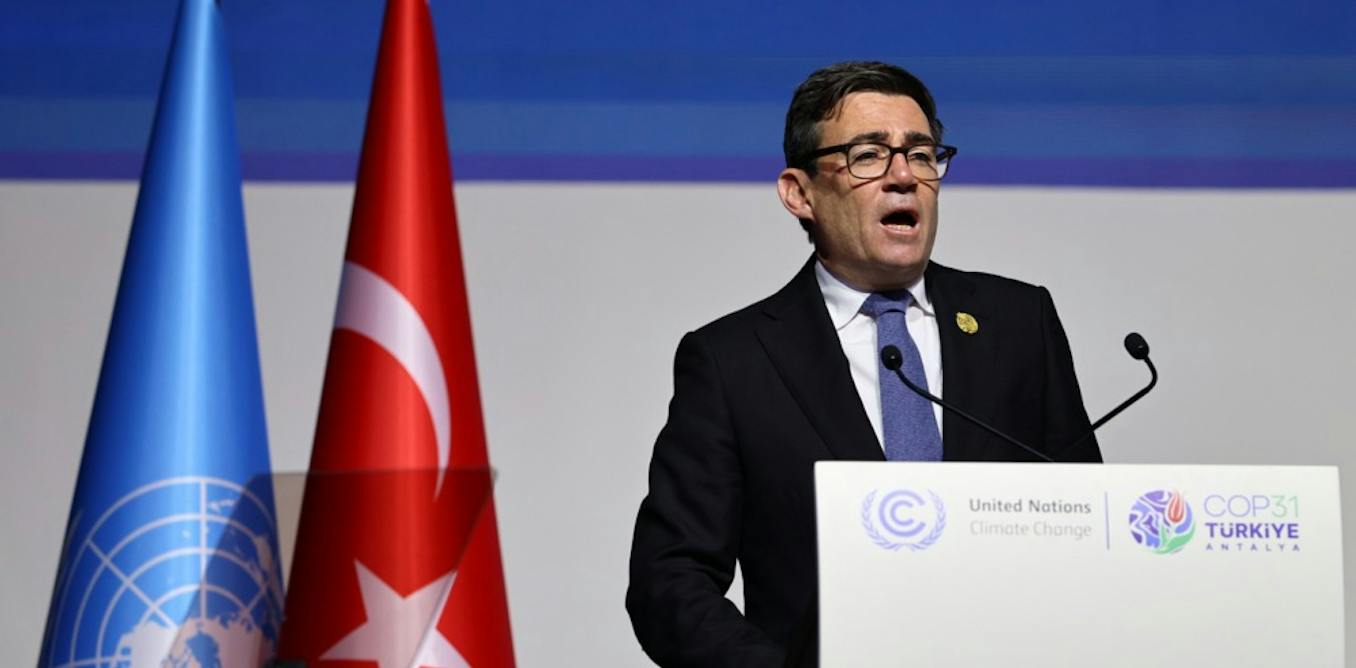
Andy Burnham took to the floor at the UN climate summit, Cop31, in Turkey and promised a “new era of British leadership”. The UK’s new prime minister does not talk a lot about the environment, and many of his recent decisions have disappointed environmental activists. Since late October, he has approved a new gas field in the North Sea. He decided to extend the freeze on fuel duty, and has floated reducing the electric vehicle target. His government also recently reduced support for heat pumps. And his chancellor, John Healey, has recently said the government backs Heathrow airport’s project to build a third runway. Although some sources are reporting that Burnham has still not confirmed it. Yet Burnham might end up being the saviour of Britain’s ambitious net zero agenda, the initiative to push countries to remove as much greenhouse gas as they emit by 2050. His plan has a razor-sharp focus on consumers, and a by-product of this might be to cut fossil fuel use too. But along the way, he looks like he is ready to drop any decision that could make the broader agenda unpopular. Just six months ago, the country looked like it might be on track for a Nigel Farage-led Reform right-wing populist government. Reform was well ahead of Labour and the Conservatives in the polls. And Farage does not hide his intention to scrap net zero targets if he ever gets into power. Today, Labour is pulling further ahead in the polls. It would be useful to take seriously how Andy Burnham got there. There are broadly three ways to promote environmental policy. One is de-growth: the idea that we can only save the planet by doing less. Read more: Jackdaw approval: what a new North Sea gasfield means for UK energy security, bills and tax Another is boosterism, the spirit behind Boris Johnson’s net zero idea. It promises a green revolution that unleashes decades of growth from new technologies. This works as a vision, but there can be a backlash when people face the short-term costs. Then there is Andy Burnham’s: the consumer-first environmental agenda. UK government have announced it will go ahead with Heathrow’s third runway. Why it might boost electricity use Take the current electric vehicle target, that 80% of new cars sold in the UK must be electric by 2030. It looks like Burnham is happy to lower it if it can protect consumers from higher costs. But, so far, Britain has also chosen not to tax cheap Chinese car imports, unlike the European Union and the United States. But around a third of Chinese imports are electric vehicles. So, this could push up EV use significantly. The approval of the Jackdaw gas field, 150 miles off the Scottish coast, follows the same ruthless logic. Extracting gas domestically is not unambiguously bad for the environment. One argument is that if Britain does not exploit that field, it may end up importing even more polluting foreign gas instead. Although the benefits could be minimal. Gas is traded globally, so Jackdaw will not affect global prices. But it will raise money for the government’s energy wealth fund. This will be spent on renewable investment and lower electricity bills. Sometimes, supporting consumers also supports the environment. Cutting value added tax and green charges on electricity bills could encourage people to switch from gas boilers and petrol cars to heat pumps and electric vehicles. This benefits the planet but also should make electricity cheaper for everyone down the line. A big driver of high electricity costs in Britain is the lack of demand: the cost of infrastructure is shared among too few consumers. But, sometimes, supporting consumers means making decisions that totally conflict with the general goal. Take the decision to freeze fuel duty, which has appeared in every budget since 2011. Protecting consumers from higher petrol prices discourages people from switching to electric vehicles. That makes electricity more expensive for everyone. And it has cost the Treasury £139 billion so far. However, motorists are way too dangerous to anger. Emmanuel Macron spent his two terms in France under the permanent threat of the yellow vest riots. The movement started with a complaint about petrol prices and speed limits. So Burnham chooses not to anger them. Then there’s the proposed plan to build a third runway at Heathrow. Burnham, a champion of decentralisation, has never been a fan of the London-centred project. But it appears that he may (or may not) now back it. Certainly his chancellor thinks so. Read more: The Cop31 climate summit is betting on electrification – but still needs a plan to ditch fossil fuels To understand why, it can be useful to look at the project impact assessment. Expanding Heathrow would potentially be bad for the environment and good for the economy. The project is expected to bring passengers more than £20 billion in direct economic benefits, and cheaper airfares. Current congestion at Heathrow means airlines can charge very high prices, for instance during school holidays. So a third runway could open up competition, and bring fares down. So it looks like Burnham may be willing to cut part of his environmental goals to let Britons afford some cheaper trips abroad. But, overall, it is unclear how much of his broader political agenda Burnham must sacrifice for social acceptability. He must also try and balance this with encouraging investment in Britain. With anti-environmental populism on the rise around the world, Burnham’s current popularity is based on getting this balance right. If he can, it might be a sign he could quietly deliver a new era of British leadership, and a stealthy boost for the environment.
In a world of anti-environment backlash, Andy Burnham walks a line between popular and green
Full Article
Original Source
Read the full article at Theconversation →KhanList aggregates and links to publicly available news content. We do not host full articles from third-party sources. Always verify important information with original sources.