
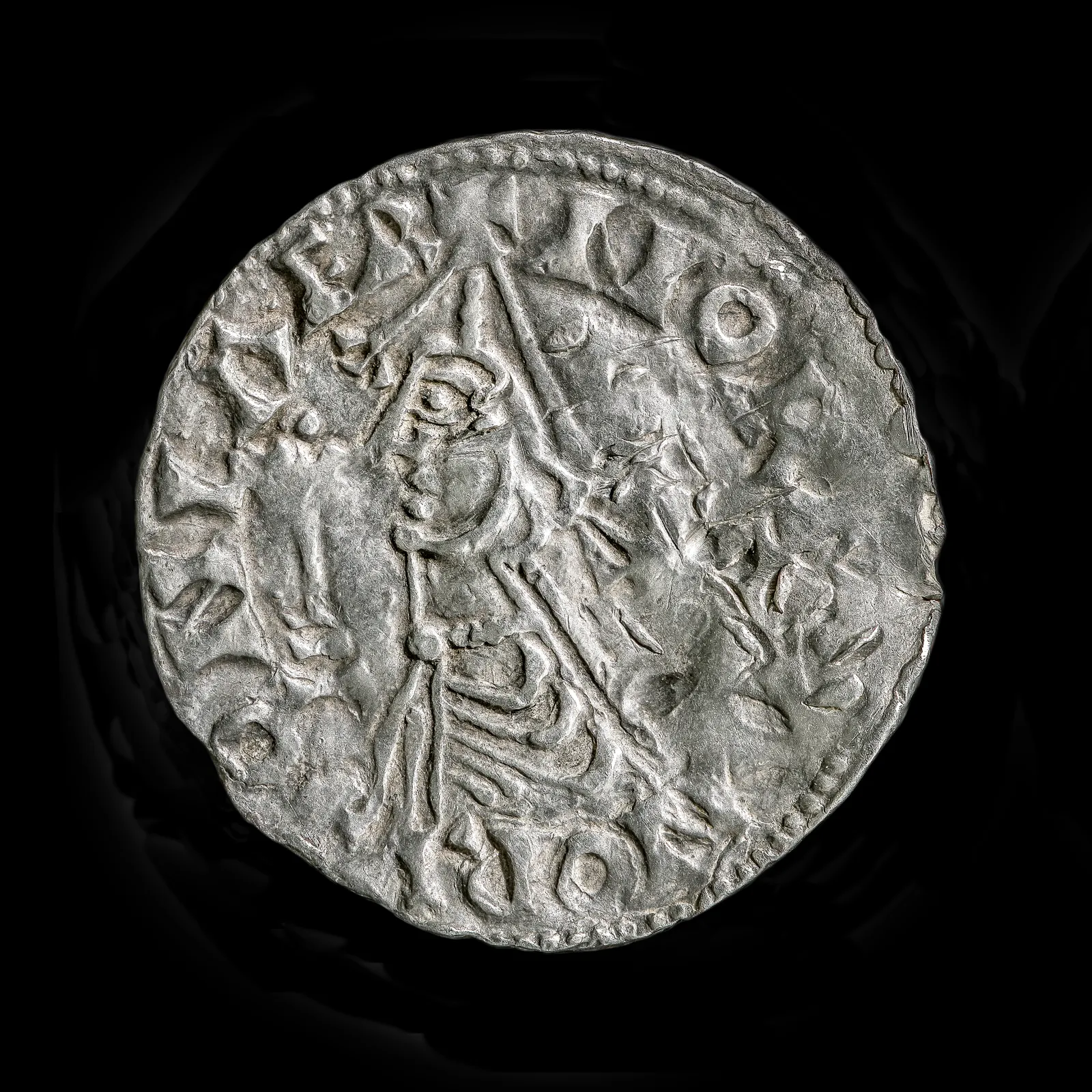
Fewer than 20 coins minted under Norwegian King Olaf II Haraldsson have ever been found. “We can almost imagine Olaf himself holding this coin in his hand,” one researcher says October 23, 2026 8:00 a.m. The coin offers a rare glimpse into Olaf's life and royal power. Lill-Ann Chepstow-Lusty, Museum of Cultural History In April, metal detectorists stumbled upon a massive cache of 1,000-year-old silver coins in eastern Norway. At the time, archaeologists were impressed by the sheer size of the find, known as the Mørstad hoard, which totals thousands of coins and counting. They hailed it as the largest Viking Age coin stash ever found in Norway. Now, researchers are even more excited about the cache. While cataloging the hoard, they found an exceedingly rare silver coin minted during the reign of Olaf II Haraldsson, a Norwegian king who later became the patron saint of Norway. Anne Skogsfjord, an archaeologist with the University of Oslo’s Museum of Cultural History, was the one who discovered the coin. She didn’t realize its significance at first, until she took a closer look at the inscription: “ONLAF R+ NORMANORV,” which means “Olaf, King of the Norwegians,” according to a statement. She was shocked, as only four coins of that type had ever been found before, just one of which was discovered in Norway, during the restoration of church ruins in 1924. Fewer than 20 coins minted under Olaf have ever been found, and most have been discovered outside of Norway. “I realized that we had found a national treasure,” she says in the statement. Jon Anders Risvaag, a numismatist at the Norwegian University of Science and Technology, agrees with that characterization, adding that finding an Olaf coin is like “finding a needle in a haystack,” he tells Science Norway’s Ida Irene Bergstrøm. “There are so few of them.” Anne Skogsfjord discovered the rare coin while cataloging the hoard. Tea Kristiansen, Museum of Cultural History The obverse side of the coin features Olaf’s left-facing bust wearing a conical battle helmet, as well as a so-called Golgotha cross on three steps, inspired by Byzantine coinage. The other side depicts a double cross and an inscription that means “My leader, my lord.” The design, researchers say, is emblematic of Olaf’s bid to establish Christianity in Norway. “It is a Christianization coin on a grand scale,” Svein Gullbekk, a numismatist at the University of Oslo, says in the statement. “We can see how Olaf used coinage to legitimize the new faith and to establish himself as a Christian king of European standing. This is branding.” Only three types of coins were issued under Olaf’s reign, so the king and his inner circle were probably intimately involved in the design and production process. “We can almost imagine Olaf himself holding this coin in his hand,” adds Gullbekk. For Olaf, minting the coin was probably a political power move. Lill-Ann Chepstow-Lusty, Museum of Cultural History Coin production in Norway didn’t really take off until Harald Hardrada came to power in 1045 C.E. For Olaf, minting coins was likely more of a political power move than anything else. “It’s someone pulling out all the stops and showing that he can do what people do abroad,” Risvaag tells Science Norway. “It’s a demonstration of kingship.” However, this particular coin may also have been used as currency. It bears numerous small cuts that appear to have been made by a knife, which was a method of testing the silver content during transactions. Researchers think the coin was probably produced around 1024 to 1028, near the end of the Viking Age, then buried with the rest of the Mørstad hoard in the late 1040s. During those intervening years, the cut marks suggest it changed hands several times.Olaf, born around 995, first discovered Christianity as a young man, when he joined Viking raids against England and France. He was baptized in Rouen, France, around 1013. He became king not long after and ruled from 1015 to 1028. During his reign, he pushed for the acceptance of Christianity, and his 1024 religious code is considered the founding of the Church of Norway. His aggressive efforts to Christianize Norway sparked resistance, particularly in Trøndelag and the inland districts of eastern Norway, according to the museum. Olaf was killed in 1030 and canonized in 1031. His popularity skyrocketed after his death, with churches and shrines built in his honor across the world. Did you know? Olaf's exile When Danish King Cnut conquered Norway in 1028, Olaf took refuge with his brother-in-law, Yaroslav the Wise, the Grand Prince of Kyivan Rus. Olaf’s comeback attempt in 1030 failed, resulting in his death at the Battle of Stiklestad. Historical accounts of Olaf are relatively scarce, so the newfound coin offers a rare and valuable glimpse into his life and royal power. The museum plans to feature it in an upcoming exhibition on the Mørstad hoard, marking the first time any part of the cache will go on public display. In the meantime, researchers are continuing to catalog the hoard—a process that’s not likely to wrap up any time soon. The cache now contains an estimated 5,500 coins, according to the latest count. “I am beginning to think that the hoard may soon exceed 6,000 coins,” Florent Audy, who is overseeing the Mørstad hoard cataloging process, says in the statement. You Might Also Like Get the latest stories in your inbox every weekday. More about: Archaeology Christianity Coins European History History Kings Museums Norway Religion Religious History Vikings
In a Hoard of 5,500 Viking Age Coins, Archaeologists in Norway Found One So Rare That They Already Consider It a 'National Treasure'
Full Article
Original Source
Read the full article at Smithsonianmag →KhanList aggregates and links to publicly available news content. We do not host full articles from third-party sources. Always verify important information with original sources.