
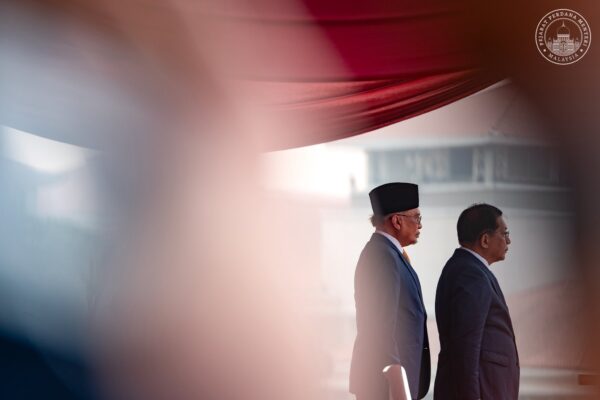
Malaysia’s Prime Minister Anwar Ibrahim met today with Myanmar’s military-appointed leader Min Aung Hlaing, pledging to work for Myanmar’s reintegration with the Association of Southeast Asian Nations (ASEAN). Min Aung Hlaing arrived in Myanmar yesterday evening for a two-day visit, part of a campaign of diplomatic outreach aimed at shoring up key diplomatic partnerships normalizing his country’s relationship with the Southeast Asian bloc. After being granted an official welcome at the Perdana Putra Complex in Putrajaya this morning, Min Aung Hlaing held a one-on-one meeting with Anwar, the Malaysian state news agency Bernama reported. This was followed by a meeting involving senior ministers and officials from both countries. Min Aung Hlaing also spoke to Malaysian business leaders late yesterday, urging them to invest in his country. In a post on X after the meeting, Anwar said that his half-hour discussion with Min Aung Hlaing “focused on the plight of Myanmar refugees in Malaysia and the prospects for their voluntary, safe and dignified return, regardless of ethnicity.” He added, “I believe direct dialogue and negotiations with President Aung Hlaing and Myanmar’s leadership are essential to securing a lasting resolution.” Both Anwar and the Malaysian Ministry of Foreign Affairs had previously indicated that this would be a primary point of discussion. The two nations recently agreed to the repatriation of around 5,000 Myanmar nationals currently being held in Malaysian immigration detention centers. The first batch of 1,476 people departed Malaysia via ship on September 29. Speaking to the press after the meeting, however, Anwar suggested that his engagement with Myanmar extended beyond the refugee issue. Indeed, according to Reuters, he said his government had ongoing concerns about the situation in Myanmar but was willing to respect outstanding differences. He also appeared to endorse the normalization of Myanmar’s relations with ASEAN, , which has excluded Myanmar from its summits since late 2021, for its lack of effort to implement its Five-Point Consensus conflict resolution plan. “I would say that we and our part in Malaysia, will do whatever is possible to make sure that we enhance this collaboration and ultimately, take Myanmar as part of our community of nations, without prejudice, and particularly in the context of ASEAN,” Anwar said. According to Bernama, Anwar also “welcomed Myanmar’s efforts to pursue reforms and policy adjustments aimed at addressing the country’s complex challenges.” Malaysia is the fifth member state of ASEAN to host Min Aung Hlaing since he took office as president in April, after trips to Laos, Thailand, Cambodia, and Vietnam. It is also the first nation from maritime Southeast Asia to take such a step. The visit marks a significant diplomatic shift for Malaysia, which had previously been among the ASEAN member states most critical of the military coup of 2021. Speaking last month, Anwar justified the invitation to Min Aung Hlaing on the basis that Malaysia needed an authority to negotiate with on returning Myanmar nationals who he claimed were in Malaysia illegally. This has become a pressing domestic political issue for Anwar this year, due to the growing public hostility toward Myanmar asylum seekers, particularly Rohingya Muslims. Large numbers of Rohingya have come to the country since 2017, when the Myanmar military launched an ethnic cleansing campaign that pushed more than 740,000 from their homes in Rakhine State into Bangladesh. Around 126,000 Rohingya asylum seekers are currently registered with the U.N. refugee agency in Kuala Lumpur, around half of the agency’s total. Both Anwar and his government have claimed that the refugees have become a financial burden, a security risk, and a source of social discord. Needless to say, Anwar has drawn heavy criticism both for acquiescing to the repatriation of refugees to a country still wracked by civil war, and for hosting Min Aung Hlaing, whose policies prompted many refugees to flee the country in the first place. In a statement, the Burmese Rohingya Organization U.K. noted that Min Aung Hlaing is the subject of an international arrest warrant by the Argentine Federal Court for genocide and crimes against humanity allegedly committed against the Rohingya between 2012 and 2017. It urged Anwar to order Myanmar’s arrest on the Argentine warrant, stating that “he belongs on trial, not on a red carpet.” The Malaysian Foreign Ministry said in a statement yesterday that Anwar’s engagement with Min Aung Hlaing was consistent with the principles of the Five-Point Consensus, and that it followed a decision made by ASEAN at its last summit “to continue constructive and principled engagement with Myanmar.” During bilateral meetings between the Malaysian and Myanmar delegations today, Anwar also said that he emphasized “the importance of inclusive dialogue to realize peace and reconciliation efforts in Myanmar” and expressed Malaysia’s “readiness to facilitate this process towards sustainable peace.” Interestingly, when Min Aung Hlaing spoke at the joint press conference in Putrajaya, he said that his administration would only take back refugees who were confirmed to have Myanmar citizenship. As Jonathan Head of the BBC noted on X, this effectively rules out most Rohingya, who have been denied citizenship by successive Myanmar governments. While this is in some ways good news – civil society groups have expressed concern that any Rohingya returned to the country could be confined to ghettos in Rakhine State or conscripted into the military – it does raise the question of whether Anwar’s outreach to Min Aung Hlaing, and the reorientation of Malaysia’s policy toward Myanmar, will address its stated domestic political purpose. In any event, the fact that Malaysia, previously the ASEAN state that was most outspoken about Myanmar, has accorded de facto recognition to Min Aung Hlaing’s quasi-civilian government suggests that full normalization with the bloc is likely just a matter of time.
In a Diplomatic Shift, Malaysian PM Hosts Myanmar’s Min Aung Hlaing
Full Article
Original Source
Read the full article at Thediplomat →KhanList aggregates and links to publicly available news content. We do not host full articles from third-party sources. Always verify important information with original sources.