
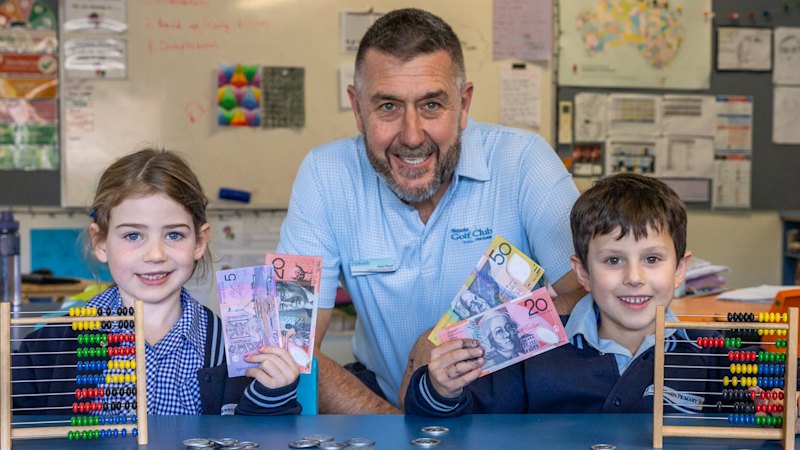
November 5, 2026 — 4:15pmChildren starting school will learn about financial concepts as part of maths lessons to keep the Australian curriculum relevant and help them grasp the foundational skills as international standings in numeracy slide.Education ministers announced the biggest change to the national curriculum in years on Thursday, including streamlining maths content in the first three years of school to ensure what students learn builds on itself.The main focus of foundation to year 2 remains on teaching maths, with the Australian Curriculum, Assessment and Reporting Authority now breaking down content into explicit, sequential steps for teachers to follow.St Bernard’s School maths leader Nick Flavel with students Thea Nolan and Zavier Perez, who learn about cash in primary school despite growing up in an increasingly cashless society. Justin McManusBut students will also encounter money in their lessons as a way of applying the concepts they learn and preparing them to have greater financial literacy in later years, with studies showing people confident in their numeracy skills often have higher financial and health outcomes.“We’re not teaching five-year-olds about superannuation,” said ACARA chief executive Stephen Gniel.“We’re giving them the foundations they need to become financially literate adults. By developing essential mathematical skills such as addition, subtraction, multiplication and fractions, students build the knowledge and confidence they’ll need to understand more complex financial concepts later in life.”However, in an increasingly cashless society, teachers are grappling with how to introduce their youngest students to financial concepts. At St Bernard’s School in Coburg East, maths leader Nick Flavel said lessons still relied on teaching students about cash.“It’s a difficult concept to teach because we are living in a cashless and digital world. They have grown up watching their parents pay for things with a phone,” he said.“They almost need something tangible there to understand it’s worth something. If it’s just a balance on a spreadsheet, then it almost doesn’t mean anything, but if there’s cash there, then it’s visibly worth something.”Carly Sawatzki, a senior lecturer at Deakin University who researches financial education in schools, said linking maths with financial literacy during early years helped bring real-world application to maths for many students, but only if they learnt about the world they were living in.“Many children don’t see financial exchange taking place with notes and coins,” Sawatzki said.“The challenge for the curriculum writers and then of course school teachers as well is to figure out well what other sorts of examples of financial exchange might be relevant for very young children to be learning about … Children might receive gift cards for cultural celebrations, for example, so that’s a different way they are experiencing money.”Content about money was previously in the curriculum but removed at the last national review in 2022 for those in year 2 and younger.ACARA commenced a review into early years maths curriculum earlier this year, months after Australian 15-year-olds recorded their lowest ever maths results in the Programme for International Assessment (PISA) this year.“We know that investing in the early years gives us the biggest bang for our buck. When children develop strong foundational knowledge and skills in mathematics from the outset, it sets them up for success throughout their schooling and later in life,” Gniel said.Earlier this week, education ministers committed to returning year 5 NAPLAN tests to pen and paper – a move that followed experts linking the declining PISA results to time spent on digital devices.The curriculum will now also ensure early primary school students learn about broad concepts of identity, family and belonging, before later learning about community, diversity and respect. Secondary school students will learn about antisemitism and other forms of hate in classes including history.These changes, which follow recommendations by David Gonski’s antisemitism education taskforce, accompany content about Jewish history, culture and its contributions to Australia more broadly at the request of the Jewish community, who did not want the new content to only focus on educating students about the Holocaust.Education ministers have also tasked the curriculum authority with investigating whether to make civics compulsory for year 9s and 10s nationwide after research showed high school students’ understanding of democracy had dropped to its lowest level since testing began in 2004.“Schools don’t just teach numeracy, literacy and critical thinking skills. They also build character,” said federal Education Minister Jason Clare.“We have to make sure our students are learning about our democracy and Australian values.”Start the day with a summary of the day’s most important and interesting stories, analysis and insights. Sign up for our Morning Edition newsletter.From our partners
In a cashless society, younger kids to learn the value of a dollar
Full Article
Original Source
Read the full article at Smh →KhanList aggregates and links to publicly available news content. We do not host full articles from third-party sources. Always verify important information with original sources.