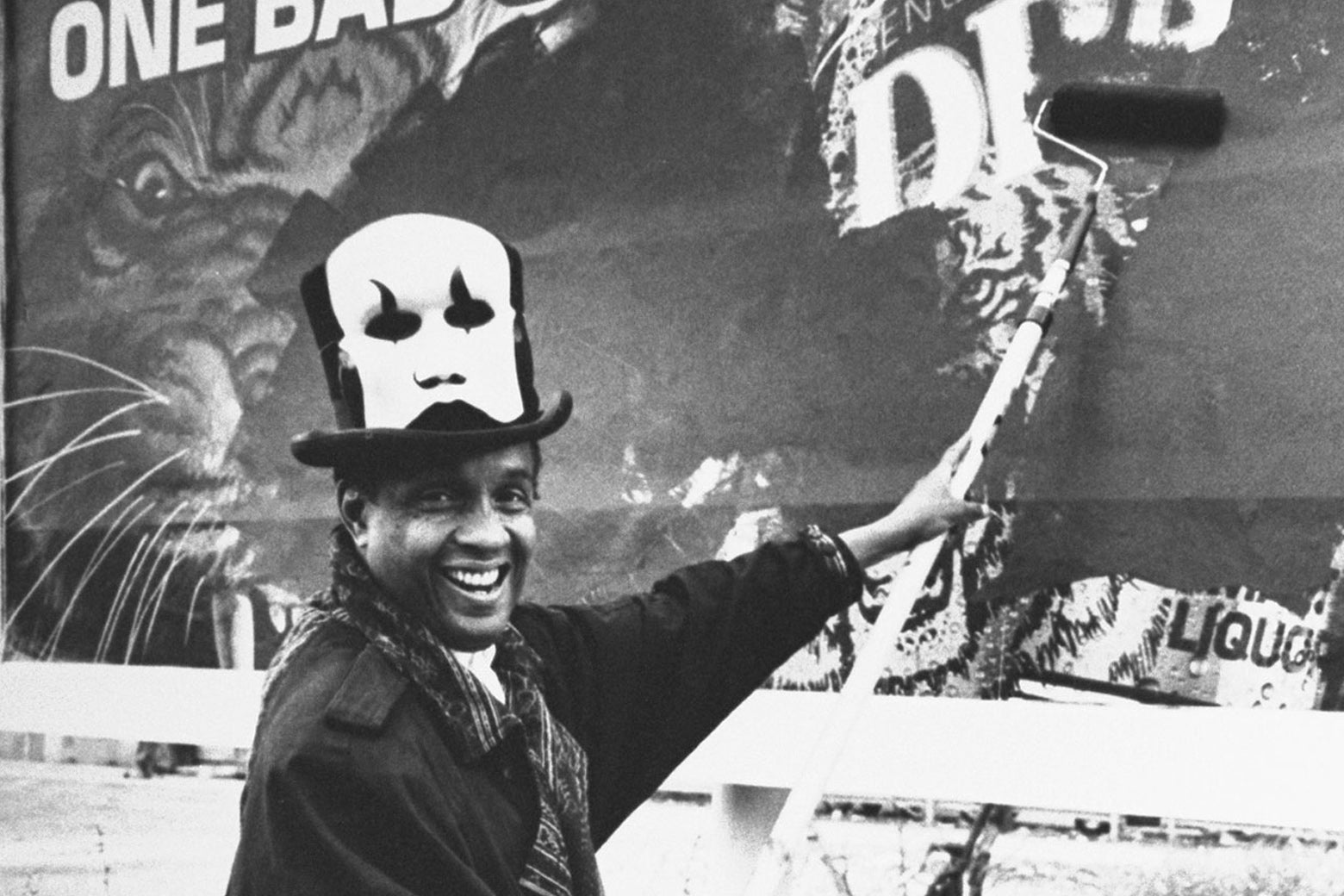
Steve Kagan/Getty Images Early one Saturday morning in 1990, a middle-aged man with a top hat and a cape set out on the South Side of Chicago with a target in his sights. His name was Henry Brown, but that morning, he’d adopted a secret identity: “Mandrake the Magician,” a reference to one of America’s first superheroes, a dashing crime fighter that dated back to the 1930s. This Mandrake saw himself as a crime fighter of sorts too. And he was about to take the law into his own hands, at great personal risk. Not long before, he had started to notice that Chicago’s Black neighborhoods were awash in billboards that didn’t appear where his white neighbors lived. Those billboards were full of Black faces like his, men and women smiling, laughing—and smoking cigarettes. He felt as if those people were blowing smoke right into his face, and it infuriated him that on the predominantly white North Side, those ads were nowhere to be seen. “It was obvious what was happening,” Gwen Jones, Brown’s girlfriend at the time, told me. “They were targeting the Black community, pushing the smoking. And Henry was like, This is not right. It’s not fair.” So Brown—Mandrake—was going to make the billboards disappear. It wasn’t a complicated magic trick: He’d simply paint over them in a blinding shade of white. His first night as a billboard vigilante went exactly as he’d hoped. He climbed up to a sign, whitewashed it, and made that tobacco ad vanish. He felt emboldened, and ready to go much bigger. That Saturday morning in 1990, Brown and Jones navigated her car to a busy intersection: 79th Street and Stony Island Avenue. His target that day was a billboard advertising Crown Royal whisky. He hated liquor ads almost as much as tobacco ones, and this sign was looming over the neighborhood, next to a major bus stop with traffic day and night. For Brown, that visibility was the point. He wanted everyone in Chicago to see what he’d done. But as soon as they parked, he realized he had a problem: He couldn’t reach the sign. Brown stood on top of his girlfriend’s car, stretching up to the billboard’s ledge. As he lifted himself up, his legs dangling in midair, his zipper got caught on a jagged edge. “He couldn’t move,” Jones told me. “People were at the bus stop, looking at us, and I was like, Oh my God. And here comes a police car.” Jones thought that was it—that they were about to get arrested. But for whatever reason, the police didn’t pay them much attention that day. “Eventually, he was able to hoist himself up, and he painted that sucker. Got some paint on my car, but that was OK,” she said. “And then he got down, and we went out and had breakfast.” For Jones and Brown, this became a regular routine: He’d whitewash the billboards, and she’d look out for trouble. Something had awakened in Brown: He’d found the cause he wanted to devote his life to. Throughout the 1990s, this man from Chicago would inspire a national anti-smoking movement. He’d be celebrated as a hero and become a public enemy of the tobacco industry. The NAACP would actually speak out against him. Oprah would call. For years, his secret identity would make him a legend—until a mysterious, tragic final chapter ensured that he’d never know how much he ultimately won. This story was adapted from an episode of the One Year podcast. Evan Chung and Kelly Jones were the lead producers. There was additional production from Olivia Briley. Listen to the full version: Gwen Jones saw Henry Brown well before she met him. She was on a vacation for Black skiers, and when she got to the mountain, she caught a glimpse of something that commanded her attention. “I was down at the bottom, and I looked up at the top, and I saw this handsome man going down the slopes,” she said. That man was wearing a wide-brimmed hat, a double-breasted suit, and a long duster coat. Later on that trip, they got to talking, and once that conversation started, it never really stopped. I asked Jones how long it took for them to get into a relationship. “Not long,” she told me. There was a part of Brown that loved to stand out, to roar down a mountain in a double-breasted suit or twirl his girlfriend on the dance floor. But he also had a way of receding into the background. He worked his whole life as a court reporter, sitting silently and taking down what other people said. And when he wasn’t in the courtroom, he was usually home with his daughter, whom he raised mostly on his own. “I remember him learning how to braid hair, sitting on top of the washing machine in my maternal grandmother’s house, braiding the mop,” his daughter, Micheline Russell-Brown, recalled. “He told me every day that I was loved, and that he loved me.” Russell-Brown is biracial, and after her parents separated, she and her dad lived in a majority-white neighborhood on the North Side. “He would warn me that people might not like me because of the color of my skin or because of who I was or who he was, and he was always making sure that I had Black role models,” she said. When she was young, her father took her to campaign rallies for Harold Washington, Chicago’s first Black mayor. Brown also made sure she stayed connected to the predominantly Black parts of the city where he had grown up. He wanted her to understand that even though they didn’t live on the South Side, the people in those neighborhoods were still their community. One day in the late 1980s, Russell-Brown remembered, her father asked her to count the number of billboards they passed on their drive home from the South Side. She took that task very seriously, pulling out a notebook and pen and tallying every tobacco ad she saw. The results were clear to her, even as a preteen: “All these billboards—they’re in the Black neighborhoods.” A public health survey backed up her findings: The city’s minority wards had, on average, three times as many tobacco billboards as the white ones had. Most of those signs weren’t huge—6 feet by 12 feet—but they were impossible to overlook. And this wasn’t just a Chicago thing. All across America, Black children were besieged with pro-smoking messages, while white kids were largely insulated from them. From the exhibition Of Mice & Menthol: The Targeting of African Americans by the Tobacco Industry (https://csts.ua.edu/minorities/), University of Alabama Center for the Study of Tobacco and Society Brown felt certain that wasn’t an accident. And he was right. The billboards he saw in Chicago in the 1980s were part of a sophisticated tobacco industry plan, one that was decades in the making. Tobacco companies always invested a huge amount in marketing. Their ideal customer was someone who could get hooked for life—someone young. In the 1950s, cigarette makers focused their advertising on college campuses. But in 1964, the U.S. surgeon general issued a report linking tobacco use to lung cancer, heart disease, and overall mortality. That stark warning put Big Tobacco on the defensive. Feeling that pressure, the tobacco companies ditched their strategy of marketing on college campuses. That technique of targeting young people was just too obvious to regulators. Going forward, they would try to capture the youth market in a different way—one that the government would be less likely to restrict. “That’s when they moved aggressively for the first time into urban advertising, and Black youth markets were the place to go, as far as they were concerned,” said Keith Wailoo, the author of Pushing Cool: Big Tobacco, Racial Marketing, and the Untold Story of the Menthol Cigarette. In 1964 advertisements for Kool menthol cigarettes started showing up in Black newspapers. Those ads sold the lie that menthols were healthier than other cigarettes. And when menthol sales ticked up in Black communities, everyone in the industry took notice. The tobacco companies flooded Black audiences with menthol messages. After Congress banned radio and TV ads for cigarettes as of 1971, still images popped up everywhere. Photographs of young, cigarette-loving Black people ran in magazines like Jet and Ebony, on the sides of public buses, and on billboards. “Those advertisements were tailored to my community with expert precision shaped by social science, but also an understanding of how those advertisements translated into brand preferences and sales,” Wailoo told me. A 1990 television news report bluntly laid out the consequences: “You can’t go anywhere in a Black community without being the target of fancy ads glamorizing smoking. The result: $2.4 billion a year Blacks spend on the cigarettes that kill them.” By then, it was common knowledge that Black Americans smoked at higher rates than white ones and suffered disproportionately from lung cancer. But the tobacco companies said they weren’t doing anything wrong—they were just selling their products to the people who wanted to buy them. It was a coldhearted calculation, and it made Henry Brown incredibly angry. In his hometown, he saw billboards full of smiling Black faces luring young people to their deaths. Brown, a court reporter and single dad, was a guy with no official power. But he felt a responsibility to protect all those children—kids like his own daughter. “Nobody else was talking about this,” Russell-Brown told me, “and I think it’s something that he saw as something that he could do. He could achieve it.” His first idea was to reach out to the billboard companies and straight-up ask them to take down the tobacco ads. The responses he got were polite but firm: No, we’re not going to do that. Those rejections only strengthened Brown’s resolve. He decided to take his message directly to his community—to the people he felt most needed to hear it. And he knew exactly how he wanted to reach them: on the airwaves of the Black radio station WVON. “He was on there talking almost daily about the billboards and the negative effect that they were having on the community,” Jones remembered. “As soon as one person hung up, he knew immediately to dial in.” Brown railed against the racial inequality of tobacco advertising and pushed for legislative reform. But in all his calls to WVON, he never revealed his real name. “He didn’t want people to know who he was, that he was a professional guy working in the court system,” Jones said. He was trying to win the billboard struggle with the power of his arguments. But no matter how often he called in, it didn’t feel as if he was making a real difference. On the South Side, the cigarette billboards were all still standing. Brown needed to do something else—something that would make the billboards go away. In January 1990, Brown had told Jones he had a very important mission and wanted her to come along. “He asked me if I would drive him down to a paint store,” she said. At that store, Brown bought some white paint, a paintbrush, and a bucket. Then they headed to a neighborhood on the South Side close to where Brown had grown up. When they got there, they found a billboard that he could reach with a small ladder. It showed young Black people having the time of their lives smoking cigarettes. “He got out of the car with his equipment,” Jones told me, “and he started painting.” Brown’s adoption of the Mandrake persona “really did produce a mystique about what he was doing,” Jones told me, “being so mysterious, making those billboards disappear from the community.” In early 1990, the Associated Press profiled the mysterious “paintbrush-wielding ‘magician’ who made … billboards disappear.” In that piece, Mandrake, as Brown identified himself, said that Black and Hispanic communities were overrun with tobacco and liquor ads. He explained that he had a “moral obligation” to “stand up and fight back.” In another interview, he said: “If Dr. King were alive today, he’d be doing exactly what I’m doing.” On the radio station WVON, Mandrake was celebrated as a folk hero. He was making a name for himself outside Chicago too. A writer in California called him a “gallant Black Don Quixote.” A syndicated columnist compared him with Harriet Tubman. And a national magazine put him next to Colin Powell and Condoleezza Rice on a list of people who “define what it is to be Black in the ’90s.” Mandrake also had his detractors. A Chicago Sun-Times editorial stated that no one had the “right to be a vigilante or a vandal.” That piece ended with a brush-off: “We don’t need Mandrake.” “I remember some of those [negative] comments, but he didn’t pay any attention to those at all,” Jones told me. Mandrake had wanted his voice to be heard. Now he’d started a national conversation. Later in 1990, he was interviewed for a segment on PBS’s NewsHour. The camera shot him from behind and never revealed his face. As he spoke, he stood under a cigarette billboard. The young Black woman on that sign had been covered with paint. “To my dying day,” he said, “I will see to it that every obtrusive billboard that has a negative impact upon my children is removed.” On the other side of this debate were the people putting up the billboards. They argued that tobacco was legal and that censoring cigarette ads violated the First Amendment. “It makes it awfully easy to take that next product and censor it or ban it,” one billboard executive said. “That might be oatmeal the next time, it might be grits. And that really would be a shame.” The cigarette companies themselves made a different argument, one that turned the tables on their Black critics. They said that any suggestion that Black people needed special protection from advertising was paternalistic, even bigoted. Henry Brown and Micheline Russell-Brown. Micheline Russell-Brown It wasn’t just tobacco execs saying that. The executive director of the NAACP, Benjamin Hooks, asserted that Black Americans didn’t need “guardian angels to protect their best interests.” But Hooks wasn’t an objective observer. At the NAACP’s annual convention in 1990, he accepted a $100,000 check from the tobacco company Philip Morris. “We are not for sale,” Hooks said at that convention, “but if the tobacco companies want to give us some money to help us move Black people forward in the name of God, give it, and we’re going to approve it and accept it and receive it and use it to build a stronger, stronger America.” Mandrake publicly called out Black leaders like Hooks who took tobacco money and echoed the industry’s line. But he wasn’t fighting the cigarette makers totally on his own. Although he may have been the only one whitewashing billboards, there were people all across the country—politicians, community leaders, and protesters—who thought the same way he did. That year, that activism felt especially urgent. That’s because the R.J. Reynolds Tobacco Company had just announced a plan to target Black communities even more aggressively. RJR was introducing a new menthol cigarette brand, Uptown, marketed specifically to Black smokers. Its first test market was Philadelphia. “In my mind, that was ludicrous,” the Rev. Jesse Brown told me. Back in 1990, Brown was a Lutheran minister in Philadelphia, and he helped build a coalition in the city, a group of clergy members and public health advocates who spoke out to the media and rallied neighborhood support. “We would use our clout as a community, as a culture, as a people to stop the industry from targeting us,” he said. “That’s more powerful than anything that they can come up with.” Within a matter of weeks, R.J. Reynolds admitted defeat. But the reverend didn’t stop to celebrate. Speaking out had worked against Uptown cigarettes, but it might not again. He started asking around to see who else might have a plan to take on the tobacco industry. In those conversations, one name kept coming up: Mandrake, the Chicago billboard vigilante. “Didn’t know who Mandrake was except for that name, but I know what he did,” Brown said. Mandrake wasn’t just talking. He was taking direct action. And soon, the reverend would be too. In Philadelphia, he told me, they actually blackwashed tobacco billboards. “The reality is, it was free paint that the hardware store wanted to get rid of, so we took it,” he explained. “It just happened to be black.” After just a few months, Mandrake had imitators all across the country. Activists were whitewashing cigarette ads in New York City, Baltimore, and Dallas, dozens at a time. And back in Chicago, the man who’d started it all kept on painting, with his closest ally by his side. Most of the time, Jones played a supporting role for her boyfriend, holding the ladder and making sure he had his brushes and rollers. But one night he suggested that she take the lead. “I got out of the car, I got the paintbrush and the roller, and I started painting one of the billboards,” she told me. “It was amazing, the energy that I felt around us. It was like spirits. You could actually feel it. The energy was thick. It was heavy. I was like, Wow, this is truly, truly amazing. And when I got back in the car, I said, ‘Henry, is this what it’s like?’ And he looked at me. He said, ‘Yes.’ He said, ‘I feel that all the time.’ ” In 1990 Mandrake became a bona fide celebrity. He was on the national news and got name-checked in Congress. And all the while, his true identity—the court reporter Henry Brown—remained a secret. But Brown wasn’t exactly in hiding. “My father found out about this party that Oprah was going to be at,” Micheline Russell-Brown told me. “He wanted to get her ear so he could talk about billboard stuff.” She isn’t sure what exactly her dad said to Oprah Winfrey. But he must’ve made a pretty good impression. After they met, Brown played a starring role on an episode of her daytime talk show. Winfrey hadn’t asked Brown to come on TV to talk about billboards. She’d invited him on the air so she could set him up with Peggy King—her best friend Gayle King’s mom. Gwen Jones told me she had been OK with the TV matchmaking thing because she and Henry weren’t exactly exclusive. And Winfrey? She’s all in, screaming and pumping her arms and jumping up and down. The segment has the same energy as Tom Cruise jumping on Oprah’s couch, except this time Oprah is Tom Cruise. Meanwhile, both Henry Brown and Peggy King look pretty dapper and extremely nervous. They’re actually holding hands, awkwardly, and pretty much silently. “OK, you’ll become more talkative over lunch,” Winfrey says, as the audience laughs. Russell-Brown said that sparks didn’t really fly between her dad and Gayle King’s mom, but they did develop a very nice friendship. And going on The Oprah Winfrey Show didn’t blow Brown’s cover. As the months went on, the line between Mandrake and Henry Brown did get a little blurred. In the summer of 1990, Brown testified under his own name at a Chicago City Council hearing. He argued that billboard companies weren’t totally protected by the First Amendment, citing Supreme Court precedent. When an alderman asked him what he knew about Mandrake, Brown responded coyly: “Well, rumors have been greatly exaggerated as far as whitewashing billboards.” Jones told me she’s not sure how Mandrake ultimately got unmasked. But she does remember the day he got arrested. He was on the platform of an L train station on the South Side when a security guard saw him whitewashing billboards in broad daylight. The arrest report identified him as Henry M. Brown. His occupation: painter. According to the report, he was advised of his rights, taken to jail, and released on bond that same day. “He would always carry a little extra money in his pocket in case he was arrested,” Jones said. “So he came prepared, always.” Brown had initially worried that his activism could put his career at risk. But becoming an anti-tobacco vigilante didn’t cost him his livelihood. And eventually, he decided that Mandrake didn’t have to be a secret anymore. In 1992 Brown posed for a photograph holding a paint roller. He was in the middle of whitewashing a malt liquor sign, but he was looking directly at the camera. He had on a black top hat and a duster coat—the kind he liked to wear skiing. And the white mask he had with him wasn’t covering his face, so the camera captured his big smile. Jones said that for Brown, it was vitally important that Black children knew that people in their own communities were fighting on their behalf. “Mandrake loved children, and he was very adamant about making sure our children knew that this is somebody Black,” she said. “ ‘I’m an African American male, and I love you.’ ” Gwen Jones at Mandrake Park. Evan Chung By 1996, Henry Brown’s activism was still going strong. But at age 61, he’d mostly put away his paintbrushes and rollers. Jesse Brown, the Philadelphia reverend, partnered up with Henry Brown to build a national anti-tobacco network. They pressured billboard companies to take down ads close to churches and schools and used local zoning laws to get hundreds of illegal signs removed. That year, Russell-Brown was in Brooklyn, taking time off from college. She said her dad bribed her to come back to Chicago for the summer by offering to buy her a computer. The two of them played Scrabble, went for walks, and talked for hours. In the fall, Russell-Brown went back to school. One Monday in September, she got a message after she finished up a dance class: “Somebody told me that I should call my mom. And she told me that my dad’s body had been found in the river, the Chicago River.” Henry Brown didn’t know how to swim, and his body was found fully clothed. The medical examiner’s report said he died by drowning, but that the events leading up to his death were “undetermined.” “You don’t go swimming in the Chicago River,” Russell-Brown said. “You’re either murdered or you commit suicide. And he wasn’t suicidal.” Jones also said there was no way Brown would’ve taken his own life. “It was foul play, I believe that to my heart,” she told me, “and it just wasn’t investigated in my mind enough, or even at all.” In 1996 Chicago police officials said they were “following up on every lead” about Brown’s death. But when I asked the department for files connected to the drowning, they told me they couldn’t find any. Russell-Brown and Jones both feel absolutely certain that Brown’s death had nothing to do with his anti-tobacco activism. They think it might have been connected to his job as a court reporter, but they can’t be sure about that. And they blame the Chicago police for that lack of certainty—for not dedicating the resources to find out why a devoted father and community leader had ended up dead in the Chicago River. “It’s so unfortunate too,” Jones said, “because he had so much more to give and so much more he wanted to do.” In 1998, two years after Henry Brown died, the four largest American tobacco companies settled lawsuits with 46 U.S. states, D.C., and five U.S. territories. The Master Settlement Agreement required Big Tobacco to pay more than $200 billion to offset the cost of treating smoking-related illnesses. It also imposed severe restrictions on tobacco advertising. That included a total ban on billboards. Mandrake had won. Keith Wailoo, the author of Pushing Cool, told me that in his research on the history of the menthol cigarette in America, Brown stood out as “unquestionably the most admirable character.” At a crucial moment, Wailoo said, Brown “acted on his convictions, knowing that what he was doing was controversial.” Although plenty of Americans believed that the tobacco companies were causing tremendous harm, “he was willing to take one extra step that I don’t think many people in his time period were willing to do.” Today, three decades after Brown’s death, Jones likes to walk through the South Side neighborhood where Mandrake worked his magic. Now, thanks to him, this community in Chicago—as well as communities all over America—looks very different. “He’s looking down now, smiling, because you don’t see any billboards out here, none whatsoever,” she said. In one spot, at 39th Street and Cottage Grove Avenue, there’s now a city park. It’s named for a man who cared about this neighborhood and the people who lived there. “They got a big sign that says Mandrake Park,” Jones said. “A park named after him—isn’t that beautiful?” Chicago Health History Smoking Black Americans
In 1990, a Man Saw Something He Didn’t Like in His Neighborhood. His Response Changed History—but It’s Been All but Forgotten.
Full Article
Original Source
Read the full article at Slate →KhanList aggregates and links to publicly available news content. We do not host full articles from third-party sources. Always verify important information with original sources.