
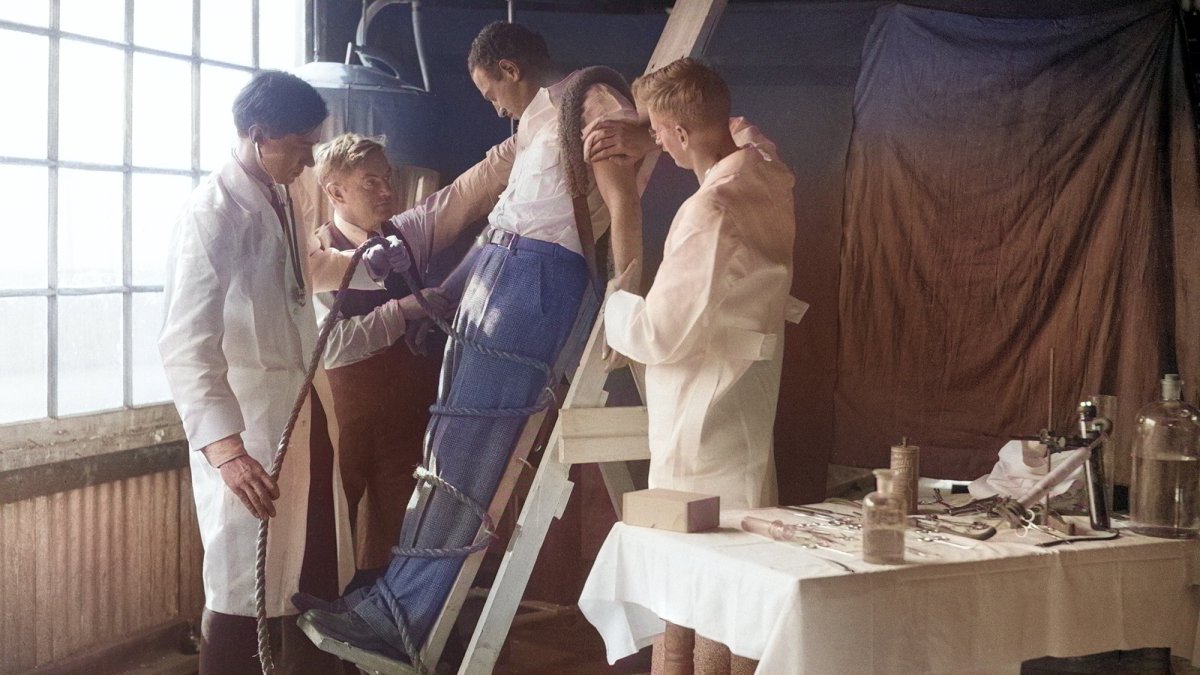
Under the harsh glare of overhead lights at a laboratory at the University of California at Berkeley, Lazarus II lay motionless. Dr. Robert E. Cornish, who’d asphyxiated the rangy white fox terrier with ether and nitrogen, watched the clock. Six minutes after the final heartbeat, the scientist gathered up the dog and strapped him to a teeterboard, a see-saw-like invention whose back-and-forth, up-and-down motion Cornish believed was key to restoring the blood’s circulation. He pushed a saline solution primed with oxygen, heart-stimulating adrenalin, and the liver extract heparin into a vein in Lazarus’ thigh, then lowered his head over the patient. As his assistant rocked the teeterboard and rubbed the little body vigorously, Cornish exhaled deep breaths into the dog’s mouth and lungs. Long seconds turned to minutes and then, suddenly, Lazarus gasped and jerked his leg. Slowly, his heart began to beat. Lazarus II had returned from the dead. Dr. Cornish’s real-life zombies With the invention of modern cardiopulmonary resuscitation (CPR) still a quarter century off, resurrecting Lazarus after his heart stopped was something of a miracle in 1934. But while the fox terrier lived for another eight hours and 13 minutes, he did not live well, stuck in a restless zombie state punctuated by the occasional whine, bark, and panting. “Irreversible damage occurs to either the heart or the brain after a period of time, making a good recovery impossible,” Samuel Tisherman, professor of surgery and director for the Center for Critical Care and Trauma Education at the University of Maryland, Baltimore, tells Popular Science. Lazarus II wasn’t Cornish’s first attempt to revive dying patients using his teeterboard. He wasn’t even the first Lazarus. The young scientist, a former child prodigy who’d earned his doctorate from UC Berkeley at age 22, became obsessed with resuscitation sometime around 1933. Dr. Cornish feeds one of his dog subjects named Scooter. Image: Getty Images / Contributor / Bettmann Dr. Cornish tried to resurrect people, too Before working on dogs, Cornish began his reanimating work on people. A 62-year-old printer who died of cardiac arrest was the first to receive Cornish’s reanimation treatment. Four-and-a-half hours after his death, Cornish arrived at the hospital to strap the man’s heating pad-swaddled body to a teeterboard. After see-sawing the patient up and down for 90 minutes, Cornish failed to revive the subject—although Cornish noted a point at which the printer’s “face seemed to warm up suddenly, sparkle returned to the eyes, and soft pulsations were observed in the soft tissue between windpipe and sternum,” according to science journalist Frank Swain’s How to Make a Zombie: The Life (and Death) Science of Reanimation and Mind Control. Two weeks later, Cornish tried the same treatment on a 22-year-old machinist who’d been pulled dead from the San Francisco Bay three hours before, working his body on the teeterboard for a full four hours. It, too, failed, along with a third attempt the following day in which Cornish submerged an electrocuted cadaver in a warm bath instead of using heating pads before placing the body on the teeterboard. Dissatisfied with the outcomes, Cornish decided it would be wise to perfect his methodology on fox terriers before returning to human subjects. He named each one Lazarus after the biblical man Jesus brought back to life. Cornish’s biggest breakthrough came with Lazarus IV. Though blind and unable to stand on its own, within 13 days the dog could crawl, bark, and sit up. Its appetite, too, had returned. Over the few months of his life after death, Lazarus IV went through almost a pound of meat each day. The next patient, Lazarus V, recovered even more quickly. It took just four days for the dog to resume some normal behaviors despite suffering blindness and brain damage. Like his predecessor, he too lived only a few months. Despite their mixed outcome, Cornish was praised for his Lazarus experiments. In the press, the scientist who’d often been considered an oddball by his peers for pursuing projects like underwater reading glasses was hailed as a celebrity. A movie about his work, Life Returns, was released in 1935. Life Returns (1935) | Full Movie | Onslow Stevens | Lois Wilson | Valerie Hobson The 1935 film Life Returns follows Dr. Kendrick (played by American actor Onslow Stevens) as he tries to bring a dog back to life. Video: Life Returns (1935) | Full Movie | Onslow Stevens | Lois Wilson | Valerie Hobson, TriCoast Worldwide But Cornish’s resuscitation experiments were not without controversy. Dogged by animal rights protests and other outcries from the public, UC Berkeley’s administrators had him removed from campus. Cornish continued his work from home, turning a garden shed into a laboratory that neighbors claimed stunk up the street. How does CPR bring people back to life The science behind resuscitating a dying patient has come a long way since the Lazarus experiments. These days, “how to restore a pulse depends upon the cause of the cardiac arrest,” says Tisherman. “The first, most important intervention is assuring good chest compressions,” he continues. How quickly intervention begins also plays a role. “It’s generally been considered that if the period of no blood flow at all, before someone starts CPR, is greater than five minutes, the outcome will likely be poor,” says Tisherman—though that idea has been challenged and “no one knows for sure.” While drugs and medications similar to those used by Cornish to improve blood flow and return heart rhythms to normal in his Lazarus experiments play a part in modern resuscitation protocol, emergency medical practitioners have never adopted the teeterboard he believed was key to restoring life. Cornish never had the opportunity to prove that his teeterboard worked, despite appealing to the governors of Nevada, Arizona, and Colorado for permission to revive criminals executed by the gas chamber shortly after completing his Lazarus experiments. Their refusal didn’t stop Cornish from making one final attempt in 1948, sending multiple requests to the warden at San Quentin State Prison to resuscitate kidnapper and murderer Thomas McMonigle following his upcoming execution by gas chamber—all of which were rebuffed. Once news of Cornish’s plan for McMonigle became public, more than 50 other “mostly single men” volunteered to be brought back to life by his teeterboard but by then, it seems, Cornish had moved on to something a little less extraordinary: formulating and marketing toothpaste to the American public. In That Time When, Popular Science tells the weirdest, most surprising, and little-known stories that shaped science, engineering, and innovation. Related 'That Time When' Stories 2026 Popular Science Home of the Future Awards 39 products that will improve your everyday life.
In 1934, a doctor brought a dog back to life. He tried to do the same with humans.
Full Article
Original Source
Read the full article at Popsci →KhanList aggregates and links to publicly available news content. We do not host full articles from third-party sources. Always verify important information with original sources.