
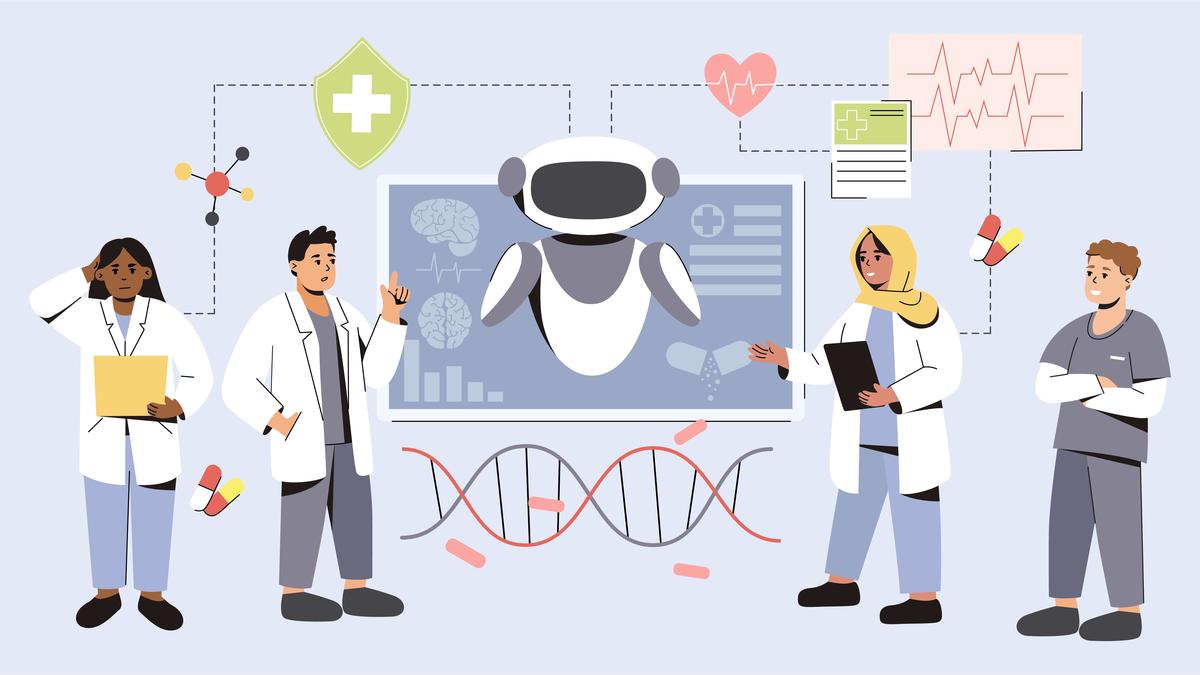
Students need to learn not only how to use AI, but also how to build enough independent clinical understanding to know when its output deserves to be questioned. | Photo Credit: Magnific.com Medical students have traditionally been taught to be suspicious of easy answers. A symptom may point in one direction while a test result points elsewhere, and the student has to work through those contradictions before settling on a diagnosis.But AI is changing that process. Given a clinical presentation, it can produce a differential diagnosis within seconds, explain the possibilities, and often sound far more certain than the student feels. This is enormously useful, but creates a challenge for medical education. If AI supplies the likely answers too early, students may become better at evaluating ready-made diagnoses without developing the same ability to construct them independently.Independent analysisClinical reasoning is not simply information retrieval. It involves recognising patterns, identifying missing information, questioning assumptions, and deciding whether a familiar diagnosis actually makes sense for a particular patient. Students develop these abilities by making provisional diagnoses, defending them, discovering inconsistencies, and revising their thinking.Once AI supplies a plausible diagnosis, the task changes. Instead of asking, “What could explain this patient’s condition?”, the student is now asking, “Does this explanation seem reasonable?” The second task is easier, but it does not exercise the same depth of independent reasoning. This matters because modern AI can be wrong without sounding wrong. An incorrect conclusion can arrive in polished language, supported by an explanation that feels coherent and persuasive.A recent study published in Nature Medicine illustrates the risk. People without medical expertise were more likely to follow an incorrect AI diagnosis when it came with a persuasive explanation. Experienced doctors were much harder to mislead, while medical students fell somewhere in between. The researchers described expertise as a “cognitive firewall”, an independent mental model against which the machine’s answer can be tested.Way forwardThe implication for medical education is clear. Students need to learn not only how to use AI, but also how to build enough independent clinical understanding to know when its output deserves to be questioned. That does not mean keeping AI out of medical training. It means designing its role more carefully. For some learning tasks, students could record a provisional diagnosis before seeing the AI’s assessment. AI should then show not only its conclusion, but what supports it, what information may be missing, and where uncertainty remains. If the student and AI disagree, the system should encourage the student to explain why rather than simply accept or override the recommendation.The student may identify a part of the history the AI has underweighted. The AI may expose a weakness in the student’s reasoning, or both may conclude that more information is needed. This is productive friction. Medical education has always relied on difficult cases, probing questions during rounds, and provisional diagnoses that have to be defended. These are not inefficiencies, butpart of how judgment develops.AI creates a temptation to remove that friction because it can provide answers so quickly. But educational efficiency and educational effectiveness are not the same. A system that gets a student to the correct answer faster may still be a poor learning tool if it reduces the reasoning the student has to practise.Calibrated trustThe goal should therefore not be to make future doctors distrust AI. Blind distrust is no better than blind trust. Medical education needs to develop calibrated trust: doctors who know when AI is useful, when its recommendations deserve scrutiny, and when something important may have been missed.AI will outperform doctors-in-training at many forms of information retrieval, pattern recognition, and rapid synthesis. Medical education does not need to compete on those terms. Its responsibility is to develop the judgment needed to use that capability safely.The doctors of the AI era will not prove their value by knowing everything the machine knows. Their value will lie in knowing when a convincing answer still deserves to be challenged.The writer is co-founder of CLIRNET and Chief Technology Officer of myMD Healthcare. Published - September 22, 2026 12:30 pm IST
Importance of teaching medical students to think in the era of AI
Full Article
Original Source
Read the full article at Thehindu →KhanList aggregates and links to publicly available news content. We do not host full articles from third-party sources. Always verify important information with original sources.