
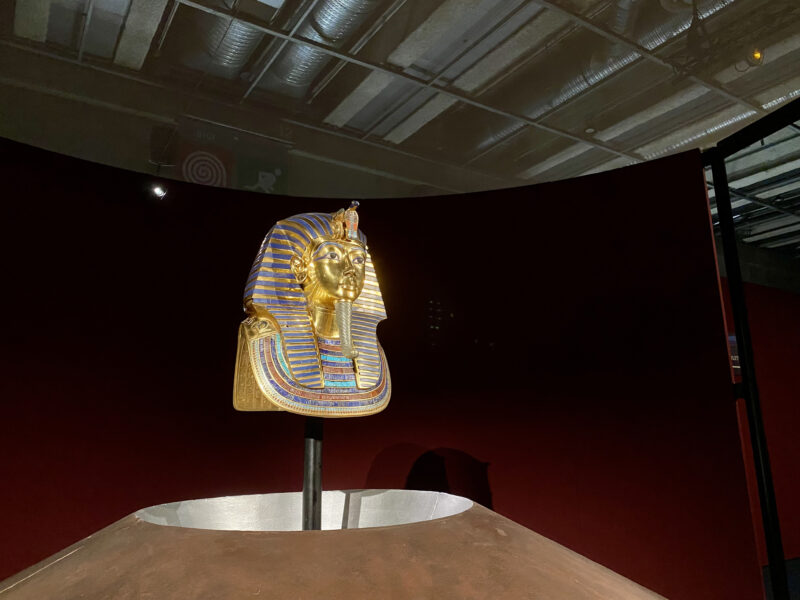
PARIS (CN) — It’s unlikely that King Tutankhamun would have imagined the afterlife looking like this: curious people strolling through a model of his tomb, examining a replica of his golden mask and wearing virtual reality headsets to digitally render his burial chambers.But that is precisely what people are doing at “Tutankhamun: His Tomb and His Treasures,” an exhibit at the Paris Expo Porte de Versailles exhibition center in the 15th arrondissement of Paris. The show runs from July 3 to Sept. 6, bringing modern technology to the study of ancient Egypt.“I think his take on it would have been, ‘My name is being remembered,’” said Aidan Dodson, an honorary professor of Egyptology at the University of Bristol.“One of the key things about ancient Egyptian belief was that you were never dead until you were forgotten. ‘While your name was on the lips of the living,’ as they put it,” Dodson explained. “Tutankhamun [has] had that in spades ever since 1922. So, I think [his reaction] would be sort of, ‘Thank you for keeping me alive in the next world.’”King Tutankhamun, better known by his nickname King Tut, ruled Egypt from roughly 1332 to 1323 B.C.E.He was largely forgotten for centuries. But that changed in 1922, when the English Egyptologist Howard Carter discovered his tomb, helping spark an abiding global interest in ancient Egypt.A replica of the art on the north wall of King Tutankhamun's tomb, seen on Aug. 20, 2026. (Lily Radziemski/Courthouse News)Carter had spent years searching for the tomb. “He’d been given the idea that this tomb existed both by other scholars as well as by findings that made him think this was the case,” said Salima Ikram, a professor of Egyptology at the American University in Cairo and the author of several books on ancient Egypt. “So he went in search of it, because they thought that it would be marvelous — as indeed it was — to find an intact tomb in the Valley of the Kings, because no intact royal tomb had been found.”The Paris exhibition gives focus to this search.Visitors are invited to watch an eight-minute docudrama about it. One scene shows a worker discovering a step leading to the tomb. He silently rushes over to Carter in silence, tugging on his sleeve.Carter’s eyes widen. Laborers dig out the area surrounding the entryway, revealing King Tut’s cartouche, a decorative frame used to contain the hieroglyphic name of a pharaoh.The film follows Carter as he holds up a candle to a small hole in the door. The light illuminates the faint reflection of golden treasures.“Can you see anything?” asks Lord Carnarvon, who funded the excavations.“Yes,” Carter replies. “Wonderful things!”The intact site gave archaeologists a more complete understanding of what lay inside the royal tombs of ancient Egypt.Researchers already had some clues from finding other, less complete tombs. “Although they’d been robbed, there were bits and pieces of stuff left lying around. So, you get an idea of what sort of things” were in them, Dodson said. “But with Tutankhamun, you’ve got the full set.”The discovery also brought new clarity to the life of this ancient Egyptian king. Previously, Dodson explained, it was assumed he died as an adult, but he was actually still a teenager when he was buried.It was also assumed — erroneously — that Tut might not have been a born member of the royal family and might have instead married into it.The study of his skull, along with later genetic testing, helped disprove that.Visitors gathered to watch immersive video about King Tutankhamun on Aug. 20, 2026. (Lily Radziemski/Courthouse News)Dodson explained that in 1907, another tomb had been found in the Valley of the Kings. The names on the coffin had been erased — as was the case with most royal monuments of the period — and the identity of the mummy has been much debated, but it’s pretty clear that it was either King Akhenaten or his co-ruler Smenkhkare.The shape of this mummy’s skull was noted as somewhat unusual. And as Tutankhamun’s own mummified skull was unwrapped, it was almost identical, showing he was closely related.“That was quite a major thing,” Dodson said. “He’s not a nobleman who got lucky by marrying a princess, which had been the dominant theory previously. No, he was actually a member of the royal family.”Some of what was found in the tomb — or rather, what wasn’t found — was bizarre, Ikram said. For example, there was no beer (only wine) and no books or scrolls.There were other treasures, though, including imported materials like lapis lazuli and walking sticks decorated with the iridescent wings of beetles. “The combination of things you see — things from when he was a little boy to [when] he was an adult — all of these things I find astonishing, amazing, and fabulous,” she said.Outside the exhibition’s exit, friends and family contemplated the experience.“I thought it would be a more classic exhibition” with actual artifacts, said Laurence Hesson, a French woman who was interested in ancient Egypt. But she was pleasantly surprised.“It was very good, interesting, playful [and] well-documented,” she said. “It was very rich in the level of explanations and objects. We understood this period of King Tut. We learned lots and lots of things.”Carter’s 1922 discovery — one of the greatest archaeological finds of all time — ignited a craze known as “Tut-mania.” Directors made movies about ancient Egypt, clothing designers and architects incorporated its motifs, and businesses used it for branding.While the craze lasted for just a few years, interest in this ancient civilization and in King Tut in particular has never faded.Dodson believes the global fascination with King Tut can be boiled down to two driving factors: bling and romanticism.A replica of the antechamber of King Tutankhamun's tomb on Aug. 20, 2026. This area would have been the first thing that Howard Carter saw when he opened it in 1922. (Lily Radziemski/Courthouse News)“You’ve got somebody who’s buried in a solid gold coffin, with a solid gold mask and all this kind of stuff. I think that inevitably draws people in,” he said. Plus, “this is a teenager who died young, so there’s that whole romance of the boy king with all these treasures and so on.”Ikram agreed with this assessment. “His tomb was found intact — and it’s a pretty sexy tomb with all of this great stuff,” she said. “Of course, the fact that he came to be king when he was young is another thing that has appealed to people.”Ikram became fascinated with ancient Egypt at the age of 8, when she read the illustrated history book “Egypt: Land of the Pharaohs.”A year later, her family traveled to Egypt. She marveled at the Great Pyramid and Grand Gallery, a corridor deep inside the pyramid.At the Egyptian Museum in Cairo, she found herself face-to-face with King Tut’s statue, which depicts him as a child. “He was 9 and a half and I was 9 and a half, so clearly we were destined to be friends,” she said. “When you see it up close and personal, it makes an enormous impact.”Subscribe to our free newslettersOur weekly newsletter Closing Arguments offers the latest about ongoing trials, major litigation and rulings in courthouses around the U.S. and the world, while the monthly Under the Lights dishes the legal dirt from Hollywood, sports, Big Tech and the arts.Additional Reads
Immersive experience brings Paris into tomb of King Tut
Full Article
Original Source
Read the full article at Courthousenews →KhanList aggregates and links to publicly available news content. We do not host full articles from third-party sources. Always verify important information with original sources.