
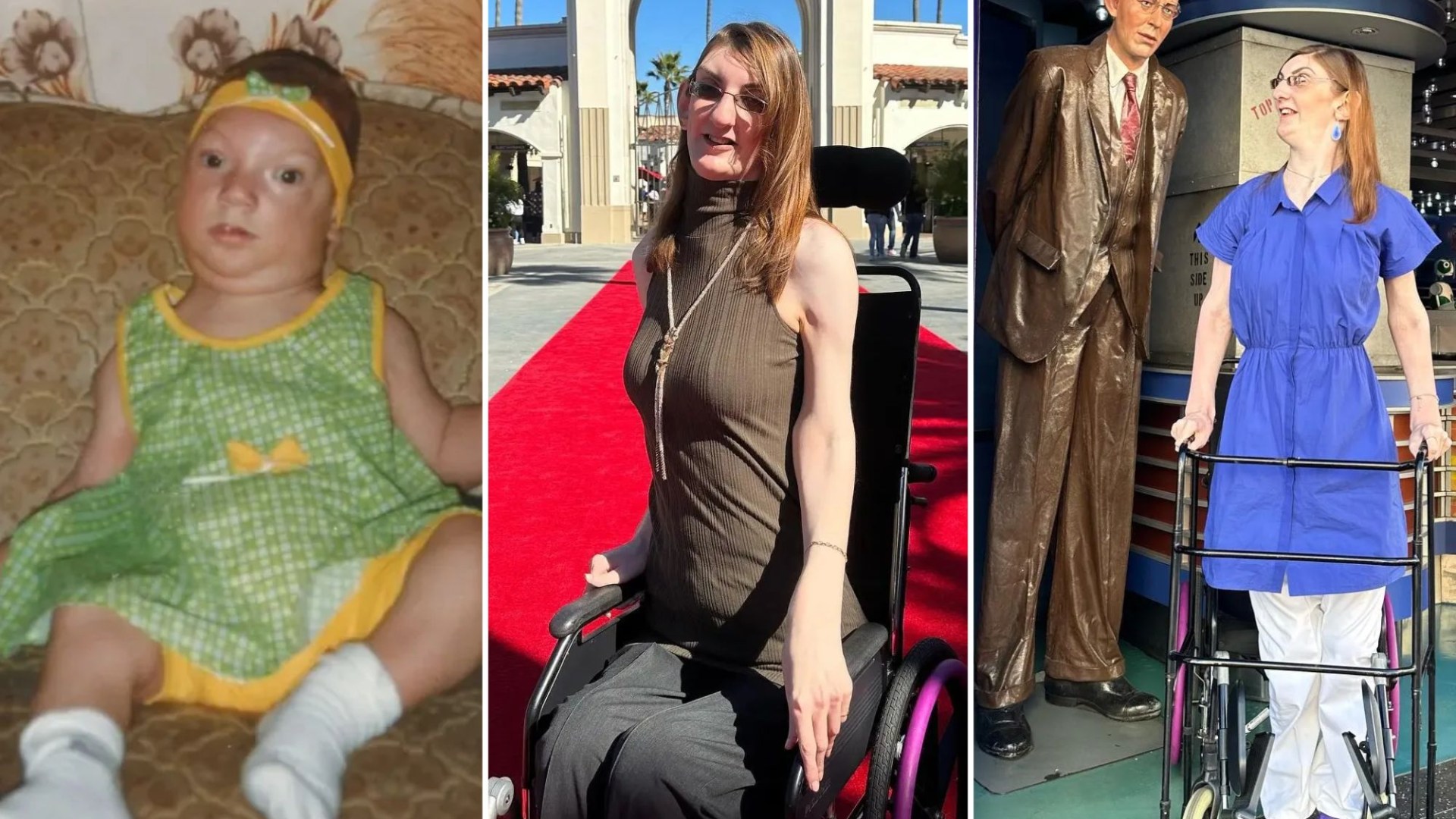
AT 7ft tall and with size 16 feet, Rumeysa Gelgi is the tallest woman in the world. Doctors have no idea why she is so tall, which was first realised when she was born, though she takes her difference in her stride. At 7ft tall, Rumeysa Gelgi is the tallest woman in the world Credit: Jam Press/@rumeysagelgi She holds the Guinness World Records for her height and is 2ft taller than the average woman in the UK Credit: Jam Press/@rumeysagelgi The 29-year-old, from Karabük, Türkiye, is almost 2ft taller than the average woman in the UK and Türkiye (5ft 4in), and at least 1ft taller than the average man (5ft 9in). She is crowned the tallest woman in the world by Guinness World Records. Sign up for the Health newsletter Thank you! Her height is not genetic – she towers over her parents. Instead, it’s the result of an extremely rare condition, which also causes weak muscles. The web developer, who works from home, is one of just six known cases in the world with her ultra-rare genetic mutation, the cause of which is unidentified. Rumeysa has grown so much, and so fast, that it has put pressure on her spine, meaning she cannot walk unaided. But she positively shares insights into her life and the unique obstacles she faces online with her 297,000 Instagram followers. Rumeysa currently lives with her parents, who assist her in day-to-day life, and she holds the world record for the longest baby, having been 59cm in length at birth, compared to the average of 50cm. Most read in Health “I stopped growing at age 9,” she tells Sun Health. “I was homeschooled and then completed my education online rather than attending a school. Rumeysa’s height is caused be a rare genetic condition and she is pictured here at seven months old Credit: Jam Press/@rumeysagelgi Pictured here at the age of 4, she cannot walk unaided as the speed at which she grew put pressure on her spine Credit: Jam Press/@rumeysagelgi “I was exceptionally tall compared to other children my age from birth due to my extremely rare overgrowth syndrome.” Doctors initially believed she had Weaver Syndrome – a rare genetic overgrowth disorder with fewer than 100 confirmed cases worldwide – based on clinical findings from when she was a newborn. But, upon further clinical testing in recent years, the mutation within her DNA was unable to be identified, casting doubt on the diagnosis. In June, Rumeysa’s diagnosis was formally changed to Moreno–Nishimura–Schmidt (MNS) Syndrome – a collective name for clinically identified overgrowth syndromes. Rumeysa says: “I used to feel that I was one in a million with Weaver Syndrome, but now it’s even less than that! “For MNS Syndrome, only six documented cases currently exist in medical literature, making it approximately 25 times rarer than Weaver Syndrome. “When you have been identified with one diagnosis for your entire life, finding out that it is not the complete answer changes the way you think about your own medical history. “There is a sense of starting over, learning new information, and accepting that there are still many unanswered questions.” MNS profoundly affects growth, the development of the skeleton and connective tissue. Therefore, people with it, such as Rumeysa, have a number of physical problems, such as spine and back issues, joint stiffness, motor incoordination and tissue laxity. Doctors initially believed Rumeysa had Weaver Syndrome, a rare overgrowth disorder Credit: Jam Press/@rumeysagelgi But this June, her diagnosis was changed to Moreno–Nishimura–Schmidt (MNS) Syndrome Credit: Jam Press/@rumeysagelgi They may potentially have developmental delays, vocal and facial changes. Weaver Syndrome and MNS Syndrome are very similar to each other in their presentation and clinical findings. But MNS has an unknown genetic cause or mutation. “Current technology and modern medicine have not yet been able to identify any known mutation in my genes,” Rumeysa says. “Suddenly hearing a different name attached to my life story naturally takes time to absorb.” Speaking of her day-to-day challenges, Rumeysa says: “I use a wheelchair and a custom walker for mobility. “My wheelchair allows me to move around safely and conserve my energy, while my walker supports me when walking. “I see them both as tools for my independence rather than as something that confines me. Rumeysa had to be carried onto a flight with a gurney and book six seats due to her height Credit: Jam Press/@rumeysagelgi Rumeysa’s clothes and shoes often have to be custom made due to her size Credit: Jam Press/@rumeysagelgi “Clothes also need careful searching or alterations and are sometimes tailor-made. “Finding shoes is challenging. I get very large sizes from abroad, while specialised footwear can be custom-made. “My size is 51.5 on the EU size chart [UK size 15 to 16].” Rumeysa previously went viral after sharing footage of herself flying with Turkish Airlines in 2022. She was carried on board with a gurney and had to book six seats – which were removed in order for the gurney to fit. “Many everyday things are not designed for someone of my height or with a disability,” she explains. “Travel requires significant planning. “Places without suitable accessibility can be difficult or impossible for me.” Rumeysa hopes to move to the US one day to have more opportunities and better accessibility Credit: Jam Press/@rumeysagelgi She says she will voluntarily participate in research on her condition to help others in the future Credit: Jam Press/@rumeysagelgi Looking to the future, Rumeysa hopes to move abroad one day, to somewhere where accessibility and opportunities for people with disabilities are more advanced. The US is one of the countries she is considering. She says: “I believe that [moving abroad] would allow me to live more independently and expand both my personal and professional horizons. “I also hope to continue traveling the world, sharing my experiences, and showing that having a rare condition should never define the limits of a person’s ambitions. “If my journey encourages even one person to see disability or rare conditions differently, or inspires someone facing their own challenges, I will feel I have made a meaningful contribution.” She says that she will voluntarily participate in research on her condition with the hope of helping others in the future. “I have always approached my life with curiosity rather than fear,” she says. “Even if there is not a complete explanation today, I believe each new discovery brings us closer to a better understanding. “I will continue passionately advocating for people living with similar syndromes.” Comment now
I’m the tallest woman in the world – I need six plane seats and have size 16 feet
Full Article
Original Source
Read the full article at Thesun →KhanList aggregates and links to publicly available news content. We do not host full articles from third-party sources. Always verify important information with original sources.