
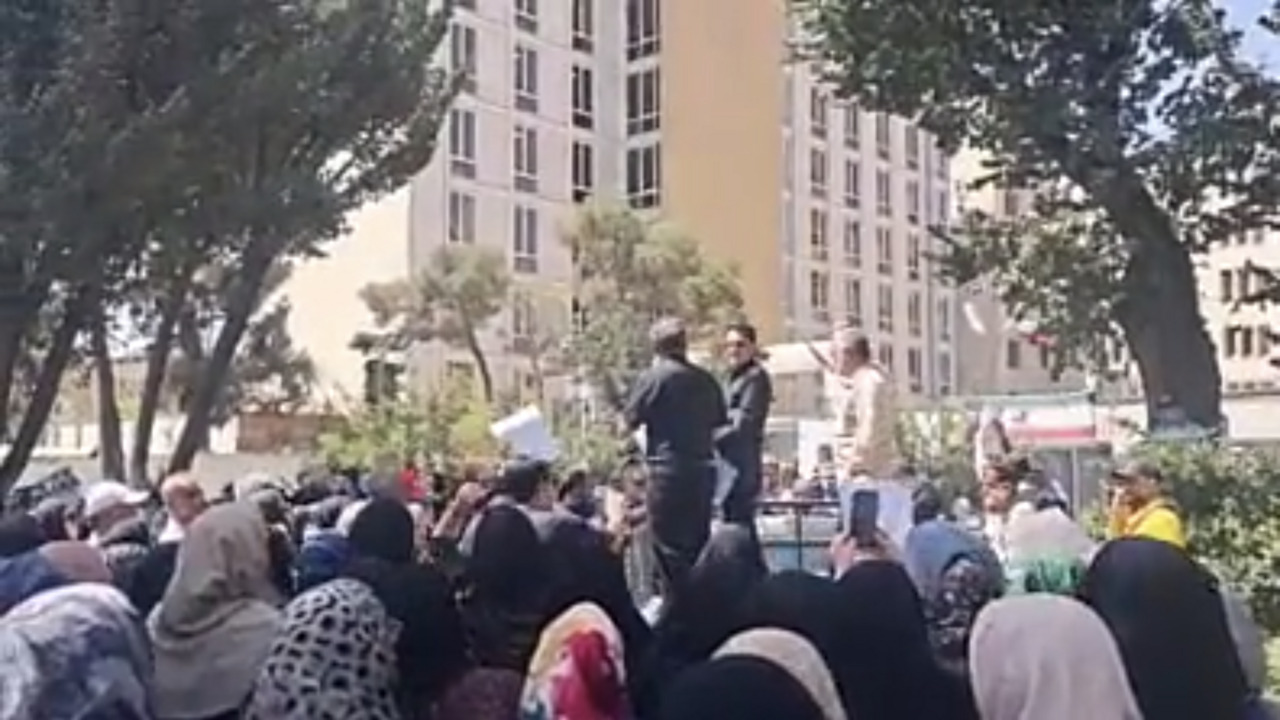
Every week, the regime hands down severe sentences to arrested protesters, including death sentences. It also relentlessly arrests journalists, artists, activists and athletes for the slightest public expression of anti-regime views or for failing to observe restrictive Sharia rules on social media. Over the past eight months, the Islamic regime in Tehran has executed at least 54 prisoners for political reasons, including 31 protesters who took part in the mass anti-regime protests in January, according to the Iran Human Rights Group based in Norway. But many Iranians continue to protest despite the risks. Retirees protest in Shush, in southwestern Iran, on August 9, 2026 chanting: ‘We don’t want war. We want life.’ To display this content from Telegram, you must enable advertisement tracking and audience measurement. On September 9, the syndicate of university professors in Iran said in an open letter that if the government failed to fulfil its economic promises and raise professors’ salaries, they would not attend classes in the new academic year, which begins on September 23. Nurses protest in Neyshabur on August 11, 2026, over months of unpaid salaries. To display this content from Telegram, you must enable advertisement tracking and audience measurement. Since the US-Israeli war against Iran began on February 28, the country's already devastated economy has deteriorated further, creating unprecedented hardship. The situation has worsened since the Trump administration imposed a naval blockade on Iran in the Persian Gulf on April 13. Iran can now import very little through the country's main ports in the Persian Gulf and, more importantly, can export very little oil, a major source of government revenue. On August 29, Iranian President Masoud Pezeshkian said that the US naval blockade had caused Iran to lose 35 percent of its imports and exports. Nurses hold a sit-in in Kermanshah on September 8, 2026 chanting: ‘We want our salaries. They brought the police for us.’ To display this content from Telegram, you must enable advertisement tracking and audience measurement. FRANCE 24 spoke to several Iranians who described their experiences of an economy in free fall amid an ongoing war and after decades of sanctions, mismanagement and corruption. 'Prices change hour by hour' “Sirvan” is the CEO of a small startup or used to be. Since the war began, he has had to fire all of his employees and now runs the business alone. [We are concealing his identity for security reasons.] I can only describe the situation as “free fall”. A few months ago, I had to fire all 12 of my employees. I know many other employers who had to do the same. Prices used to increase month by month or week by week. Now they change hour by hour, and I’m not exaggerating. One day, I had an order and checked the price of a machine a client needed to replace. In the morning, it was around 180 million toman [€660, based on the exchange rate on September 9, 2026]. By noon, when I wanted to buy it, the price had risen to 220 million toman [€814]. I informed the client, and he changed his mind. He is trying to continue with the defective machinery he already has. A cellphone seller describes in a video posted on September 7, 2026 how rapidly rising prices have made business increasingly difficult. He says the wholesale price of a phone rose from 70.8 million toman [€262] to 76.5 million toman [€283] within six hours. To display this content from Telegram, you must enable advertisement tracking and audience measurement. A cellphone seller explained in a video posted on social media on September 7 how rapidly changing prices have made it increasingly difficult to run a business in Iran: ‘Doing business in Iran is a joke now. This morning, an online customer wanted to buy this cellphone. Its wholesale price for us was 70.8 million toman [€262, based on the exchange rate on September 9, 2026]. I told him the price was 72.8 million toman [€269]. He bought it and transferred the money. Fifteen minutes later, when I wanted to send the cellphone to his address, the price in our system was updated. By then, I had to buy the phone myself for 71.8 million toman [€266]. Just a few minutes later, before we had even sent it to the customer, our online pricing system was updated again, and the price for us had increased to 72.8 million toman [€269]. So I had to send it to the customer without making any profit. It doesn’t matter. I’m recording this video six hours after I sold the cellphone, and the wholesale price for us to buy the same phone is now 76.5 million toman [€283].’ 'Importing has become a game of chess' “Sirvan” continues: ‘It’s impossible to run a business in this situation. If I sell something now, I cannot replace it in my stock for the same price at which I sold it. Part of the problem is the nonstop rise in the toman-dollar exchange rate. But this new situation has another cause. Since Trump imposed the naval blockade on Iran and the UAE refused Iranian ships access to its ports, importing anything has become a game of chess and an extremely costly process for any product we need to bring into the country. All imports now come through overland routes, either by lorry or rail. It is complicated, slow and very expensive. We first have to send the goods from the exporting country to a neighbouring country, which adds another fee. Then we have to store them there, which adds another cost. After that, we have to bring them into Iran by rail or lorry, adding another exorbitant expense. And once you finally have the product after paying all those costs, you still do not know how much you need to sell it for in order to have enough capital to buy it again through the same complicated system. So, in practice, almost no one can really do business.’ At least 40 percent of the Iranian population has fallen below the absolute poverty line, compared with 34 percent before the war, while another 40 percent is at risk of doing so, according to several estimates. Workers in Mahshahr went on strike over unpaid salaries on August 15. To display this content from Telegram, you must enable advertisement tracking and audience measurement. 'I sold my car, I have to sell my house too' Amir is a 75-year-old retiree living in Tehran. After decades of hard work and earning what I would describe as an upper-middle-class living, I have now had to start working again. My pension does not even cover the first week of the month, and I’m one of the lucky ones: I receive my pension every month. There are millions of retired people who have not received theirs for months. I work as a driver for Snap [editor’s note: Snap is the Iranian equivalent of Uber]. Before that, I had to sell my car and buy a cheaper one, using the remaining money to pay for my wife’s medicines and medical bills. I could no longer afford them. Some medicines are difficult to find, and they are expensive. We now want to sell our house and buy two apartments in a cheaper neighbourhood. We would live in one, and my daughter would live in the other. She can no longer afford her monthly rent despite working full time. According to the director of the Iranian retirement syndicate, as of September 7, the Iranian government had not paid pensions for five months. 'I literally have four jobs' Nilou is a young graphic artist. While the minimum wage in Iran is around 17 million toman [€63, based on the exchange rate on September 9, 2026], Nilou says she recently paid almost €30 for a small amount of chicken and meat. I’m tired. I’m depressed. I see no future ahead of me. I literally have four jobs. I work for three companies as a graphic designer, and I also work in a shop as a salesperson. But over the past couple of months, I have no longer been able to keep up with the rising prices. For years, I managed to build up a small amount of savings. I had bought gold ingots and dollars as savings, but now I’m selling them little by little just to pay the bills and survive. I live alone; I don’t eat much. But just a few days ago, I had to pay 1.5 million toman for some fruit [5.50 €, calculation based on exchange rate on Sept 9, 2026]. For a little chicken and meat, I paid around 8 million toman [29.70 €], and that will last only two weeks. Some shampoos and conditioners cost 6 million toman. [22 €] In a few months, when I have spent all my savings, I will no longer be able to afford this life. I think I will have to move into my parents’ apartment. What we have is not a life. I’m sure that if the situation continues like this, people will organise another huge protest, despite the massacre we endured just a few months ago. Estimates suggest that Iran’s annual inflation rate reached as high as 80 percent in August 2026, rising to around 130 percent for food.
‘I’m spending my savings just to survive’: Iran’s economic crisis fuels new protests
Full Article
Original Source
Read the full article at France24 →KhanList aggregates and links to publicly available news content. We do not host full articles from third-party sources. Always verify important information with original sources.