
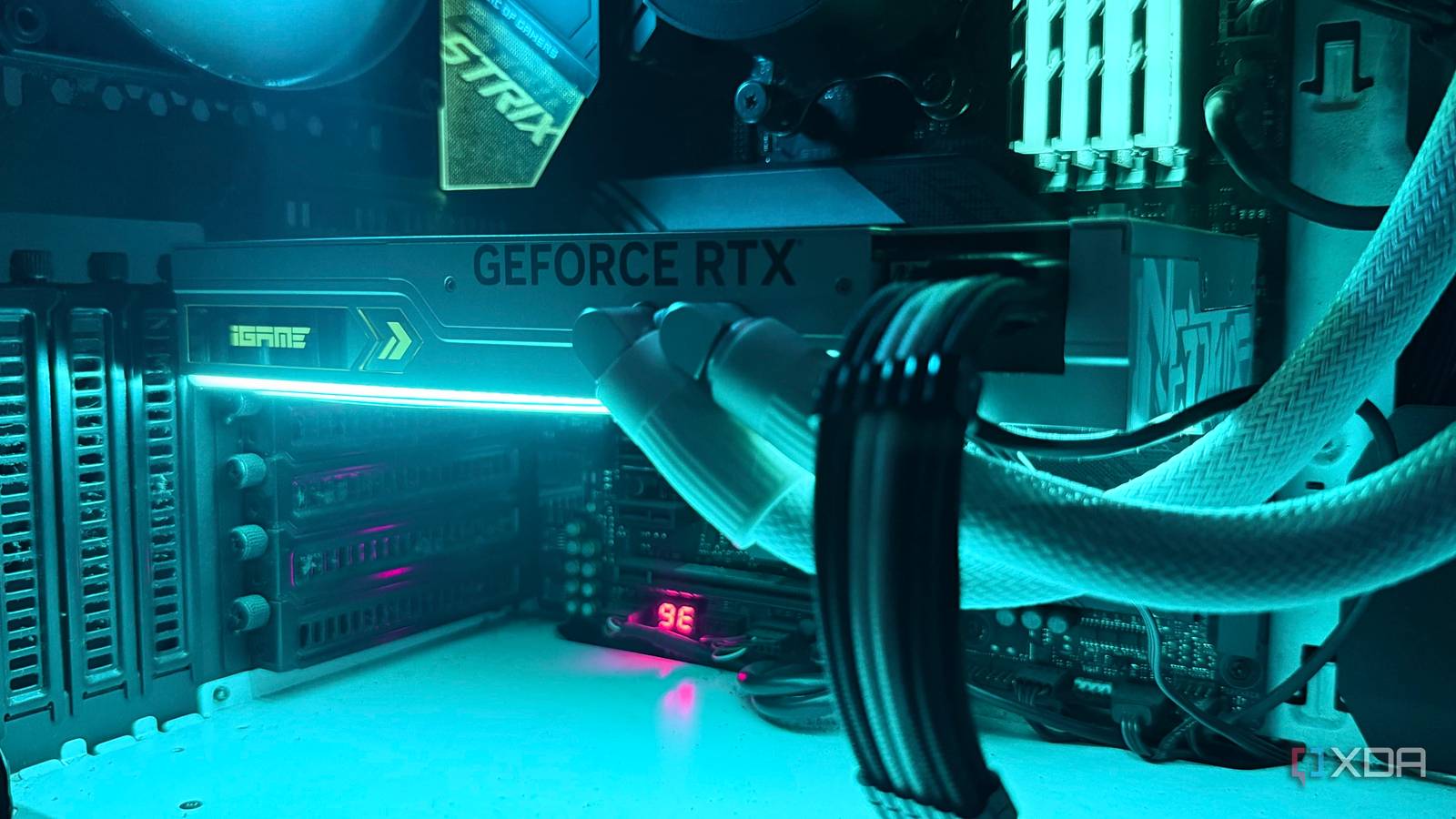
Published Aug 20, 2026, 12:00 PM EDT Hamlin has been in the tech field for over nine years. Since 2017, his work has appeared on MakeUseOf, Android Police, OSXDaily, Beebom, and more. He served as the Senior Editor at Valnet's MakeUseOf for over two years before joining XDA. He uses a high-end gaming rig for desktop use and a MacBook for traveling, but dislikes some of the quirks of macOS. You're more likely to catch him at the gym or on a flight than anywhere else. I've been using the RTX 4090 since 2022, and honestly, I never thought I'd stick with it for this long. After all, I upgraded from the RTX 3090 after barely two years, so I fully expected Nvidia's next flagship GPU to tempt me into upgrading just as quickly. Except it only convinced me to save my hard-earned money. At this point, I don't think I'll upgrade next year either, since there's no clear sign of a next-gen Nvidia flagship arriving in 2027. And even if it did, what are the odds it'll be priced reasonably? I know, I probably sound like I'm complaining from a pretty privileged position here. Most people who spend over $1,000 on a GPU aren't replacing it every couple of years in the first place. But if the RTX 3090 taught me anything, it's that I don't mind upgrading when the performance jump is big enough to justify it. And GPU prices were closer to MSRP when the RTX 4090 launched, so spending that kind of money was a much easier pill to swallow than it is today. The RTX 5090 doesn't make my 4090 feel old It's not nearly as big an uplift as my RTX 4090 was over the 3090 The biggest reason I haven't upgraded yet is simply that the RTX 5090 doesn't feel like a big enough step up from what I already have. Of course, the RTX 5090 is still a very powerful GPU, but compared to my RTX 4090, it's barely 30% faster at 4K, according to several benchmarks. To many of you, that jump might seem decent, but maybe I'm spoiled by the fact that my RTX 4090 upgrade gave me roughly a 60-70% FPS uplift over the 3090 in most games at 4K. In fact, even the RTX 4080 was considerably faster than my 3090, despite being just two years old at the time. The RTX 5090, on the other hand, costs 25% more (let's stick to MSRP for now) for a much smaller performance uplift than I got with my last upgrade. Despite being four years old, my RTX 4090 is still the second-fastest GPU for gaming. Sure, you can get significantly better frame rates on RTX 50-series GPUs with Multi Frame Generation, but that doesn't feel the same when responsiveness is still mostly tied to the base frame rate. If anything, I'm more than happy sticking with standard 2x Frame Generation since the disconnect isn't too obvious in single-player titles. I'm looking at paying $4,000+ for an "upgrade" Any temptation to upgrade disappears when you look at current GPU prices The RTX 5090 was already too expensive at its official launch price of $2,000. Paying 25% more for nearly a 30% improvement in frame rates didn't exactly seem like a great deal, but I could at least understand the appeal if you wanted the absolute best gaming GPU money could buy. After all, I paid $2,000 for my liquid-cooled RTX 4090 in 2022 so that I could overclock it and get even more performance. The problem now is that it's practically impossible to snag an RTX 5090 for anywhere close to its MSRP. If you look on Newegg right now, you'd struggle to find an RTX 5090 for under $4,500. Even if I sold my RTX 4090 to recoup some of that money, I'd still be paying more than its official MSRP. All that for a mere 30% improvement kills the value proposition, even if you have the money to spend. Back in 2022, you could build an entire rig with the RTX 4090 for that money and still have some cash left for an OLED monitor and peripherals. I know we'll probably never see those days again because of massive demand from AI data centers, but I'd at least expect the performance jump to justify the higher price. With the RTX 5090, it simply doesn't. Of course, time will eventually catch up But I'll worry about that when my GPU actually feels outdated To be fair, my RTX 4090 doesn't crush 4K gaming. Even today, some AAA titles like Assassin's Creed Shadows and Black Myth: Wukong force me to lean on DLSS upscaling and Frame Generation to stay above 60FPS consistently. And I know games will only get more demanding over the next few years, especially after next-generation consoles come out with more powerful hardware. There will eventually come a point where I'll have to dial down my settings, and my 4090's 24GB of VRAM won't seem nearly as impressive. But that's a problem I'll deal with when I actually experience it firsthand. Right now, DLSS Balanced and Quality modes look almost as good as native 4K, so there's really no reason to chase native rendering and tank frame rates anymore. And I'm more than happy to turn off ray tracing altogether since most of the time, the differences are subtle outside of select scenes where the lighting and reflections really stand out. All in all, if Nvidia expects me to pay over $4,000 for a GPU, its next-generation flagship should be twice as fast as my RTX 4090. I'll just wait for the upgrade that feels impossible to ignore The RTX 4090 was simply too tempting when it launched. When I first bought the RTX 3090, I thought I'd skip the next generation, but that 60–70% FPS uplift was just what I needed for 4K gaming to not be a problem. But the RTX 5090 didn't feel the same. Sure, my frame rates would be even less of a problem, but the underwhelming generational gains and street prices that are out of touch with reality make the upgrade hard to justify, especially when my 4090 still holds up in the vast majority of AAA titles. For now, I'll just sit back and see what Nvidia has to offer with the eventual RTX 6090, because it'll take another 4090-like leap to convince me to spend my hard-earned money.
I'm not upgrading my RTX 4090 until Nvidia makes a GPU twice as fast, and that's probably years away
Full Article
Original Source
Read the full article at Xda-developers →KhanList aggregates and links to publicly available news content. We do not host full articles from third-party sources. Always verify important information with original sources.