
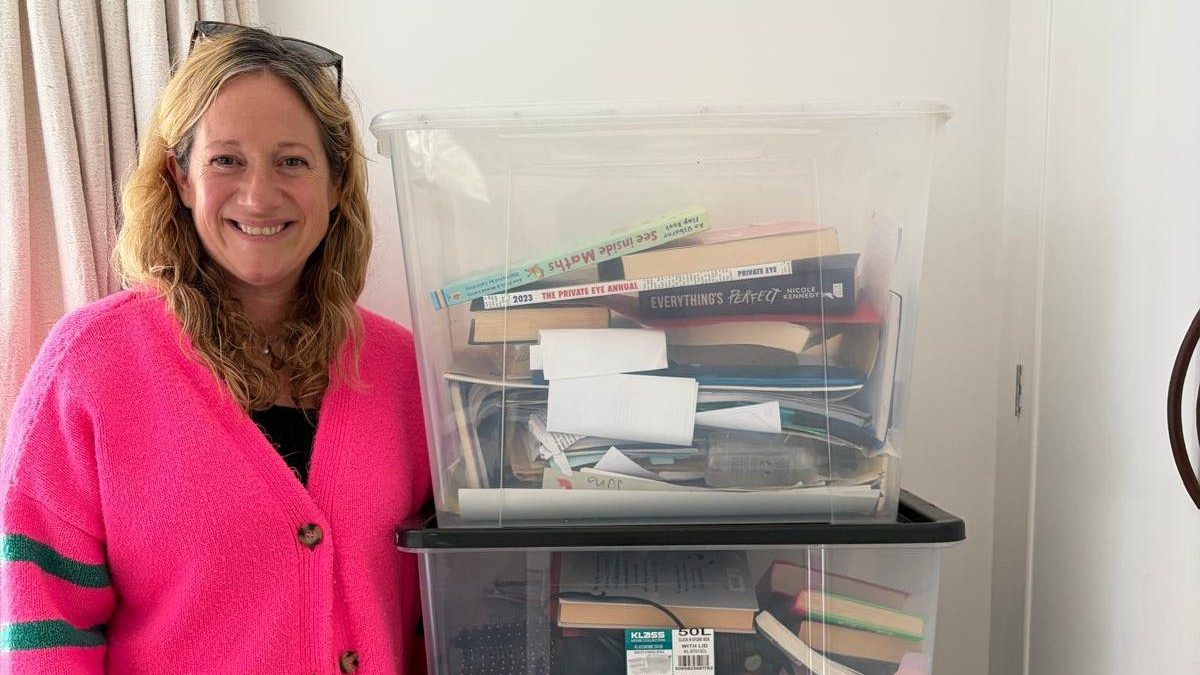
Every summer, strangers move into our home. Many of my friends tell me they wouldn’t dream of letting someone they’ve never met stay in their bed. But Airbnb is part of our summer – for over a decade now, we’ve rented out our home while we’re on holiday, and it feels no more strange to me than sleeping in a hotel bed where I know countless others have laid their head. The income helps us pay for our holidays – and as it’s below £7,500 a year, it’s tax-free. But I’ve recently discovered another unexpected bonus – it forces us to declutter. For many, the off-putting downside of homeswapping or Airbnbing your home is all the tidying and preparation – transforming your home from comfortable clutter to guest-ready. It’s true that it’s a huge task; my day-to-day tolerance for clutter is fairly high and we seem to amass stuff quickly. When we have guests coming to stay, we fill our son Xavi’s room full of boxes and lock it up so it’s out of bounds for guests. This year, my husband Mark took on the brunt of it – plus we paid two cleaners who worked for 14 hours combined: even the cutlery drawer was scrubbed. Upon returning, there’s a real temptation to tip it back into drawers as soon as we get back. But this year I’ve resisted, and found an unexpected bonus to renting out our home: it’s making our house much clearer, more organised and more calming to be in. Shorts When guests leave, I’ve been slowly unpacking and reordering our home. Our craft drawers are now unjumbled, the children’s artwork filed, with some recycled. All games are in the games cupboard. There’s still a long way to go, but I am appreciating the sense of order. I’ve sorted my wardrobe and hidden the size eight clothes that I don’t fit into now (and haven’t for years) as I can’t quite let go of the idea that they’ll be part of my future. I’ve surprised myself hugely by listing things I know I’m unlikely to wear again on Vinted. I have inattentive ADHD and find returning goods to shops hard enough, so I know I would never have joined in with Vinted sales unless our belongings were all boxed up. It’s a brutal and slightly uncomfortable way of decluttering (my son’s upper bunk bed is still covered in coats that I still need to sort through four weeks after we’ve arrived home), but it’s effective and is slowly improving our quality of life. Kathryn Lord, founder of More to Organising, says that clutter can cost “time, stress and sometimes even money, if you rebuy things when you can’t find them.” She says there is a minimalist movement, spearheaded by author Joshua Becker, that has echoes of my accidental box-decluttering technique. “They put everything (and I mean everything) in boxes and only get something out if they feel they need it. After a certain amount of time, if something hasn’t been used, the items are donated or sold,” she explains. “With clients, we create a ‘maybe box’ for certain items and decide on a time limit. If they haven’t reached for things within that time, they end up being sold or donated. Unless something is of high value, I recommend donation as attempting to list and sell items creates an extra layer and can be a cause of stress with another thing on the to-do list.” Heather Tingle, founder of Untangled by Tingle, works with neurodivergent customers who want to declutter. She says that packing for Airbnb rentals means accidentally stumbling upon the “House Hushing Method”. “This is not my favourite method, and for neurodivergent brains in particular it can be a real gamble because it’s tempting to never address the items in the boxes or bags, which can become too overwhelming to be addressed,” she says. “But it can be a great quick fix if you need a transformation quickly and want to enjoy the feeling of an ordered home. Once you’ve got the room how you want it, there’s now no deadline or motivation to go through the boxes. It can lead to an unusable spare room or a lot in storage company fees as life then takes over and the impetus has gone.” She recommends that I make a few changes that will help me keep on top of things rather than building up more piles of stuff. “I recommend clients have a mini recycling bin by their front door, rather than in the kitchen,” she says. “Otherwise leaflets come through the letter box, sit in the hall, eventually make their way to the kitchen and end up in a pile that needs sorting through.” I feel myself blush. She also recommends keeping a box file by your printer for paperwork. “Laundry is often a problem for clients,” she adds. “Not the washing and drying, but the job of putting it away.” I blush some more. Mark does the washing and drying and we end up with piles of clean laundry, neither of us able to make the time to put it away. “Can you wash each person’s clothes together and then dry them in their own bedroom?” she asks. “Or have shallow boxes where you put each person’s laundry once folded in your utility space.” Finally, I ask her about how to keep on top of the level of toys and games for our children, particularly as all three play with different things. “Have a designated space for things, whether it’s role play bits, crafts, random plastic bits or Lego, then when that is full something has to go. It’s a finite space and their decision what to play with.” It sounds so simple, and I’m full of September optimism: perhaps the unintended upside of Airbnb is that we’ll get to enjoy a decluttered home ourselves, as well as our holiday guests.
I’m naturally messy – now I’ve learned an easy way to declutter
Full Article
Original Source
Read the full article at Inews →KhanList aggregates and links to publicly available news content. We do not host full articles from third-party sources. Always verify important information with original sources.