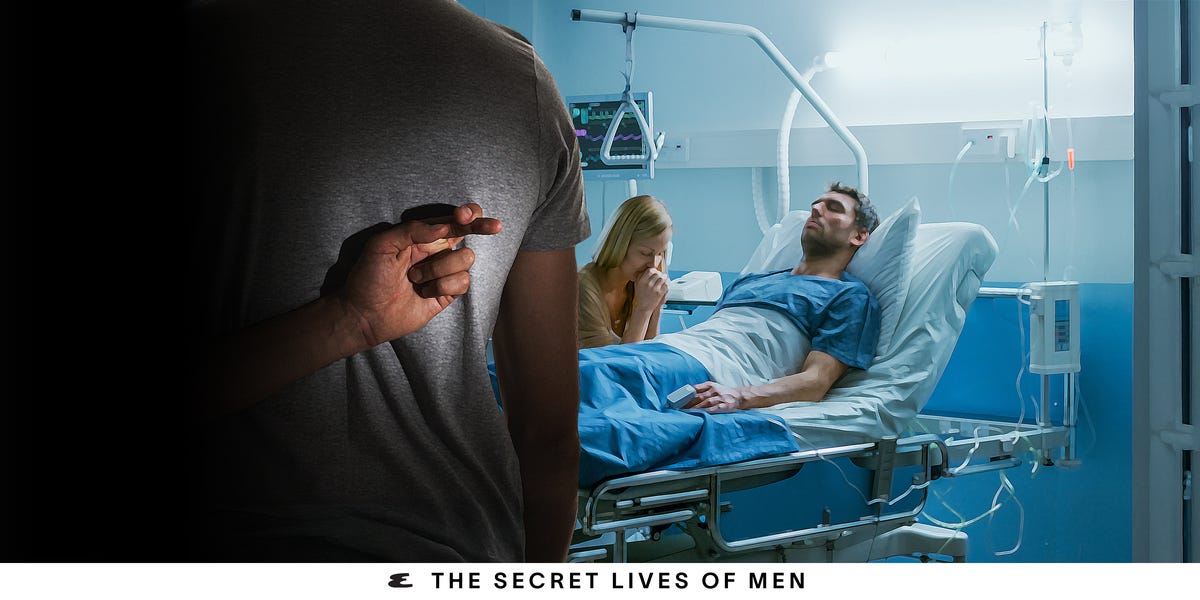
Getty Images / Art Illustration by Mike Kim7 min readMost men don’t admit to harboring dark thoughts about the people they call friends. For that reason, secretly wishing for a rival’s demise is a taboo usually reserved for fiction. For the latest installment of the Secret Lives of Men, we interviewed Leo*, a 42-year-old urban planner, who found himself crossing a moral line in his own head. When his best friend’s husband was suddenly paralyzed by a rare neurological disorder, Leo stepped up to help care for their young son. But beneath the surface of his altruism lay a deeply buried, shameful hope.*Names and identifying details have been changed to protect anonymity.Leo, 42, Urban PlannerThese days, I catch myself checking the mirror before I head over to their house. I make sure my hair is sitting just right. I pull out my better shirts, the ones that fit a little closer to the chest that she always compliments. It’s an involuntary vanity, a quiet preparation for the moment.I arrive to find Elena wrestling dinner while her husband, Mark, rests upstairs. I’ll slide right into the routine, spooning mashed potatoes and peas into their three-year-old son’s mouth, wiping avocado off his chin, and trading quiet, exhausted nods with Elena over the high chair. Every time we’re in that room together, passing a cutting board or reaching for the same bottle of wine, I feel a spark in the space between us.Maybe it is all in my head. Maybe this is just the ceiling of a profoundly deep male-female friendship between two people who know better than to burn their lives to the ground. But to explain these moments in that kitchen, I have to rewind a few years.I first met Elena years earlier in San Francisco, where we bonded over marathon running. Back then, I found her breathtaking but safely out of my league. She carried herself with the smug, detached air of an elitist, which protected her surprisingly fragile core.When we both moved to Chicago in 2020, Covid-19 had ground the world to a halt. We were in our late 30s, suddenly eager to embrace adulthood. I bought a drafty loft in the West Loop, adopted two greyhounds, and settled into the relentless cycle of modern dating: scrolling through apps, suffering through awkward dinners, and rotating through brief, disposable relationships. Elena, meanwhile, married Mark, her longtime partner; bought a suburban house; and brought a little boy into the world.The kid quickly learned to call me Uncle Leo. We are all massive Seinfeld fans, so the cosmic joke of me walking into their house, throwing my arms up, and aggressively shouting “Hellooo!” like Jerry’s notorious uncle was extremely funny to us. It was a golden era. I genuinely loved the kid, and despite my feelings for Elena, I actually loved her husband, too.Every time we’re in the kitchen together, passing a cutting board or reaching for the same bottle of wine, I feel a spark in the space between us.Mark was brilliant, though deeply neurotic. Even on a good day, his anxiety hummed beneath the surface like a faulty refrigerator. He overcomplicated simple weekend plans and obsessed over the uncontrollable. We both studied urban design, shared a ridiculous, pedantic obsession with obscure 1990s jazz, and viewed the world through the same pragmatic lens.When Elena and I both took jobs at a boutique architectural firm outside the city in 2021, she became my ride. For almost four years, we spent an hour and a half together in the sealed ecosystem of her sedan.We navigated brutal Chicago winters with the heater blasting in a losing battle against the cold, the windshield framing a frozen wasteland. Her sedan had a terrible defroster, so I’d frequently lean across the center console to wipe the fog from the glass with the sleeve of my coat. One morning, when stuck at a red light in a total whiteout, I reached over to clear the condensation from her line of sight. She turned her head, and our faces were suddenly inches apart. She didn’t pull back. Instead, she just looked at me with this piercing expression, reached up, and gently tucked a stray piece of hair behind my ear. “You’re always fixing things for me, Leo,” she murmured softly. My chest tightened.When we weren’t suspended in those loaded moments, we listened to niche running podcasts and shared comfortable silences. When we did talk, our accents collided in spectacular, garbled ways—she’s Polish, I’m Brazilian—and we’d laugh until our ribs ached at our frequent misunderstandings. From the passenger seat, I told her about fresh breakups and my sudden waves of existential dread. I watched her tough exterior crack when her family dog died.Maybe it is all in my head. Maybe this is just the ceiling of a profoundly deep male-female friendship between two people who know better than to burn their lives to the ground.I loved the way she desperately wanted to project a cool detachment but simply couldn’t help doing the right thing. I loved the way she could pull a perfect pop-culture metaphor out of thin air to explain a highly technical marathon pacing strategy. And I loved the way she could talk me down when my own anxiety spiked.There were clues she felt it too. Hugs that lingered a fraction of a second too long. Pointed compliments. The way she smiled when I asked, “Do these running shades look stupid on me?” And then there was her ruthless hatred of every woman I dated, to the point where it became a hobby for us to grab drinks just and roast my ex-girlfriends.Shortly after he and Elena’s child was born, Mark suffered a minor viral infection that rapidly escalated into an aggressive autoimmune attack on his nerves. Within days, he went from a healthy, active dad to paralyzed and on a ventilator in the ICU. The world inverted. Nobody deserves a catastrophic illness out of nowhere, definitely not a guy like Mark. For a few bleak months, as he navigated life support, severe respiratory failure, and endless rounds of plasmapheresis, his chances of pulling through did not look good.I remember feeling furious that a little boy could lose his dad so quickly, angry that my friend Elena would be forced to raise a child entirely alone. But beneath that righteous anger was something else, a thought so toxic I’ve never shared it until this exact moment: If Mark succumbed to his illness, eventually, maybe, after the grief cleared, Elena and I could finally be together.That guilt ate me alive, manifesting in a bizarre, aggressive altruism. I organized the meal trains. I spent weekends babysitting my godson. I sat beside Mark in the rehab facility as he detailed the terrifying reality of being trapped in his own body, the agonizing nerve pain, the relentless exhaustion of physical therapy. Meanwhile, Elena struggled to juggle a demanding career, a toddler, and full-time caretaking.“You’re always fixing things for me, Leo,” Elena murmured softly. Mark’s entire identity was consumed by the disease. The brilliant architect and jazz aficionado vanished, replaced by a ghost tethered to an IVIG infusion chair and paralyzed by survival anxiety. He developed a sudden, militant obsession with anti-inflammatory diets, purging the pantry of anything processed and forcing down foul-tasting, turmeric-heavy green smoothies. He spent his few good hours hunched over his laptop in the dark, spiraling down internet rabbit holes to research obscure nerve-regeneration supplements and wildly expensive holistic neuro-rehab retreats in Sedona, Arizona, that they couldn’t even begin to afford. It was a desperate, exhausting grab for control. Elena, in turn, became nothing but a caretaker who managed his endless medications, meticulously prepared his strict new diet, and placated his daily existential fears. I felt selfish as I wondered where my friends had gone.I tried to put a wall up. But God, there were moments in that kitchen when I wanted to shake Elena by the shoulders. I wanted to beg her not to cave to Mark’s panicked insecurities. Whenever she reached over from the driver’s seat of her car to squeeze my hand in silence, I wanted to pull her close to my chest and order her to finally break down.Mark lived.Survival isn’t always a cinematic victory lap. Today, Mark deals with the brutal, lingering realities of severe muscle weakness and permanent neuropathy in his feet, a parting gift from months spent paralyzed, which wrecked his balance. His stamina is shot. The agonizing numbness in his legs means he can’t sprint down the block to the playground or chase his son across a soccer field. He is tethered to the house in ways he quietly hates, even though he remains a fiercely loving dad.Because of his physical limits, I’ve been stepping in to fill the gaps. I’m the one who regularly handles the chaotic midday school pickups, the one who carries the heavy grocery bags inside, and the one who spends Saturday afternoons pushing the kid on the swings.Whenever she reached over from the driver’s seat of her car to squeeze my hand, I wanted to pull her close to my chest and order her to finally break down. Which brings me back to the kitchen. Back to my better shirts and the lingering eye contact.As the years go on, the shame of my secret hope has evolved into a strange, melancholic pride. I wanted something terrible, but I chose to do something good. I showed up for my friend, and I showed up for her husband. If Elena actually feels the same way about me, I respect and love her infinitely more for being wise enough, loyal enough, not to act on it.We are two adults, standing in a kitchen, holding a match we refuse to strike. And maybe that’s the truest kind of love I’ll ever get to offer her—or anyone.
I’m in Love with My Best Friend. When Her Husband Fell Ill, I Secretly Hoped He Wouldn’t Make It.
Full Article
Original Source
Read the full article at Esquire →KhanList aggregates and links to publicly available news content. We do not host full articles from third-party sources. Always verify important information with original sources.