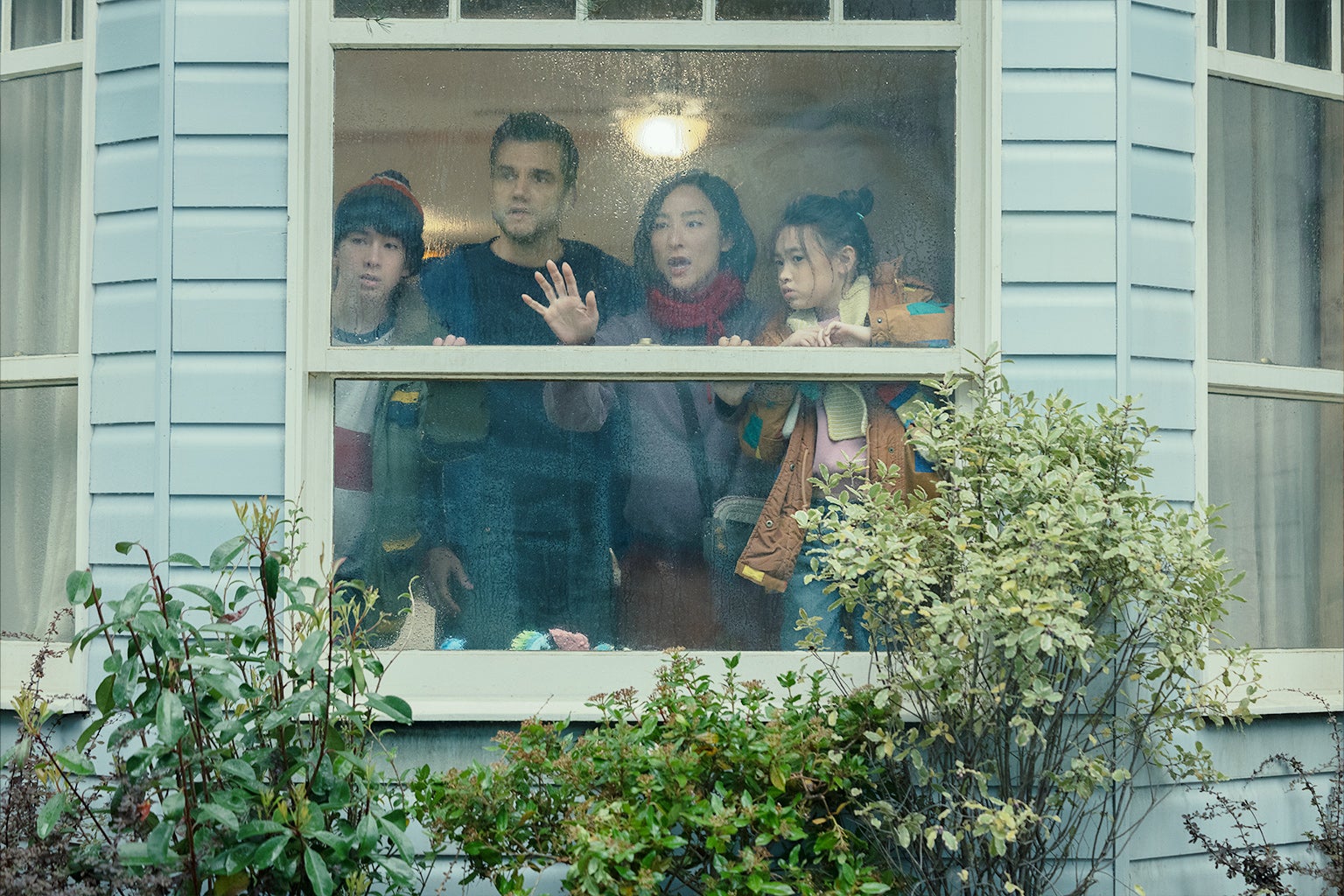
Movies It’s the End of the World as We Know It (but Netflix Feels Fine) By Enter your email to receive alerts for this author. Sign in or create an account to better manage your email preferences. Unsubscribe from email alerts Are you sure you want to unsubscribe from email alerts for Sam Adams? Aug 07, 202612:31 PM Netflix Sign up for the Slatest to get the most insightful analysis, criticism, and advice out there, delivered to your inbox daily. The idea that the algorithm knows our innermost fears and desires is mostly a marketing construct, but there’s something a little unsetting about the fact that a company that purports to base its decisions on cold, hard data keeps turning out stuff about the end of the world. From Bird Box to The Electric State, Sweet Tooth to The Society, Netflix has been serving up one postapocalyptic scenario after another, stories of what it will be like after most of humanity has ceased to live. People have been telling stories about the end of the world for as long as they’ve been telling stories, but if 325 million households are choosing to watch the human race get snuffed out often enough to justify the unending river of content, that feels to me less like a healthy confrontation of our own fragility and more like a collective death wish. The latest entry in the Armageddon minigenre—keywords: cataclysm, annihilation—is The Last House, in which an unremarkable family of four becomes humanity’s last holdout. One day, a mysterious rain envelops the world, and suddenly the Delgado family, Jason (Wagner Moura), Ann (Greta Lee), and their children Graham (Noah Alexander Sosnowski) and Ruth (Riley Chung), are trapped inside their crumbling two-story house, just like everyone else they can see from their suburban living room. The doors won’t open, the windows won’t break, and although the water keeps running and the power’s still on, every connection to the outside world is severed—if, that is, the outside world still exists at all. For the Delgados, the enforced isolation is a mixed blessing. Yes, they can’t step outside, can’t talk to anyone, have no idea what’s going on or how long it is likely to last. But it also means that no one is coming to collect on their past-due bills, and the fact that Jason, an engineer, has been out of work for some time no longer makes him any different than anyone else. They make a fleeting effort to communicate with their neighbors across the street, a retired dentist and his wife, using dry-erase boards like the stranded survivors in Zack Snyder’s Dawn of the Dead. But it turns out they don’t know enough about them, or anyone else on their street, to keep up much of a conversation. Even before the rain locked them inside, they were living in their own worlds. There’s a germ of a good idea in Matthew Robinson’s script, presumably inspired by the COVID pandemic: What if the place we go to take a break from the world suddenly became the world? And what if, in some ways, it wasn’t so bad? Sure, there are the imminent questions of survival—how much food is in the fridge, what happens if someone gets sick or the lights go out? But this happy nuclear family has got each other, which is more than anyone in sight. The elderly neighbors don’t live with their kids, a guy up the street has found himself indefinitely stuck with a one-night stand, and the only other mother we see had the bad luck to be out jogging when the rain sealed the rest of her family in, and her out. (Moral: Never go for a run.) Ann and Jason don’t have any lingering issues, and their kids, while exasperating in the way that 8- and 12-year-old siblings can be, reconcile themselves to their new reality with relative ease. Plus, they’ve got movies. The Delgados’ internet and TV go out at the same time as their doors slam shut. Whatever, and whoever, locked up the world did it so quickly and thoroughly that there isn’t even a whisper or a crackle of static to hint what happened elsewhere. And as far as this family or the movie they’re in is concerned, it doesn’t really matter. Jason digs out his LPs so he can teach the kids about the Cure, and an old DVD player is retrieved from the bottom of some shelf, along with the only two movies they happen to own: Annie (the original version, thankfully) and Air Force One. And for as long as the power lasts—which turns out to be quite a long time—they’re content to watch and rewatch the only things they have available. In other words, they’re perfect Netflix users. There’s something a little ironic about the company that killed off video stores underlining the importance of physical media. Jason’s search for stuff to watch even turns up an iconic red envelope from the company’s mail-order days, although sadly there’s no long-overdue disc inside. But it echoes the ending beat of Leave the World Behind, another Netflix end-of-the-world movie, in which a teenage girl sneaks away from her family to watch the Friends finale on DVD. That movie, based on a novel by Rumaan Alam, had the sense to imbue her sitcom escapism with a touch of ironic complexity: On the one hand, the character was choosing to take refuge in fiction rather than confront the real world falling apart around her; on the other, if you’ve only got an hour to live, why not take the last chance to find out what happened to Ross and Rachel? But in The Last House, the movies are just harmless pacifiers, a way for the family to blow off a little steam at the end of a hard day and forget that anyone else even exists. The clunky narration slapped over The Last House’s slower patches makes a few vague gestures toward framing the story as a parable of disconnection in the modern world, or at least something of that nature. (The speaker is never identified, nor is the audience they’re meant to be telling this story to.) But the movie doesn’t really care about intimacy—certainly not enough to develop any rapport between Moura and Lee, who play a long-married couple as if they met 30 seconds before the cameras started rolling. The script occasionally remembers to confront the darker aspects of what a family running low on resources might do to survive. (Suffice it to say that Does the Dog Die will have its hands full with this one.) But then it skitters back to safer ground, where infinite house arrest and the mysterious creatures squelching their way through the fog are just the occasion for some good family bonding. The end of the world might be coming soon, but at least we can all watch it together. Get the best of culture Get the best of movies, TV, books, music, and more. Movies Netflix Science Fiction Horror Thrillers
I’m Beginning to Feel a Little Disturbed by a Certain Pattern in Netflix’s Movies
Full Article
Original Source
Read the full article at Slate →KhanList aggregates and links to publicly available news content. We do not host full articles from third-party sources. Always verify important information with original sources.