
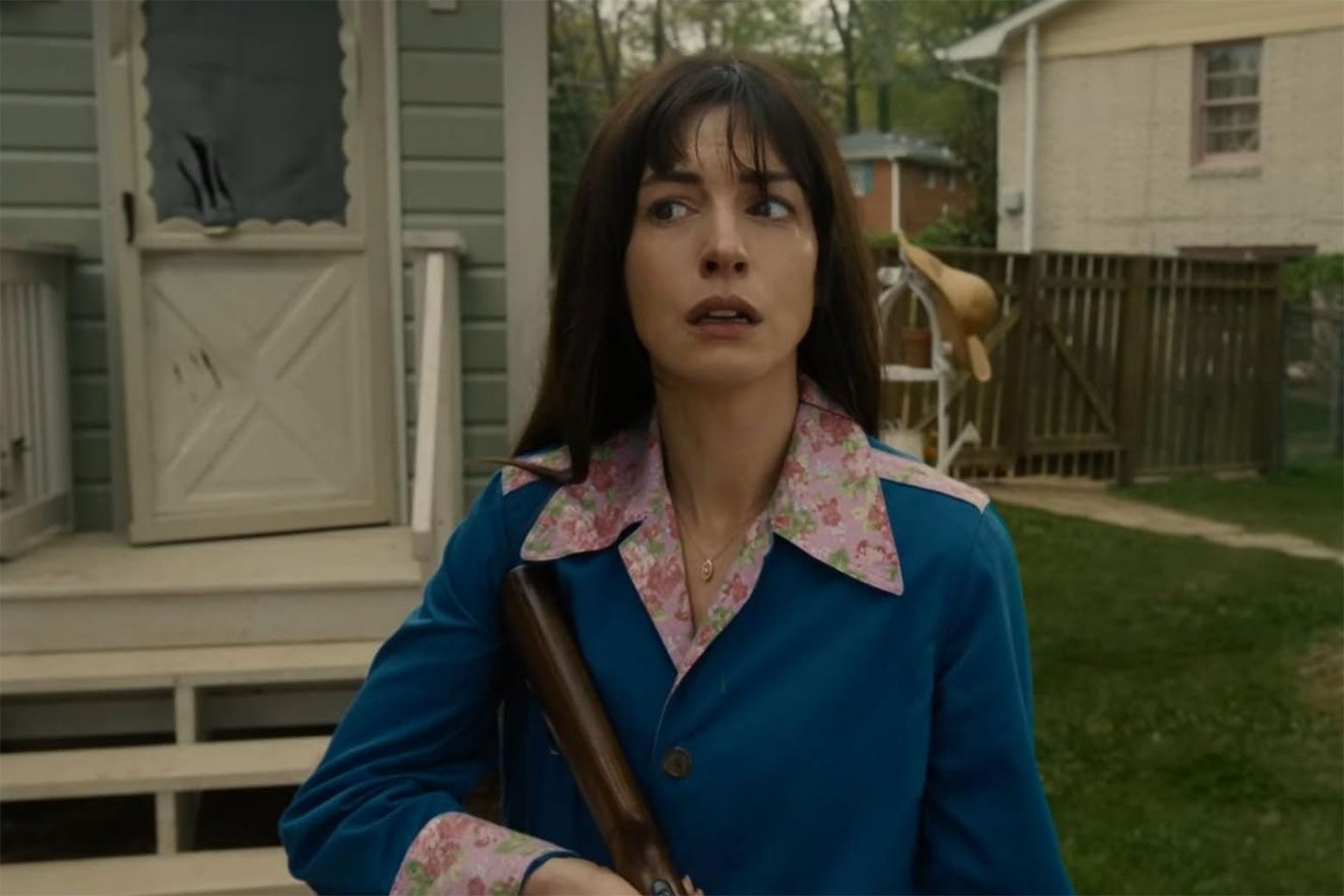
Movies A Field Guide to the Dinosaurs of The End of Oak Street A professional paleontology nerd’s take on the prehistoric creatures in Anne Hathaway’s new movie. Warner Bros. Sign up for the Slatest to get the most insightful analysis, criticism, and advice out there, delivered to your inbox daily. Some nights, when I can’t sleep, I think of dinosaurs outside. Thick reptilian necks stretching to browse the palms in the neighbor’s yard, scaly smirks concealing banana-size teeth just outside the bedroom window. I’ve done this since I was a child, to wish, perhaps to my peril, that my favorite reptiles would come visit. The End of Oak Street imagines the same tantalizing nightmare. It’s not dinosaurs as science reconstructs them. It’s how small, frail, and astonished we’d feel in the presence of voracious reptilian hordes. Easy as it is, I’m not sure it makes much sense to compare the insatiable creatures of Oak Street to the still-stunning dinosaurs of Jurassic Park. Steven Spielberg’s 1993 dinosaur disaster flick set the standard for all dinosaur films in perpetuity, just the same way any shark film is held up to his Jaws. But the adaptation of Michael Crichton’s novel took pains to bring in paleontologists as science advisers and—spitting Dilophosaurus and drab colors as exceptions—the computer-generated and practical-effect creatures were pretty close to scientifically accurate dinosaurs for the time. (When the franchise was rebooted in 2015, I did some dinosaur consulting for the website and marketing.) The new film doesn’t carry on this tradition. The End of Oak Street is like a bad trip fueled by doing a Google Image search for “scary dinosaur” on too strong an edible. The film doesn’t hide its indifference to the science that named the film’s animals. Early in the movie, when we know that dinosaurs have shown up to give a divorcing straight couple a reason to stay together, just like in Jurassic Park III, son Brian (Christian Convery) pulls a book off the shelves to gain some now vital dinosaur knowledge—just like Brody, reading up on sharks in the aforementioned shark movie. Nostalgia hit me. A little later in the decade from the film’s summer 1982 setting, I had endlessly pored over old, outdated dinosaur books at my local and school libraries. I recognized those illustrations. Which totally undoes the intended menace of the final page we see, an illustration of a T. rex slapped together with a stock image created by Roger Harris in 2013 made to look faded enough to be in a book from the past century. The message was clear. For the next hour and change, I’d be watching some real dinosaur boners. Sometimes literally. I can’t argue with a film that isn’t interested in cracking a paleo text. The End of Oak Street is not a documentary. More than anything else, it shares a great deal in common with a set of spattery cards I had as a child, Topps’ Dinosaurs Attack! series, in which a time experiment in the 1980s causes dinosaurs and other prehistoric creatures to suddenly materialize all over the world and try out our new flavor of soft, bipedal mammal. The film’s dinosaurs are monsters first and foremost, a scaly and feathery crisis that will save a bitter hetero marriage the same way the prospect of group sex threatens to in The Invite. But I didn’t pay $13.50 plus snacks to see marital resentment. I came for the creatures. To amuse myself during all the selfish bickering between Anne Hathaway’s Denise and Ewan McGregor’s Greg, I tried to work out what period Oak Street disappeared to and ascertain the nature of the local fauna. Our first clue is a wobbly one. Neighbor Mrs. Huddleston (Anne Gee Byrd) has a strange plant growing in her yard. It doesn’t look too different from what you’d find in the Lowe’s garden section, essentially a yucca palm with a cycad cone sprouting from it. At the local library, librarian Mrs. Valcourt (Emily Kuroda) identifies it as Pleuromeia, which is a real ancient plant that lived more than 240 million years ago. Only Pleuromeia was a 6-foot-tall quillwort that looked like a scraggly green feather duster. My apologies to paleobotanists. We know what the stray Pleuromeia means because we’re watching a movie. In real life, the discovery would have certainly received a cover story from an academic journal like Science, and there would undoubtedly be Pleuromeia for sale in suburban nurseries, just as with the discovery of the Wollemi pine. Such discoveries had been made before. The dawn redwood, Metasequoia, was named from fossils in 1941, only for Chinese botanist Toh Gan to find living Metasequoia in Hubei, already known to locals as shui-sha. Metasequoia shaded Tyrannosaurus rex and yet are still here, because evolution preserves as well as changes. Mrs. Valcourt says Pleuromeia lived more than 200 million years ago. That would indicate that the environment penning in Oak Street would be Triassic (or, technically, the very earliest sliver of the Jurassic, which started 201 million years ago). If I’m feeling generous, I could say that the feathery raptor stand-ins aren’t too far off from that era’s Coelophysis. This was a loosely turkey-size carnivore related to bigger bruisers of the time, but Oak Street seems to have nearly doubled its size, in the latest case in the long history of dino inflation. (Real-life Velociraptors weren’t nearly so big as they are in Jurassic Park either.) But only one other potentially Triassic creature appears in the film, chubby terrestrial crocodiles that resemble the carnivorous Postosuchus of that time. The rest are a mix of Jurassic, Cretaceous, and Cenozoic, dinosaurian creatures created as if from memory without looking at any scientific reference. Our main dinosaurs are Late Jurassic reptiles. Stegosaurs with bizarre arrangements of plates like table-saw blades gallop around the sidewalks too, while bewilderingly hairy Brachiosaurus eat playground trees, have dino diarrhea, and slowly hump in a way that would have risked broken bones for all concerned. Look, I’ve stayed on top of dinosaur sex science, and I’m telling you, such affairs between titans must have been brief given the sheer amount of tonnage the bottom sauropods had to balance as they made the bed rock. And, of course, our big bad is a suppurating, dirty Allosaurus, seeming to indicate the apex predator we know from fossils from about 150 million years ago that have been found largely in the United States’ own Morrison Formation. To be generous, perhaps the dinosaurs look funny because they’re from slightly earlier or later than what experts have uncovered—the ancestors from the Middle Jurassic, or the last members from the Early Cretaceous. According to the timing of when these dinosaur lineages arose, proliferated, and disappeared, that’d be a range of 174 million to 100 million years ago, not exactly a small window. But the Jurassic consistency doesn’t hold. The Oak Street menagerie is a total jumble. In addition to our Morrison Formation stars, we have heavily armored turtles that roughly resemble the heavily spiked turtles of the ice age, a Spinosaurus that feels straight out of Todd Marshall’s gnarly paleoart, and an uncharacteristically slimy-looking (except even larger) Titanoboa snake that lived only about 6 million years after the big asteroid impact 66 million years ago. The snake even manages to defy gravity as it tries Snakes and Ladders, winding through a suburban house without making a peep, despite the fact that the reptile would have weighed around 2 tons. There are a few fleeting moments when the dinosaurs behave a little more like dinosaurs. When our resident Allosaurus stalks the Platt family and friend, the dinosaur creeps up on them quietly until the pip-squeak mammals cry and flee. And while the feathering on the dinosaurs is sloppy, and oddly hairlike on the sauropods, it’s still more than the Jurassic franchise has done in trying to catch up to what we’ve known since the 1990s—that birds are dinosaurs, and many dinosaurs were feathery. Still, picking out fleeting moments of imaginative dinomania feels like polishing a coprolite. The end credits leave various recognizable fossils festooned around the actor and crew names, many of them fossil mammals from after the heyday of the dinosaurs, such as beasts from Messel, Germany, and one of the earliest fossil bats. I seemingly put more thought into actual prehistoric creatures in the process of writing this piece than the creators of Oak Street put into their creations. You’d think that stunning, updated dinosaurs would be a focal point of a summer dinosaur movie. They’re not, and they haven’t been for some time. Ever since Jurassic World hit theaters in the summer of 2015, the world’s most popular dino films have repeatedly told us that the public is bored with dinosaurs. Real dinosaurs aren’t exciting enough for the screen. Dinosaur fans will go see the movies because dinosaurs, but who else will know the difference? Dinosaurs are not merely creatures described in technical literature and restored in exacting detail. They are ready-made monsters, creatures we could not have imagined had we not found their remains. And with a save-the-nuclear-family story as trite and mean-spirited as The End of Oak Street’s, no surprise that care wasn’t shown to the dinosaurs either. From the inaccurate dollop of dinosaur dung in the neighbor’s yard (clearly inspired more by the “one big pile of shit” in Jurassic Park than by the actual record of dino doo-doo, which looks nothing like it) to the mechanically ridiculous dinosaur sex, I kept thinking, I wish they’d called me. It wouldn’t have been hard to tighten up the special-effects screws a little. Maybe greater accuracy wouldn’t have changed much other than cosmetics. But I believe that more attentively rendered dinosaurs could still terrify and inspire. A realistic Allosaurus would still make the terror run down my leg if I met one face-to-snout. But that’s not what The End of Oak Street chose to do. Perhaps, if the numbers look good (though the jury’s still out on that), we’ll get more dinosaur films to give us additional options beyond the Jurassic franchise. Make enough dinosaur movies, and maybe one will recapture that 1993 magic. Maybe The End of Oak Street can spark the beginning of a dinosaur film that nerds like myself can finally, unabashedly hold close to our hearts. Science Horror Jurassic Park Thrillers
I’m a Paleontology Nerd. Anne Hathaway’s New Movie Gives Us Some Real Dinosaur Boners—Sometimes Literally.
Full Article
Original Source
Read the full article at Slate →KhanList aggregates and links to publicly available news content. We do not host full articles from third-party sources. Always verify important information with original sources.