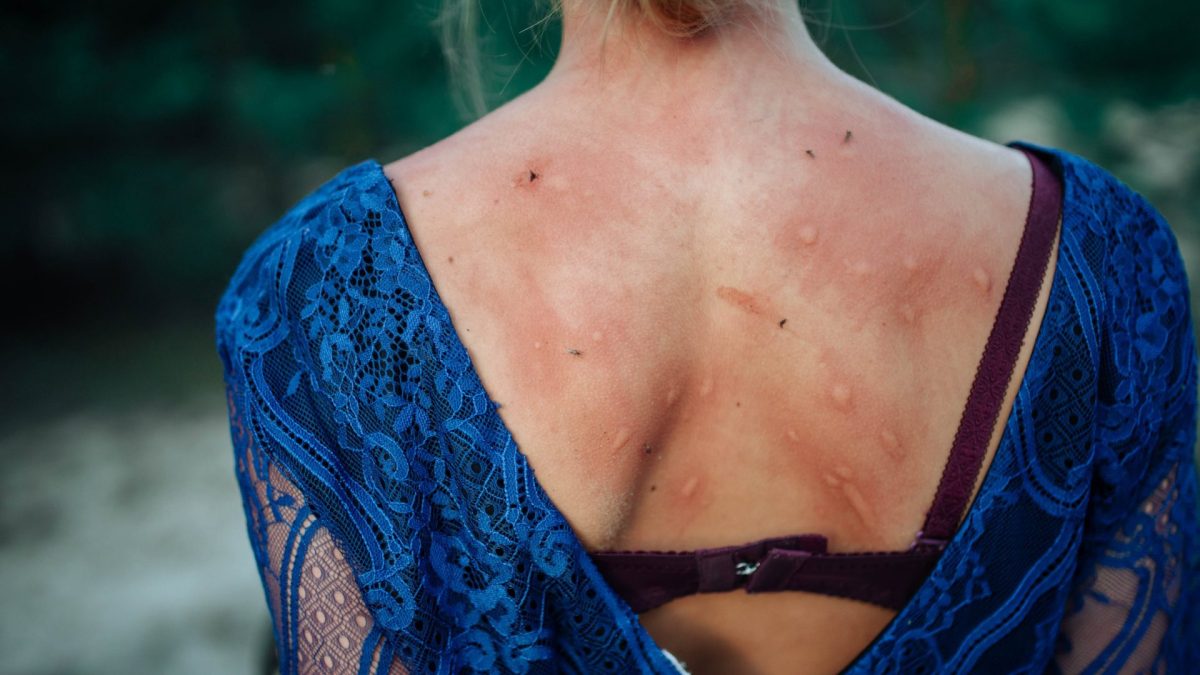
Picture this: you’ve woken up during your first night on holiday somewhere hot. While you were sleeping you had started to itch at a small, hot mark on your shoulder. As you wake yourself up with your scratching, the mark blooms and swells to quadruple the size, resembling a continent. Before long it’s taking everything in your power to not rip your own arm off to relieve the constant, throbbing itch. You eventually fall asleep again but when you wake in the morning and putter into the kitchen you can still sense this angry, swollen beast on your shoulder. Another has popped up, under your elbow and, weirdly, on your forehead. But by the coffee machine, looking well-rested, is your friend who shared your room. As you lament the onslaught from mosquitoes, your friend looks at you, shrugs, and says: “I don’t really get bitten – you must just be delicious to them.” Mosquito bites can be a major irritation – and in certain regions of the world, raises the risk of tropical diseases such as Zika virus and malaria. If you are such a person who has been dealing with these massively itchy, verging on painful annoyances on your summer holidays – or indeed at home in the UK – you’ve probably asked yourself more than once: “Why me?!” “The question about why some people get bitten more than others has been asked for as long as people have not only been studying mosquitoes, but being bitten by them,” explains Heather Ferguson from The Royal Entomological Society, a professor of infectious disease ecology at the University of Glasgow. “Today we have some clues why it happens, but we don’t have the entire picture figured out.” Shorts She explains what we currently know about what affects your relative appeal to a mosquito and crucially what we can do about it. Your genes may play a role The disparity in mosquito bites is not an imagined problem: there are several factors that seem to coalesce and result in it. “20 per cent of the population get 80 per cent of the exposure. Of course, this doesn’t apply across every insect or every disease, but it’s a general concept that the risk of being exposed to mosquitoes or disease or whatever is rarely spread evenly across the population.” One of the postulated theories is that your biteability is genetically determined, but there is no established, clear-cut genetic signal at the moment, says Ferguson. She points out that even in genetically linked groups like families, you will see big variations in how often people are being bitten. “It will play a role, but the jury is out on how much genetics contribute to the variation we see”, she adds. “There is conflicting evidence about blood type too. Blood type is something that has been posited as a reason for a long time, and while some have argued it plays a big role, other studies haven’t completely confirmed that.” In other words, your blood type may play a role but it is not necessarily the whole story or even provably significant yet. Feeling hot and sweaty What we do know is that mosquitoes are really attracted to heat and carbon dioxide. “These are both things that we give off when we breathe and when we live, and we know that people who are bigger often attract more mosquitoes than others,” she says. This is because larger bodies have more mass and living tissue – they will typically produce more heat and require a higher baseline metabolic rate to function at rest. However, this is not inherently a question of your BMI: “If you look at the differences between adults and children, adults will get bitten more. If you are bigger in any way you are simply giving off more heat and a greater CO2 signal.” This emission of heat intermingles with the chemical cues that our body gives off, as well as our skin microbiome. “There are a range of different chemical cues that our bodies give off,” Heather says, “including several different ones that we know can play a very big role in mosquito attraction. Octenol, for example.” This is a compound that is formed through the breakdown of fatty acids in the blood which is expelled via our lungs as breath, or through the skin as body odour. It then follows that the more heat you emit, the more you may potentially sweat too, increasing your emissions. “We also suspect that the skin microbiome, the composition of bacteria that live on your skin, probably plays a big role,” she adds. “This is not disease or dirtiness, but a natural part of people’s physiology.” Your unique microbiome make-up is affected by genes, diet, lifestyle or even personal products that you use, she says. However, “we’re not at the point yet where we can say one food or one soap is better or worse for mosquitoes. If we were, someone would be making a lot of money.” The expert guide to protecting yourself Annoyingly, we don’t yet know of any definitive ways we can make ourselves less attractive to mosquitoes – though it’s not for lack of trying. “People have investigated so many different things,” Heather says. “There’s even one study where someone tried to see if drinking beer would affect it. Unfortunately, I think the researchers just got drunk and didn’t notice anything.” Instead, Heather recommends sticking to repellents – and only the ones that are tried and true. “There’s a lot of folk myths around things that repel that are not necessarily true, like if you eat lots of garlic you can keep the mosquitoes away. There is no clear evidence of that – it might just keep other people away. “Most of the things that actually work you can already access, like Deet at a good chemist. Some people don’t like using it but I wear it if I don’t want to get malaria in Africa,” she adds. This includes brands like Jungle Formula and own brand versions from companies like Boots. Citronella candles can also play a role, as can wearing protective clothing. The key thing is to understand what kind of mosquitoes you might be dealing with, which will change depending on where you are. “Mosquitoes have very specific daily rhythms. The types of mosquitoes that spread malaria in Africa, for example, bite primarily at night during sleeping hours and inside houses. That is why bed nets work. “But in contrast, there are other mosquitoes that might not necessarily be carrying a disease which we call nuisance biters – they’ll attack you and bother you during the day. “There’s another group that will specifically bite around dawn and sunset. Hard to say why, might be because it’s cool enough, might be to do with us mating. There are certainly a lot of these in Europe.” The best thing to do is to ensure you’re protected at those times and that you understand the risks of where you’re visiting. We all get bitten – it’s our reactions that vary Finally, Heather has an additional caution for all those who think they aren’t tasty to mosquitoes. “One thing to add is that the people who think they get bitten the most often might not actually be the ones bitten the most often, they might just be the ones more likely to mount an allergic response. Two people might go out and get the same number of bites but only one will have lumpy bumps and itches. That person will know they’ve been bitten and know to wear repellent and take care, while the other might think they are off the hook. “That is a mistake! When I was living in Kenya for the first time I went weeks without getting tested for malaria because I was sure I hadn’t been bitten by a mosquito. But I had been, I just didn’t notice. You should always assume you might be bitten and always take sensible bite protection.”
I’m a mosquito expert – this is why some people get more bites
Full Article
Original Source
Read the full article at Inews →KhanList aggregates and links to publicly available news content. We do not host full articles from third-party sources. Always verify important information with original sources.