
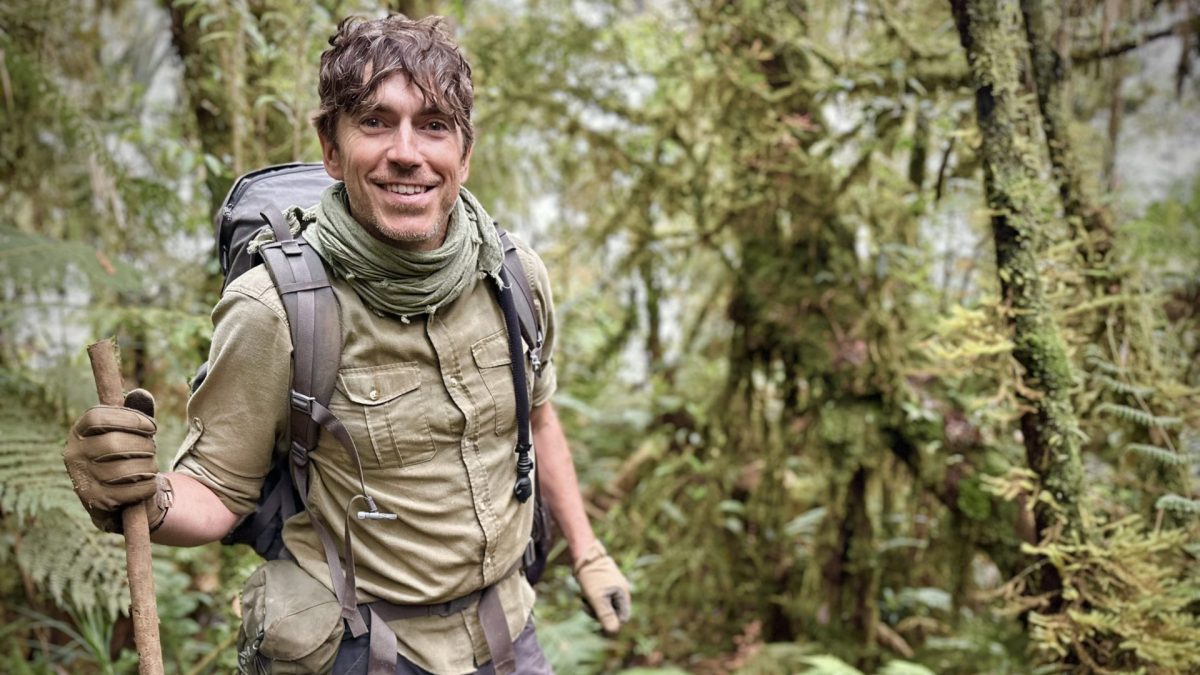
If you’ve never had the displeasure of finding a leech attached to one of your limbs, imagine a mahogany-coloured worm dancing like an inflatable tube man as it searches for the optimal spot to latch its blood-sucking end to. It’s one of the gruesome realities Simon Reeve faces in a Papua New Guinea jungle for his second BBC series of Wilderness. He is surveying the damage to his calf while 17-year-old, whisper-gentle tracker Marcus tenderly displays a writhing leech on his palm. Reeve swiftly tucks his trousers into his boots, sprays them liberally with repellent, then resumes the trek. Two years after the first outing of Wilderness to four of the most remote reaches of the planet, the 54-year-old presenter is back with a new series that begins on the world’s second biggest island, New Guinea. Shorts He also dives into the Sea of Cortez, tucked behind Baja California in Mexico, where he wakes at dawn, dressed in shirt and trousers, in a solitary tent on an uninhabited rocky islet (“I’ve always been really lucky that I can sleep almost anywhere”, he says). There are also expeditions to the Yukon in Canada’s far north and a 3,000-mile “slog” across Mongolia to see snow leopards, one if his personal highlights of the series. It is described as a love letter to parts of the earth most of us rarely reach. And if there’s a particular focus on seeking endangered wildlife, Reeve is keen to reinforce that it is “not my pitch for anyone’s job”, when the name Attenborough is suggested. “The story is really about the villagers and places.” Reeve goes in search of rare snow leopards in Mongolia (Photo: Jeff Wendorff/Getty) And yet in the remote Torricelli mountain range in northern Papua New Guinea, he’s trekking in a “wild rainforest of spectacular abundance little known to science” with local conservationist Caleb Bulu, on a mission to find one of the island’s rarest inhabitants. Residents of Mupun village have reported sightings of the critically endangered Tenkile, a species of tree kangaroo only found in these mountains. To try and see one, Reeve and his team must trek through dense jungle to the summit of Mount Sulen, where they have been spotted. It’s tough going. The initial drive to the start of the expedition in Mupun is thwarted by mud, forcing a five-hour forest trek carrying all the equipment to meet the villagers who will be hosting them. This series is every bit as tough as Wilderness expeditions for series one, when Reeve battled through the rainforest of the Congo and the ice fields of Patagonia. Working with the same team is important. He tells The i Paper: “it’s asking a lot. We’re filming 120-150 hours of footage across our different cameras, over three or so weeks. We’ve all got to push and pull in the same direction.” An integral part of that team is Si, a former Royal Marine medic who was responsible for cutting a burrowing jigger fly from one of the team’s feet during the first series in Congo. Trekking in the Torricelli Mountains, Si acknowledges, is one of the most challenging trips he’s undertaken. Snakes are a problem – the nearest hospital with antivenom is more than 24 hours away – but Reeve cautions that one of the most dangerous aspects of the trek is a simple fall: “Imagine a compound fracture here!” There are no recces, which he explains fosters authenticity. After making more than 100 programmes, he admits he is now “good at spotting interesting characters to bring stories to life, teasing out the warm welcome” he nearly always receives. This includes a “sing-sing” in Mupun, where what appears to be a hostile first encounter with weapon-wielding villagers is quickly revealed to be good-natured when Reeve clocks the smartphones villagers are filming him with, and curious smiles behind the screens. Marcus is one of the villagers accompanying him and Caleb on the trek to Mount Sulen. This little-known range is home to an astonishing 4 per cent of the planet’s biodiversity, and thousands of undiscovered species. Conservationist Caleb Bulu with Reeve and a green tree python (Photo: Rocio Lira Salas/The Garden/BBC) Caleb points out yellow-bellied frogs and thumb-sized flying insects as they walk, and Marcus unwraps a vivid green tree python from his wrist like an extravagant bangle for Reeve to try on.They make slow progress up and down valleys and gulleys, slogging up 45-degree muddy inclines, through rivers and dense foliage. “If you stop for a rest, the sweat bees come out to get you,” Reeve puffs. On day two, he despairs, “I can hardly hold the camera, let alone climb the slope” to the base of Mount Sulen. Soaked in sweat, rain and river water, they push on to build a base camp, where clothes are hung out in vain to dry under a tarpaulin. (“Putting on wet pants in the morning is not my favourite part of the day,” he half-jokes). At night, exhausted from the gruelling trekking, the team’s sleep is delayed by the emergence of thousands of insects, including “sci-fi” scale flying beetles and enormous moths. Preparing for these expeditions includes a routine of “dog walks with eight, 15 and 32kg weighted vests” at home in Devon. “I’m a bit of a lazy bastard but I can push myself”, he jokes. “I’ve got stamina, though I have started to need ear plugs and an eye mask. And I would quite like to microdose some Ozempic just to moderate my greedy lack of self-control,” he laughs. You wonder if he will have the strength to complete the punishing Papua New Guinea trek, but the sighting of some day-old Tenkile poo on a log renews the optimism the team needs to reach the 5,000ft summit of Mount Sulen. An endangered Tenkile tree-kangaroo (Photo: Getty) Taking the risk of setting off in darkness in the hope of encountering the creatures when they’re thought to be most active, there is beauty in the delight that Caleb displays at sunrise, “every time I (see it), I feel I am blessed”, he grins. It’s a crescendo moment that culminates with movement in the tree canopy and at the sight of a Tenkile’s bear-like face and big, glassy eyes, its striped tail hanging down from the tree. As soon as another emerges, prompting glistening-eyed smiles all round, the pair is gone, elusive and mysterious once again. So, was this a genuine wilderness experience? “Not really,” Reeve admits. “We’ve impacted everywhere in some way – plastic particles at the bottom of the deepest marine trenches, at the top of our tallest mountains.” There’s a sobering realisation on his descent from Mount Sulen when they survey a logging road cutting through the forest. A quarter of New Guinea’s rainforest has already been lost to logging and agriculture projects. “But we are part of nature, and we do belong in wild areas – we’ve always lived in those places,” he adds, optimistically. “And it’s locals who have the best chance of looking after them,” he says, acknowledging that 50 villages around the Torricelli mountains have joined an alliance to protect the threatened Tenkile from hunting and habitat depletion. “The planet is still exceptional and extraordinary – it’s still worth protecting and fighting for.” Series two of ‘Wilderness with Simon Reeve’ is on BBC Two, Sundays at 9pm and on iPlayer
‘I’m a lazy b*****d but I can push myself’: Simon Reeve on his tough new series
Full Article
Original Source
Read the full article at Inews →KhanList aggregates and links to publicly available news content. We do not host full articles from third-party sources. Always verify important information with original sources.