
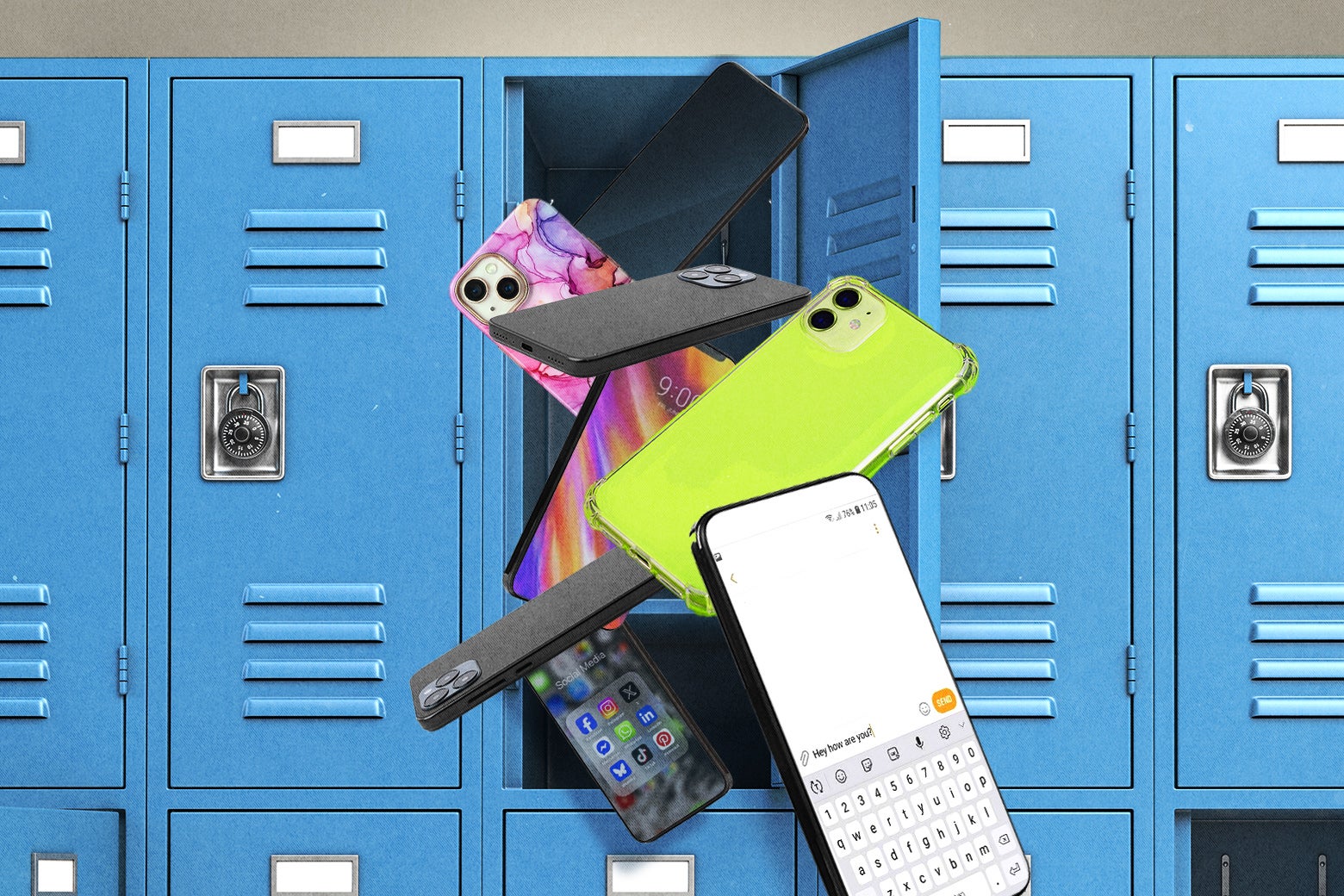
School I’m a High School Teacher. My District’s Phone Ban Didn’t Go Quite How I Expected. Students are required to leave their phones in their lockers. Pray for me. Photo illustration by Slate. Photos by Food Bro/Adobe Stock, iso100production/Adobe Stock, Liudmila Chernetska /iStock/Getty Images Plus, and Bet_Noire/Getty Images Plus. Sign up for the Slatest to get the most insightful analysis, criticism, and advice out there, delivered to your inbox daily. The first bell of the new school year rang at 7:15 a.m.: a reminder for kids to leave the commons, or the media center, or a hallway nook, and make their way to the first class of the day. On that morning of Aug. 27, the PA announcement that followed, though, was a bit different than in previous years. After the cursory welcome back from summer, students were reminded to put their cellphones in their lockers—and to leave them there until the school day ended or else risk a confiscation, then a phone call home, then detention, and, finally, in-school suspension. The new statewide policy had been whispered about for months, and here we finally were, device-free. I stood in the hallway. Newly arrived freshmen, as usual, weren’t sure where to go, their Chromebooks opened to a mysterious schedule of classes. I guided a few, hoping that my directions were both understandable and correct, and then closed my classroom door at the second bell: 7:20 a.m., AP Language. The first day of school is always quiet; the kids are a bit apprehensive. I’ve had some of their siblings; I’ve had others in study hall as underclassmen, dashing off passes to Ceramics or the cafeteria. Now, though, they were with me, in a challenging junior-year course with a notoriously difficult exam. My second-floor classroom has no windows and sparse decor. It’s both a point of minimalist pride and a joke; I’ll only hang student awards for our literary magazine, or their class-created posters of kindergarten photos, bemoaning that I could subject those poor young souls to my esoteric assignments. Otherwise, the room is plain, and rather quiet. Early in my career as a teacher, I learned that students will meet your good-natured silence. That morning, without phones—I hoped—we read from Don DeLillo’s White Noise: “There is an expressway beyond the backyard now, well below us, and at night as we settle into our brass bed the sparse traffic washes past, a remote and steady murmur around our sleep, as of dead souls babbling at the edge of a dream.” It started to rain. We are right under the roof, and the patter became heavy, followed by thunder. The projector shook. It all felt vaguely apocalyptic. In the final weeks of his second term, New Jersey Gov. Phil Murphy signed bill P.L. 2025, c. 195, which set as minimum guidelines that all districts in the state “prohibit non-academic use of an internet-enabled device on school grounds during the school day.” The state Department of Education offered districts clear reasoning: “unregulated” use of “cell phones and other internet-related devices” can “result in lower academic performance, harm to emotional well-being, and deterioration of a positive school climate.” State education decisions move at a glacial pace, and then all at once; districts, and their teachers, often have to scramble to implement new procedures. Although the cellphone ban was signed in January, districts throughout the state debated (and queried their boards and lawyers) for months. Ultimately, my district landed on a bell-to-bell ban. I teach at a small public high school in the northwestern corner of the state. We are surrounded by woods; we’ve been locked down several times because of bears on campus. Before students arrived this year, we had a pair of professional days: part teacher reunion, part mad dash to resuscitate our classrooms from their summer renovations. My principal, a 6-foot-5 former college football player who was born for the job, summed up the ban simply: Every school in the state was doing the same thing, so who would the kids even be texting? Parents could get in touch with students, and vice versa, through the main office—as they had done for decades. Teachers, he said, needed to lead by example: Don’t be on your phones. I was ready. I had a small moleskine notebook that had sat in a desk drawer at home for years, filled with errant notes and abandoned poems. I kept it in my pocket during those first few days of meetings and classroom prep, surreptitiously taking it out to jot down a thought or a plan. It took effort to train myself to unplug. My right hand would reach for my phone as a habitual break, like a phantom gesture. The notebook kept my thoughts focused. I was excited for the change, although I was never draconian about phones in the classroom. I liked the idea of teenagers learning self-control. Any instance of covert texting was a teachable moment, the opportunity for a lighthearted riff on our willing acceptance of a surveillance state. Yet perhaps I had been too idealistic over the years. I wondered about the students whose phones had become their companion and consolation. High school teaching is all about choosing one’s battles. Fairness often means weighing a student’s past and present, a gentle dance of policy and empathy. Perhaps I had been too lax with my approach, convincing myself it was an act of kindness. This change is hardly the first of its kind. In the late 1980s, school districts across the country banned beepers and other electronic devices; Baltimore schools defended the move as necessary for “good order and discipline.” Students had been distracted by technology long before then. In September 1961, according to the Lima Citizen, public school students in Youngstown, Ohio, “with transistor radios must leave them at home from now on because they annoy teachers and other pupils.” Twenty years before New Jersey dared to take phones from students, New York City put a citywide ban into action. Students and parents balked at the measure. With 9/11 in recent memory, parents claimed they needed to contact their children in times of crisis. Students, for their part, sneaked the phones through metal detectors by removing the battery. Once in school, some stuffed their phones in sandwich rolls to hide the devices. At the start of second period, my principal made a school announcement once again: All students were reminded to keep their phones in their lockers. A few more announcements followed that first day. Some teachers said they had to round up phones from the less than willing. Often phones were discovered, in an almost romantic touch, when outdated alarms would ring from their backpacks. Summer was truly over. “We are trying to erase two decades of behavior in 40 minutes,” the principal said. I have Period 4 hall duty on the first floor. Behind me, the gym thrums with noise. Basketballs rattle the doors. But otherwise the halls are quiet. Kids escape class to use the bathroom, red laminated passes dangling from lanyards, but they now walk without their phones. Absent devices, the kids move differently. They look ahead. They make eye contact. One senior comes to talk to me; he says the day has been slow. He wonders, almost wistfully, what kids will do with themselves without phones. By the final periods of the first day, the reminder announcements end. In the last few minutes of class, I asked the kids what they thought about the ban. One student said she was bored. We laughed; she clarified, for the good of truth or my own good, that she didn’t mean during class. The day felt like it was long, they told me. Another student said he was more in his head, and welcomed the introspection. As students drifted toward their buses, I heard a few teachers say versions of the same thing: Why did we ever allow phones in the classroom? The change was stressful, and then all of a sudden it wasn’t. In the days that followed, it was as if phones were never in the classroom. There will always be students who buck the system, and who will make the long walk to the main office to hand over their devices, but the digital tide has turned. In education—and other parts of our life—we worry that shifts will derail us. But once in a while, you get the opportunity to actually make a change that can reverberate. On my walk back to my car, I wondered again about my previous students—the ones who would have benefited from the ban, who perhaps could have eschewed the mindless games and the doomscrolling and the digital rumors. They would have been skeptical of the ban at first, but I think it would have been a blessing for them. Then I took out my phone. Education Smartphones Teens
I’m a High School Teacher. A Phone Ban Has Come to My School. The First Day Went Nothing Like What I Expected.
Full Article
Original Source
Read the full article at Slate →KhanList aggregates and links to publicly available news content. We do not host full articles from third-party sources. Always verify important information with original sources.