
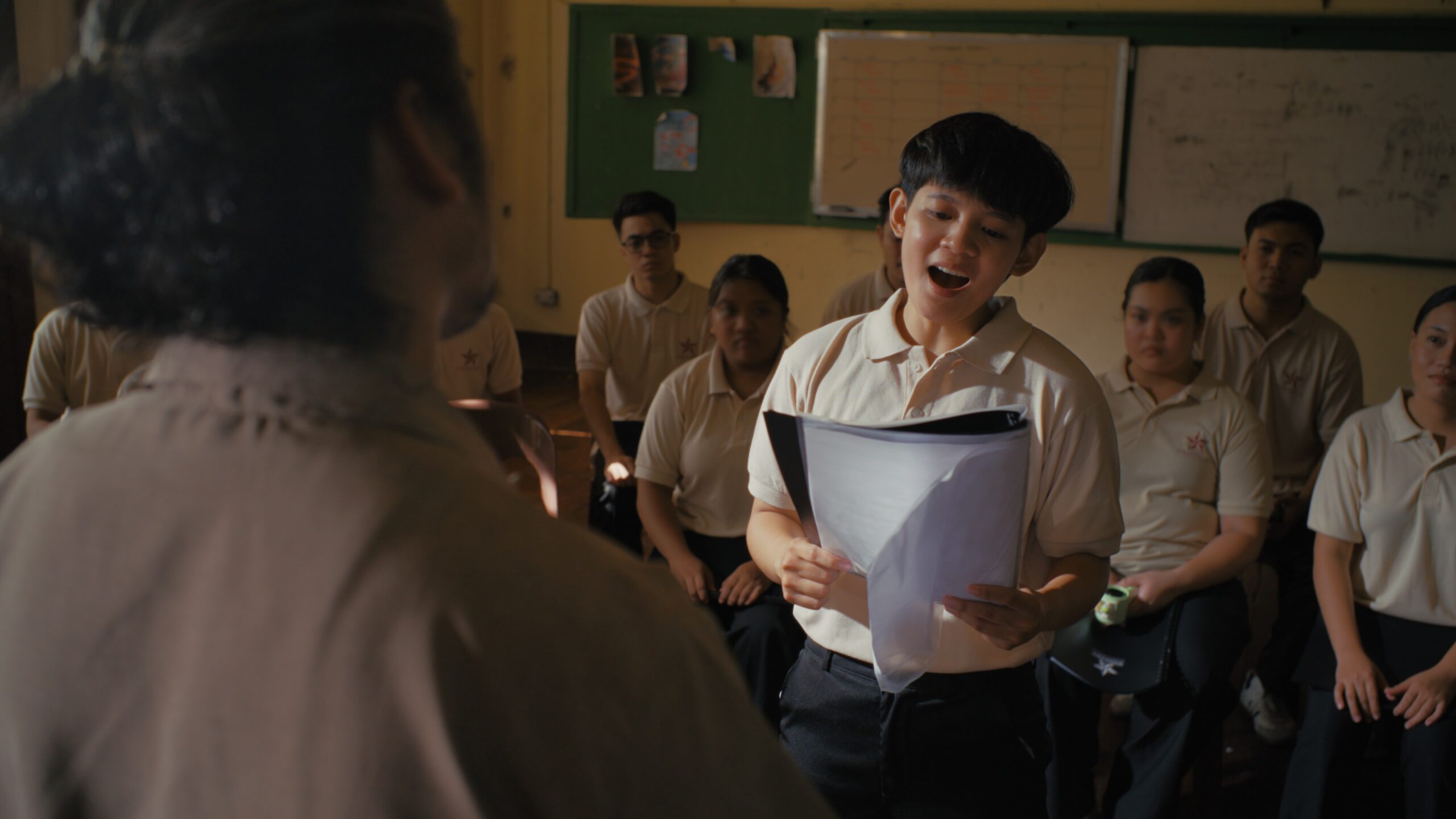
LAOAG CITY, Philippines – Eleven years ago, 24-year-old Ilokano filmmaker Ryand Angelo Ugalde was part of his high school choir. There, he saw the struggles of queers in musical groups and met another student who, like him, was struggling with his identity. Fast forward to 2026: Ryand co-wrote and directed a musical short film about identity and the hurdles queer people face, highlighting the experiences of his trans man friend, whom he sang with in junior high school. Ryand’s musical short film Piyesa(Piece) tells the story of a young Ilokano soprano, Kris — played by his real-life friend, fellow choir member, and 23-year-old trans man Nichole Ballesteros — who faces a dilemma about continuing hormone replacement therapy and preserving the voice that helps fund his studies. A still from ‘Piyesa,’ an Ilokano musical short film. Photo courtesy of YVR With the film picked as an official finalist in the 9th Sine Kabataan Film Lab and Film Festival this year, Ryand sees it as a love letter to his high school friend and to the trans community. Although he was a bit skeptical about pitching his story — feeling it should be told by a member of the trans man community — he made sure his film stayed true to Nichole’s experiences. Shared struggles As classmates in the vocal music program of the Special Program in the Arts at Ilocos Norte National High School (INNHS) in seventh grade, Ryand and Nichole saw the gender roles in the choir. As members of the INNHS’ Laoag City Children’s Choir and Samiweng Singers, both award-winning high school choir groups in the Philippines, they competed in the National Music Competitions for Young Artists and other national competitions together, eventually drawing closer as they support each other. INNHS youth choir poses for a group photo, taken on May 14, 2016, during its second US concert tour in Los Angeles. Photo by Tess Fernandez Palacio But Ryand noted that his time in the high school choir was difficult, as being openly gay made it hard for him to find a true sense of belonging. “During those years, I was also struggling with my voice because I was going through puberty,” he said in a mix of Filipino and English. Little did he know, his fellow choir member Nichole, who identified as a man, was experiencing the same struggle. “Actually, parang nabigla ako sa environment sa school. Parang mabutengak pelang ag-out idi,” Nichole shared. (Actually, I was overwhelmed by the high school environment. I was so scared coming out.) In the choir, they had a rule that girls couldn’t cut their hair and boys couldn’t grow it long. “So, we really could not alter anything about us…self-expression was very limited for us,” Ryand told Rappler. Nichole felt pressured to look like a woman, as a soprano in their choir, from seventh to 12th grade. “In our group, Nyocks (Nichole) was really…it’s safe to say that she is the powerhouse since she is a soprano,” Ryand said. Ninth grader Nichole shows off her attire for the 2018 NAMCYA held in Metro Manila. Photo courtesy of Nichole Ballesteros The two friends, though, drifted apart as Ryand transferred to another school in eighth grade. Since then, they have not been in the same choir. When Nichole entered college, he enrolled in the criminology program at Northwestern University and expressed his gender identity freely. There, he continued in the school choir, with a full scholarship from second to fourth year. While he fully accepted who he is in college, he still faced the same challenges in the tertiary choir as he did in high school. “Idi second-year-ak ket pangbabae talaga costumes ko. Tapos idi nag-fourth-year-ak ket in-try-ko sinaritaan ni conductor-mi if pwede ba akong magsuot ng panglalaki,” Nichole shared. (Since second year, all my costumes in the choir were for women. However, when I reached fourth year, I dared to ask my conductor if I could wear men’s clothes.) When he was granted permission to express his identity in his final year in college, he felt overjoyed, finally finding freedom to show his true self in their performances. Nichole (leftmost) poses with Saguday Chorale wearing his male choir costume in 2025. Photo courtesy of Nichole Ballesteros First acting gig Nichole’s story then further inspired Ryand to make a short film about their community when he was contemplating a concept in 2025. While struggling with his mental health during his first job after graduation, Ryand randomly saw a Facebook post by Nichole. This inspired him to conceptualize the story, drawing heavily on their past experiences in junior high school. Ryand kept his friend’s experiences in mind while writing the concept with his co-writer, Jodie Dantes. As a chorister in high school, the director knew how restrictive traditional choirs can be for queer people — forcing singers into rigid soprano, alto, or tenor roles based entirely on birth sex, leaving little room for fluid gender identities. ‘Piyesa’ production crew prepares for a shoot at San Agustin Church of Paoay. Photo by Dannah Erika Eclarin With the material in hand, Ryand reached out to Nichole about starring in Piyesa. Nichole accepted the lead role, bravely taking on his very first acting gig while simultaneously studying for the criminology licensure exam. Ryand and Yuan Amandy, his producer, then pitched the story to Sine Kabataan. It was selected as one of the finalists, receiving a P200,000 production grant from the Film Development Council of the Philippines this year. Starring alongside Nichole in the short film were members of the Nasudi Chorale of Mariano Marcos State University, a real-life collegiate choir group, as well as first-time actor Clarence Toledo, who portrays Ryand, the lead character’s friend. Gender roles Although he thought he could tell the story perfectly, Ryand experienced some hurdles as he worked on the independent, regional film. While securing more financial backing proved difficult, Ryand found the creative challenge even greater: accurately capturing the unique struggles of trans individuals within the rigid structure of a choir in a short film format. Ryand also related the metaphor of the film’s premise to society. “Aren’t we all part of a choir in the society? We have gender roles; we are told to be like this, to be like that, to perform a certain way, to act a certain way,” he said. “Parang dapat alto ka lang, soprano ka lang, and kung anong dinidikta sa’yo ng society, yun ka lang dapat at yun yung susundin mo,” Ryand added. (The society dictates some roles; for instance, you should only be an alto, you are only a soprano, and you must follow it.) A still from ‘Piyesa,’ an Ilokano musical short film. Photo courtesy of YVR In producing the film, the Ilokano filmmaker made sure his representation of trans people was treated with sensitivity. Aside from Nichole, he interviewed other trans people to understand their individuality and unique difficulties in society. “Half of the direction was also coming from him (Nichole). I think, kasi nga…Hindi ko alam yung psyche ng mga trans men. Hindi ko alam kung paano sila mag-isip, gano’n,” Ryand told Rappler. (Half of the direction of the film was also coming from Nichole. The reason for this is that I do not know the psyche of trans men. I do not know how they think as individuals.) To ensure truthful representation, Ryand took on a consultative approach, collaborating closely with the trans community, the actors, and the production crew. He would also usually ask Nichole what he would do when he experienced a certain situation. Nichole said he accepted the project since trans men are hardly featured in mainstream or independent films. Piyesa, he shtared, could be a way to tell more stories about them. “[Maysa kadagiti napadasak ket] tawagandaka ti basang uray tay appearance-mo ket [panglalake],” Nichole shared. (One of the experiences I have is being called a young lady even though I look like a man.) Off-screen, the first-time trans male actor has not fully come out to everyone close to him, including his own family. “Actually, diak inbagbaga kaniada [ti family’k] nga about trans man daytoy film-mi. Mabuyadan to lattan,” he shared. (Actually, I did not tell my family that our film is about trans men. They would only know once they watch it.) Ryand (center) with Nichole (left) and Clarence during their shoot at San Agustin Church of Paoay. Photo by Dannah Erika Eclarin If his family were ever to watch his film, Nichole hopes he will not receive any negative reactions from them. “Nagdakkel nga opportunity para kaniami a trans man detuy inubrana nga film. Tapos naging boses detuy film to represent the LGBTQIA+ community, especially sa mga trans man, trans woman,” Nichole shared. (This film is a great opportunity for us trans people. This can be used as a voice to represent the LGBTQIA+ community, especially the trans men and trans women.) ‘World still not kind’ Most of Ryand’s short films center on the victories, trials, and unique narratives of the Ilokano queer community. For him, telling local stories is important to shifting negative perceptions in conservative regions. It also fills the gap, he said, in a local film landscape that lacks diverse queer representation. “When no one tells their story, no one would listen; nothing will change as to how society treats us, because even if the world is progressing, unfortunately, the world is still not kind enough for all of us,” Ryand added. “In the end, this is not just Nichole’s story,” he said. “It is a found story, shaped by years of witnessing him and understanding too late what he was going through, while still singing beside him.” – Rappler.com
Ilokano filmmaker spotlights real-life queer choir stories
Full Article
Original Source
Read the full article at Rappler →KhanList aggregates and links to publicly available news content. We do not host full articles from third-party sources. Always verify important information with original sources.