
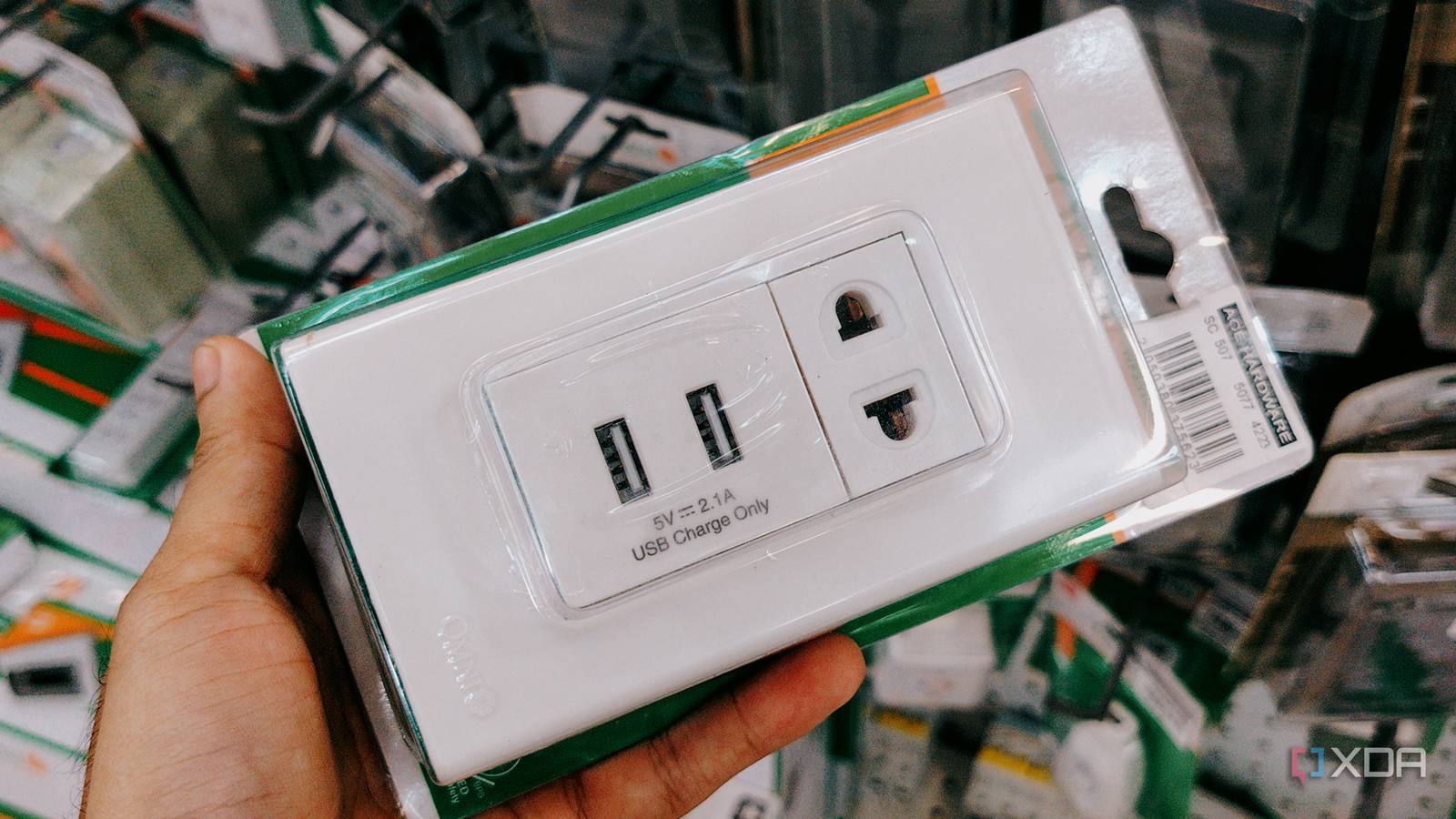
Published Sep 16, 2026, 2:30 PM EDT Jhet has gamified his life as a skill collector. He has skills ranging from woodworking and leatherwork all the way to CAD and electronics. He loves optimizing and customizing his experience with his stuff; fixing, modifying, and optimizing them to fit his needs. He has previously written for MakeUseOf.com and showcases his projects on his TikTok and YouTube channels. He is also an avid PC gamer with over 4000 hours in various FPS games and aim trainers. More and more devices in the home require USB power these days; that probably means having powered USB ports right on the wall provides a major convenience, right? I used to think that, but I realized it's not worth swapping to. USB wall outlets sound great, until you actually use them They're underpowered, take up an outlet slot, and don't last long If you charge your devices through an outlet near your bed and thought that it would be great to replace those bulky power bricks with a USB wall outlet, you should seriously reconsider. Most devices charge using at least 20W and often more. iPhones and iPads usually come with a 20W power brick; even Apple Watches fast-charge at 20W. USB wall outlets are commonly only 15W, or 5V/3A; some even only 12W, or 5V/2.4A. You'd usually only find those specs on sketchy generic power bricks you'd find at an airport. My Android phone fast-charges its 6600mAh battery at 66W. At 15W, it would take almost three hours to fully charge, whereas with fast charging, I can charge it to 80% in minutes. 5V/3A chargers have been outdated for years, and replacing a power brick with a USB wall outlet is a serious downgrade. If you install one of these on your wall, you'd have to sacrifice at least one socket to get maybe two weak USB ports. Even with GaN technology, there’s just not much space in a standard wall outlet to fit a powerful power adapter. You're basically turning one multipurpose socket into a permanent, cheap power adapter — and as cheap power adapters go, they break quite easily. While I returned my USB wall outlet after realizing it was a mistake, many have lived with one long enough to see it break, and it didn't take long. People on various home improvement and electrical forums have had plenty to say about USB wall outlets failing prematurely, even with minimal use. This may be because they're stuck on the wall and can be tugged roughly. A power brick would easily just unplug or shift slightly, whereas a USB wall outlet would not budge, potentially even breaking cables. Where USB wall outlets could be useful Low-power devices still exist I have a few USB-powered devices that don't leave their place: a lamp, my cats’ water fountain, and a camera battery charger. Oddly enough, the lamp doesn't accept USB-C PD chargers; it likes good old USB-A and only needs 5V/1.5A to function. I rarely remove that power brick to plug something else into it, making it a candidate for a USB wall outlet. However, I do occasionally use that outlet for something else, and I'd still like the flexibility of a regular outlet in those cases. My cats’ water fountain, on the other hand, is one that rarely gets unplugged. It only needs 5V/1A, and it comes with a cheap power brick, so a USB wall outlet might even be a very slight upgrade. Though I am worried about the wires getting tugged and breaking the outlet or the cable breaking. Replacing a whole outlet is more involved than just buying a new cheap power brick, assuming you don't already have one lying around; I have plenty. I do have one USB outlet I use regularly, but it's not on the wall. It's an extension cord under my desk for various devices, including a battery charger for my camera that I permanently attached to my desk. Its USB cable and the charger never go anywhere else; it doesn’t get unplugged often, nor does it get tugged with movement. It’s an ideal scenario, while also having five other normal outlets to plug into. Power bricks are just so much better You can’t go wrong with a dedicated power adapter There are so many great and affordable aftermarket power bricks these days from brands like Anker, UGreen, Baseus, and many more. I have a single 65W Anker power brick beside my bed that replaced all of my stock chargers: laptop, Steam Deck, and phone. Those devices all had bulky power bricks, but I easily replaced them with a single, denser, more compact GaN charger. Unlike a USB wall outlet, I can take it with me on trips, move it around the house, and charge more than just low-power devices. I rarely need to charge more than one device at a time, but if I do, more powerful multi-port power adapters can fast-charge multiple devices at once. Some multi-port power bricks can be very powerful, like the UGreen Nexode 500W; however, it is quite close to the literal size of a brick. Smaller 120-160W power adapters exist, like the UGreen Nexode Pro 160W, though, and they would easily charge my phone and my laptop at full speed. On my travels, I bring around an Anker PowerCore Fusion, a 5000mAh power bank that doubles as a 20W power brick; it’s not that powerful, but it’s very small considering what it can do. Even if you only need to power devices that don’t demand more than 15W, you can always find cheap power bricks that do the job; even multi-port ones to power multiple devices while only using one socket. It’s way easier and more affordable than replacing a whole outlet. USB wall outlets are rarely worth it, if at all Until charging technology can get so small that a 60W USB power adapter can fit inside a standard outlet while still having space for two or three sockets, I’ll always find it hard to justify Anker 140W Charger Input USB-C x3, USB-A x1 Maximum Power 140W Charging Ports 4 ports The Anker 140W 4-port GaN charger replaces multiple chargers in one small package while only using one outlet slot. It features a power usage display so you know how many more devices you can charge at the same time.
I’ll never install USB wall outlets in my home, and there are good reasons why
Full Article
Original Source
Read the full article at Xda-developers →KhanList aggregates and links to publicly available news content. We do not host full articles from third-party sources. Always verify important information with original sources.