
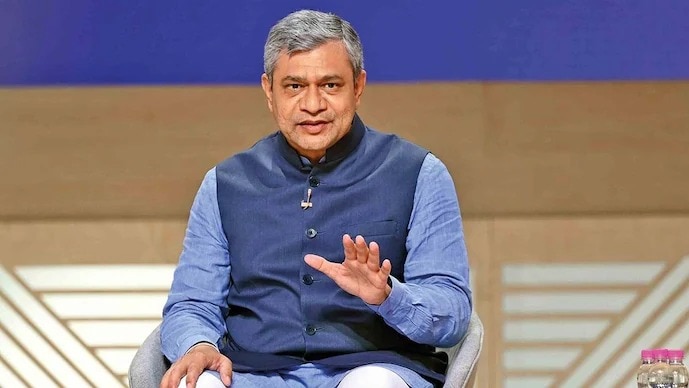
Ashwini Vaishnaw's journey to the Union Cabinet passed through engineering, the civil services, corporate leadership and entrepreneurship. He wore many coats before finally entering politics, and today, those experiences converge in his role as Railway Minister, where he is steering projects such as India's ambitious bullet train programme.You know Ashwini Vaishnaw as India's Railway Minister and as the minister handling Electronics and Information Technology and Information and Broadcasting. But his journey to the Union Cabinet began much before politics, moving through engineering, civil services, management, corporate leadership and entrepreneurship.His academic and professional path is less conventional than a straight climb up one career ladder. He graduated in Electronics and Communications Engineering from MBM Engineering College in Jodhpur in 1991 and later completed an M.Tech in Industrial Management and Engineering from IIT Kanpur.In 1994, he cleared the UPSC Civil Services examination with an All India Rank of 27 and joined the Indian Administrative Service.What followed was a career that moved between government and business before bringing him back to public life. FROM IIT KANPUR TO THE CIVIL SERVICESAfter joining the Odisha cadre of the IAS, Vaishnaw worked in the state administration and served as the District Collector of Balasore and Cuttack. His experience in Odisha came at a time when technology and data were beginning to play a larger role in administration.He later moved to Delhi and joined the Prime Minister's Office under former Prime Minister Atal Bihari Vajpayee. He worked as a Deputy Secretary and was later appointed Vajpayee's private secretary. His work in the PMO included involvement in developing the public-private partnership framework for infrastructure projects. The move from district administration to the PMO gave him exposure to policy-making at both the ground and central levels.FROM GOVERNMENT TO WHARTONVaishnaw's next move was not deeper into government but towards management education.In 2008, he went to the US to pursue an MBA from the Wharton School of the University of Pennsylvania. The decision came after years in administration and added a business and finance perspective to his engineering and public-sector experience.After completing the MBA, he returned to India and joined GE Transportation as Managing Director. He later moved to Siemens, where he served as Vice President for Locomotives and Head of Urban Infrastructure Strategy.His corporate experience was followed by another transition — entrepreneurship. In 2012, he established Three Tee Auto Logistics and Vee Gee Auto Components in Gujarat.The sequence is notable: engineering, administration, policy, management, corporate leadership and business ownership.FROM ENTREPRENEUR TO PARLIAMENTVaishnaw eventually moved into politics. He entered the Rajya Sabha in 2019 as a member representing Odisha. In 2021, he joined the Union Cabinet and took charge of the Railways and Information Technology portfolios. He currently handles Railways, Electronics and Information Technology, and Information and Broadcasting.That combination of portfolios places technology, infrastructure, communications and media under his watch.It also brings together several parts of his earlier career. His engineering background connects with electronics and technology. His administrative experience comes into play in running a large public system such as the Railways. His MBA and corporate experience provide exposure to management and business. His time in the PMO gave him experience of policy and government decision-making.Vaishnaw also has spoken about his early interest in semiconductors and recalled working on technology projects during his M.Tech at IIT Kanpur. In a recent conversation with Arm, he described working on a project involving a transformer for text-to-sound and developing a database management system because existing systems could not handle sound as a data element.Decades later, semiconductors, electronics manufacturing, artificial intelligence and digital infrastructure have become central to India's technology policy.As Railway Minister, he is also associated with projects involving railway modernisation, including the Kavach automatic train protection system and the Mumbai-Ahmedabad high-speed rail project.His technology portfolio has placed him at the centre of India's semiconductor and electronics manufacturing push.Today, the IIT Kanpur alumnus sits at the intersection of technology, infrastructure, business and public policy. The institutions he studied at — and the workplaces he moved through — are different, but together they form a career that has moved repeatedly between learning, administration and execution.- EndsPublished By: Rishab ChauhanPublished On: Sep 3, 2026 16:36 IST
IIT, UPSC, Wharton and Politics: The many classrooms of Ashwini Vaishnaw
Full Article
Original Source
Read the full article at Indiatoday →KhanList aggregates and links to publicly available news content. We do not host full articles from third-party sources. Always verify important information with original sources.