
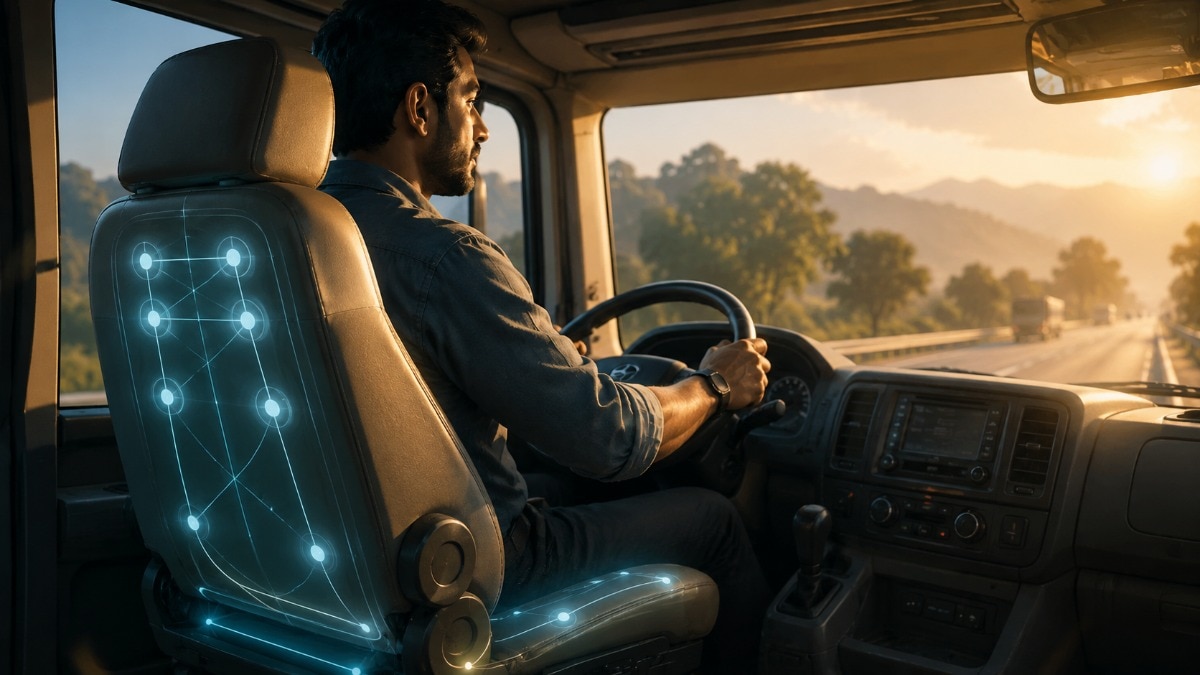
Scientists at IIT Madras have built the IntelliSeat, a smart driver's seat that senses fatigue from the way a person sits and warns them before a crash. Here is how the wireless seat works, the science of muscle fatigue behind it, and why it could make India's roads safer.A tired driver is one of the deadliest things on an Indian road. Scientists at IIT Madras built a seat that senses fatigue from the way you sit, and warns you through light, sound and vibration before it is too late. (Photo: India Today)There is an hour, somewhere past midnight, when the highway empties and the mind begins to fold in on itself. The eyes grow heavy, the road narrows to a tunnel, and a driver who has been awake too long starts to lose small pieces of the world without noticing they have gone.To catch that precise moment, the instant tiredness first tips towards sleep, scientists at IIT Madras built a chair that can feel it happening before the driver himself can. The IntelliSeat, developed by Prof. Venkatesh Balasubramanian's Rehabilitation Bioengineering Group with the seating company Harita, listens to the body through the way it sits, and speaks up before exhaustion becomes a crash.To the eye it is an ordinary driver's seat, unremarkable, the kind you would slide into without a second glance. Everything that makes it extraordinary is hidden inside the cushion.WHY ARE SO MANY INDIAN ROAD DEATHS LINKED TO TIRED DRIVERS?India's roads are among the deadliest on earth, and much of that sorrow traces back not to failing machines but to failing human beings. Data from the Ministry of Road Transport and Highways has long tied a large share of fatal crashes to human error, and fatigue sits near the heart of it. The men who move the country's goods and people often spend more than 10 hours a day at the wheel, and tiredness quietly hollows out the very skills that driving cannot do without.It is exactly the kind of everyday problem IIT Madras has turned its engineering towards. In conversation with India Today on the IIT Madras campus, where this report was put together, the institute's director, Prof. V. Kamakoti, spoke of a drive to build homegrown technology for India's hardest ordinary challenges. Prof. Venkatesh describes it as a slow tilting of scales. "The more I get fatigued, my resources deplete, but the task demand stays there or gets more complicated," he says. "So I start building shortcuts. I make mistakes, and that is how accidents happen." A weary brain does not merely slow. It begins, quietly, to gamble.HOW DOES A SEAT KNOW WHEN A DRIVER IS TIRED?Most systems that hunt for fatigue demand something of the driver, a band clamped to the head, electrodes taped to the skin, a camera staring at the face. The IntelliSeat asks for nothing, and that is its quiet genius."The purpose of the IntelliSeat is basically a seat designed in such a way that it takes all these principles and puts them in non-intrusively," Prof. Venkatesh says. "There is no electrode, there is no wire. Just sitting on a chair, we can detect various things that are happening." From sensors to alert: embedded sensors feed a processing engine that reads posture and fatigue, then warns the driver through light, sound and vibration. (Photo: IIT Madras via special arrangement) Sensors threaded through the seat's back and the base feel the driver's presence, his posture, the small restless shifts of a body growing tired, and from those alone the seat works out how far he has slipped.Beneath it lies a principle he returns to again and again. "There are two parts. There is the sensor, then the processing, then the actuation," he says. Feel the body, read the signal, then act. Billed at its launch as the world's first driver's seat to use the Internet of Things, the technology of everyday objects fitted with sensors that gather and share data, it turns a plain chair into something closer to a companion, watchful and awake.WHAT ACTUALLY CAUSES MUSCLE FATIGUE?To read tiredness, you must first understand it, and here the science is quietly beautiful. A muscle, the professor says, is no different from any material asked to work without rest. "Whether it is a metal rod or a muscle, everything gets fatigued if you keep doing the same activity repetitively."He is quick, too, to dissolve a myth most of us carry from a school classroom. "Lactic acid is not the reason it gets fatigued. Lactic acid is symptomatic," he says. The seat senses three things from the way a person sits: the driver's presence, their sitting behaviour, and the first signs of fatigue. (Photo: IIT Madras via special arrangement) The acid is the smoke, not the fire. What his group actually listens for is the faint electrical murmur a muscle makes as it works, read through a technique called surface electromyography, or sEMG, essentially eavesdropping on the signals that ripple through a contracting muscle.Follow that murmur in both its timing and its frequency, and the moment of fatigue reveals itself. His group's peer-reviewed research showed it plainly, tiredness gathering in the back and shoulders through long hours of driving, and the driver's weight settling differently into the seat as it did.WHAT HAPPENS WHEN THE SEAT SENSES DANGER?The seat does not panic at the first yawn. It escalates the way a good friend might: a murmur first, then a word, then a hand on the shoulder.At mild fatigue, a small light glows on the dashboard, a private nudge meant for the driver alone. At moderate fatigue, a sound joins the light, harder to wave away. And at severe fatigue, when the danger has teeth, the seat itself begins to tremble beneath him, a physical jolt laid over the light and the sound, and now the fleet owner is told as well. The IntelliSeat looks ordinary, but sensors built into the seat back and base read a driver's posture and movement, held in place by simple velcro straps. (Photo: IIT Madras via special arrangement) That last thread is the point. "As long as I detect it, I can act," Prof. Venkatesh says. "I can alert the driver, or I can tell the fleet owner, and the fleet owner can ask the driver to pull the vehicle over." The drowsy man is no longer left alone with his own tiredness.CAN IT BE FITTED INTO INDIA'S EXISTING TRUCKS AND BUSES?A safety idea is worth only as far as it can travel, and this one was built to spread. It runs independently of a vehicle's own computer, so it can be fitted into the lorries and buses already worn smooth by the road, without waiting for a new generation of them. From the turn of the ignition it begins to watch, feeding a mobile app that lets a fleet owner see every driver in real time, and quietly keeping the record.That memory has a second life, letting fleets find their dangerous routes, coach gentler habits, and press for kinder insurance. Harita, which supplies seating to some of the country's largest vehicle makers, built the IntelliSeat to scale into exactly the machines that carry us the furthest. Yet ask Prof. Venkatesh what moves him, and he does not start with sensors or fleets or figures. He starts with the person in the seat, a human being first, he insists, and a driver second.The IntelliSeat, in the end, is less a device than a promise, that the tired man at the wheel is worth watching over, and worth bringing home.- EndsPublished By: Radifah KabirPublished On: Aug 22, 2026 09:14 IST
IIT Madras built a car seat that knows when a driver is about to fall asleep. How does it work?
Full Article
Original Source
Read the full article at Indiatoday →KhanList aggregates and links to publicly available news content. We do not host full articles from third-party sources. Always verify important information with original sources.