
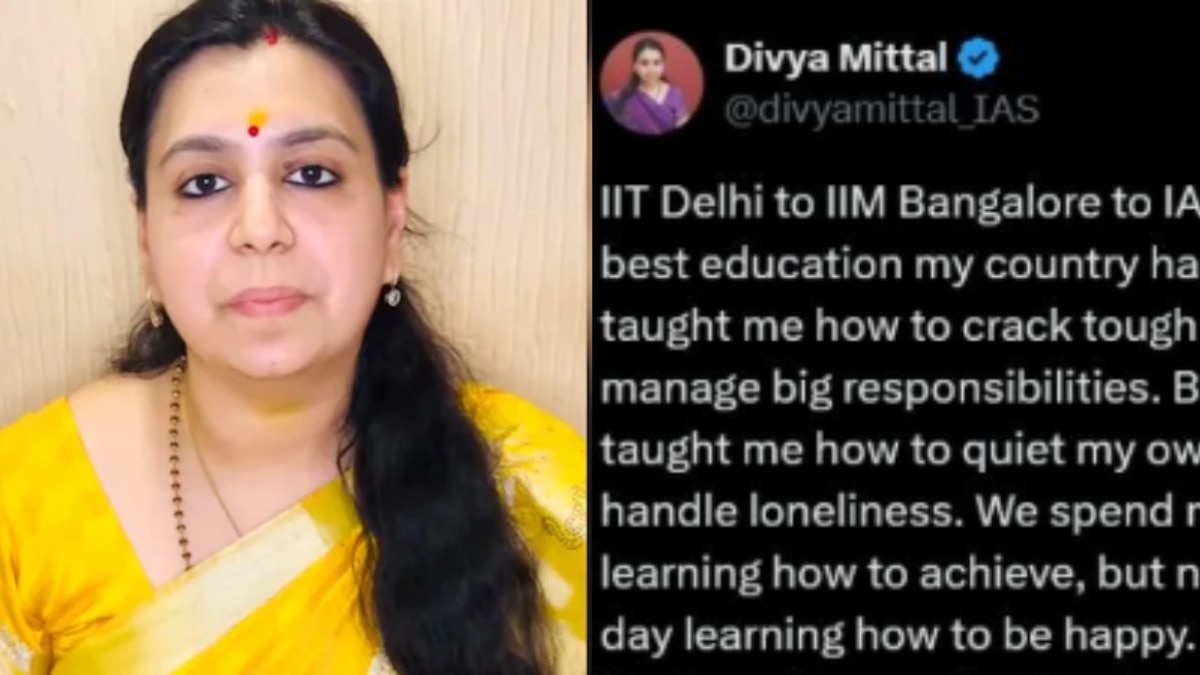
Divya Mittal said her IIT Delhi, IIM Bangalore and IAS journey never taught her to handle loneliness. She questioned the Indian education system and pointed out what we miss and why can't a student be taught how to be happy instead of everything else?Many of us believe that going to a good school, getting into a premier institute like an IIT, pursuing higher education and eventually securing one of India’s top jobs can solve most of life’s problems. We often look at education as a magic wand that can prepare us for everything. But what happens when all that education teaches us how to clear exams, take on responsibilities and build a career, but not how to deal with ourselves?That is where the questions of happiness, loneliness and emotional well-being begin.This is the question raised by former bureaucrat Divya Mittal, who studied at IIT Delhi, IIM Bangalore and later joined the IAS. In a post on X, she wrote, “IIT Delhi to IIM Bangalore to IAS. I got the best education my country had to offer. It taught me how to crack tough exams and manage big responsibilities. But it never taught me how to quiet my own mind or handle loneliness.”The statement is unsettling because it comes from someone who went through the very system that many Indian students are told will secure their future. WHEN ACADEMIC SUCCESS COMES WITHOUT EMOTIONAL SUPPORTFrom school examinations to entrance tests, from IITs and IIMs to competitive government examinations, students are often trained to keep moving towards the next target. But where in this journey do they learn how to handle failure, loneliness, anxiety or the pressure of constantly having to perform?Divya Mittal’s experience points to a gap that is often discussed only when a crisis occurs. Indian education has placed academic performance at the centre of student life, while mental health has largely remained outside the classroom. Academic pressure, competitive examinations and expectations from families can create an environment where students begin to measure their worth through marks, ranks and jobs.The numbers show why this cannot remain a personal issue. According to the Mental Health First Aid India report cited in discussions on student mental health, 7.3 per cent of children and adolescents in India live with a mental health disorder.Student suicides have also remained a serious concern. NCRB data has repeatedly shown students forming a major share of suicide cases, with academic pressure and examination-related concerns among the issues associated with student distress.The recent case at IIT Delhi has raised questions over the handling of such matters in India's premier institutes, where an MSc student died.A similar case has emerged at IISc Bengaluru, where two students have taken their own lives within 15 days.Who is to blame for the loss of such brilliant minds?Yet most schools and colleges do not have systems strong enough to identify students who may be struggling before their problems become a crisis. Counselling facilities are uneven, with better access often available in urban private institutions.POLICIES EXIST, BUT THE GAP LIES IN IMPLEMENTATIONGovernment schools, rural institutions and many public colleges continue to face shortages of trained professionals and basic infrastructure.The problem is not that India has no policy for this. The National Education Policy 2020 and UGC guidelines have placed greater emphasis on counselling and student well-being.Initiatives such as Manodarpan were also introduced to provide mental health support. But having a guideline and implementing it are two different things.A school cannot address student mental health simply by appointing a teacher as a counsellor or holding an awareness session once a year.Students need someone they can approach, privacy when they speak and a system that can connect them to professional help when required.This is where mental health education becomes important. Students should learn about emotions, stress, anxiety, failure and coping skills in the same way they learn other life skills.Programmes developed by institutions such as NIMHANS have focused on emotional awareness and stress management, while state initiatives such as Kerala’s Unarv programme have attempted to bring mental health promotion into schools.The larger challenge is changing what Indian education considers success. A student who gets a high rank but cannot handle loneliness is not necessarily failing, and a student who struggles academically is not necessarily without potential.Divya Mittal’s experience does not suggest that IIT, IIM or the IAS failed to give her an education. It points to something they were never designed to provide. The question is whether the system should now change that.Because if education prepares a student to solve difficult problems in the world but leaves them without the tools to understand their own mind, then perhaps the education is still incomplete.- EndsPublished By: Rishab ChauhanPublished On: Sep 1, 2026 14:52 IST
IIT, IIM, IAS to loneliness: Divya Mittal asks who teaches students to be happy
Full Article
Original Source
Read the full article at Indiatoday →KhanList aggregates and links to publicly available news content. We do not host full articles from third-party sources. Always verify important information with original sources.