
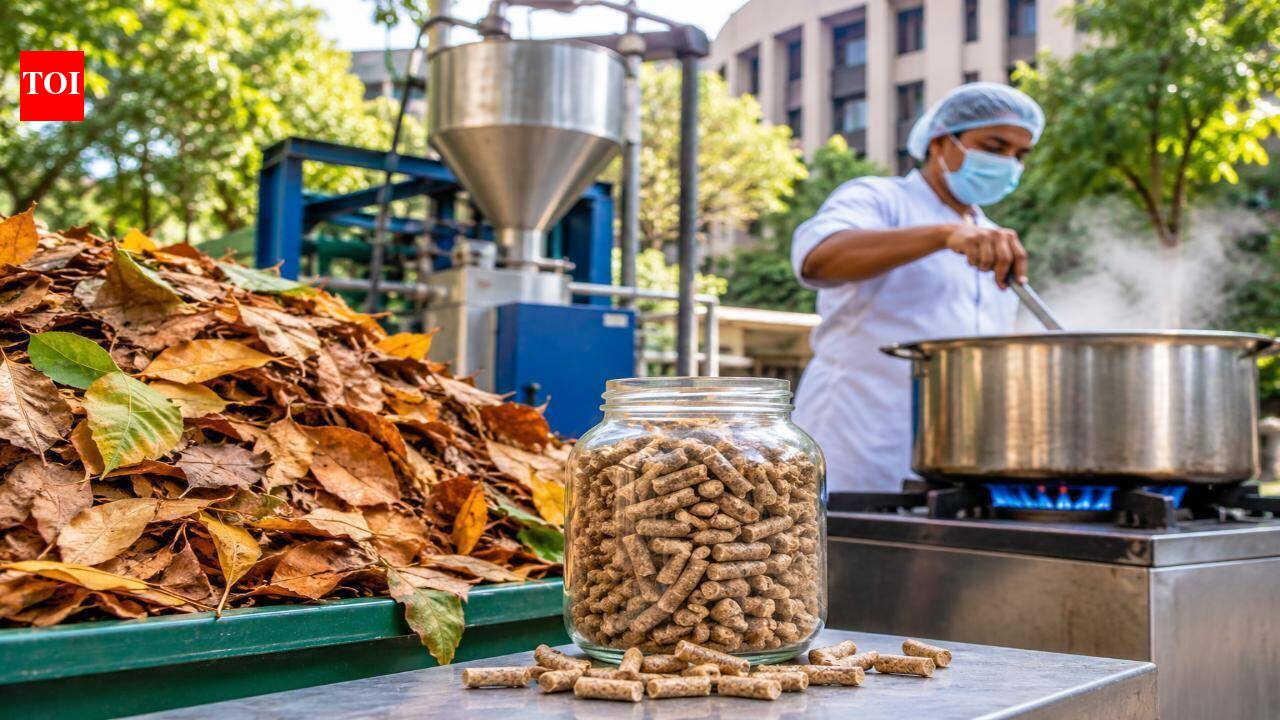
Sustainable Biomass Kitchen Scene (AI-Generated)Fallen leaves in the gardens are mostly treated as waste. They are often swept away and dumped. But at the Indian Institute of Technology (IIT) Bombay, fallen leaves and other garden waste that once cost the institute nearly Rs 50 lakh every year to transport and dispose of are being used as cooking fuel. Who would have thought! These leaves have found a second life and the institute is converting it into fuel pellets that help prepare meals for around 1,200 students, with the initiative reportedly reducing LPG consumption in one hostel kitchen by 60%.The initiative was recently highlighted by The Better India in a video. It shows how waste generated within a large educational campus can be put to productive use. According to the report, nearly two tonnes of garden waste are generated at IIT Bombay every day.How the campus waste is converted into fuelNow the process is pretty interesting and simple. First, the garden waste is collected, including leaves, twigs and other organic matter. These are processed into biomass pellets. These compact pellets can then be used as fuel instead of allowing the organic material to become part of the campus's daily disposal burden.IIT Bombay's Research Hub for Green Energy and Sustainability (GESH IITB) has documented the technology in its 2024-25 annual report. According to the report, the institute has a dedicated biomass pelletisation plant that can process up to two tonnes of material per shift per day.The cooking processThe report also records a calorific value of 16–18 MJ/Nm³ for the pellets, describing them as a greener alternative to LPG and other fossil fuels. The pellets were initially being used internally for cooking food at the staff canteen.Rather than simply burning the pellets, an in-house-developed downdraft gasifier converts the biomass into producer gas containing carbon monoxide, hydrogen and methane. This gas is then supplied to a premix burner, generating thermal energy that is used to produce steam for cooking.The men behind the projectAccording to GESH IITB, the project was initiated by professors Sandeep Kumar and Sanjay Mahajani under the name 'Gasifier-based cook-stoves to manage garden waste'. It received funding from the Tata Centre for Technology and Design (TCTD). The technology underwent several rounds of development, with researchers examining its environmental performance and experts assessing fire and operational safety before its deployment.The gasifier was installed at the staff canteen and began operating on February 26, 2025. A systematic study conducted over the following month recorded a reduction of 10 kg of LPG consumption per day.From the staff canteen to Hostel 16What began as a campus research initiative is now being extended to larger kitchens. The technology has been licensed to Infixen Energy Pvt. Ltd., an IIT Bombay-funded startup that is helping take the waste-to-fuel solution beyond its initial application.According to IIT Bombay's official alumni and institutional outreach platform, the technology was developed over several years. The idea originated in 2014 when Professor Sanjay Mahajani from the Department of Chemical Engineering began exploring biomass gasification to address the problem of campus waste.One of the major challenges was the behaviour of Indian biomass during combustion. Clinker formation, in which ash and other residues fuse into hard deposits, repeatedly clogged conventional gasification systems. Early trials also faced operational difficulties, including smoke in kitchens.Sustainable cooking (gesh.iitb.ac.in)A breakthrough came in 2016 when the team developed a patented gasifier that reduced clinker formation by nearly 100 times. Professor Sandeep Kumar from the Department of Energy Science and Engineering joined the initiative in 2017 and worked on improving the burner system.The technology is now being scaled to larger hostels, with Infixen Energy involved in its expansion. A video report by The Better India shows how the biomass pellets are being used in Hostel 16's kitchen to prepare meals for more than 1,200 students, reportedly reducing LPG consumption by 60%.The nearly Rs 50 lakh that the institute previously spent annually on transporting garden waste away can potentially be saved by finding a productive use for the material within the campus itself.At IIT Bombay, the leaves falling across the campus are no longer just part of the landscaping and cleaning routine. They are becoming part of the process that helps prepare thousands of meals, showing how a seemingly ordinary waste-management problem can be turned into an energy solution.
IIT Bombay turns fallen leaves into cooking fuel, cuts hostel LPG use by 60%
Full Article
Original Source
Read the full article at Timesofindia →KhanList aggregates and links to publicly available news content. We do not host full articles from third-party sources. Always verify important information with original sources.