
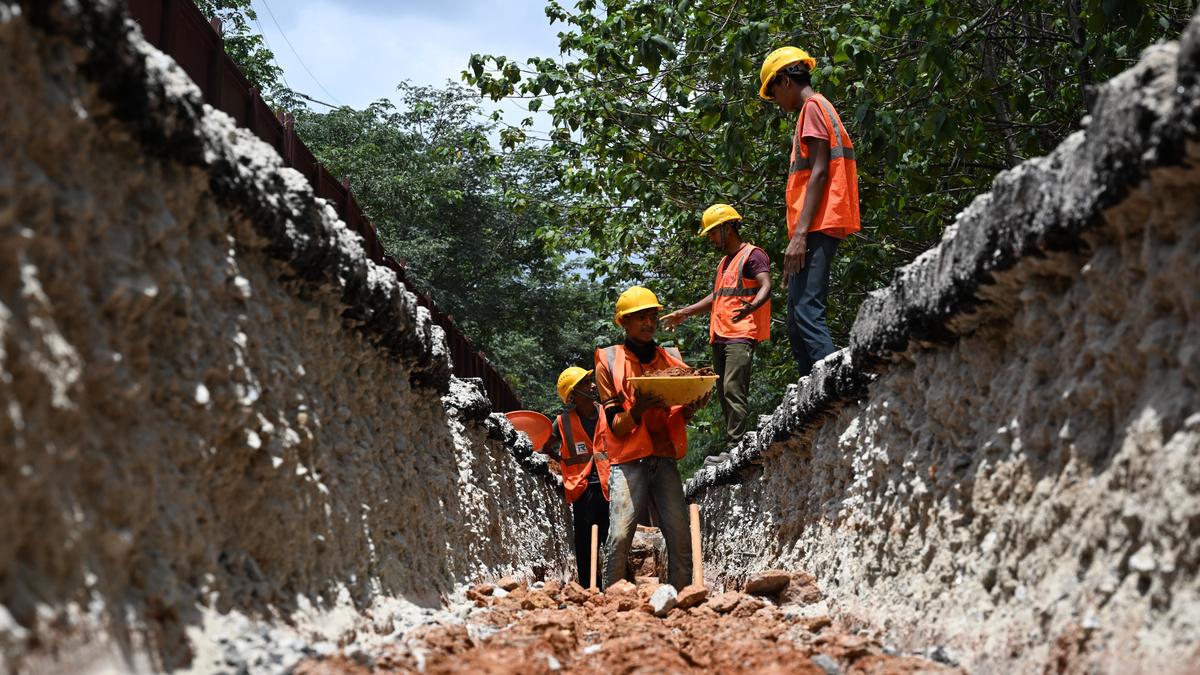
The IIT-B study said the tunnel and elevated corridor would complement each other and recommended the combined project. | Photo Credit: File photo An IIT Bombay study on the Hebbal short tunnel and elevated corridor has recommended building both projects, projecting faster traffic movement and lower delays if a major share of traffic shifts to the new infrastructure. The study, conducted by Archak Mittal for Rithwik Projects Private Limited, the BDA contractor for the short tunnel project, estimates that average peak-hour speed in 2027 could rise from 13.74 kmph on the existing road network to 20.64 kmph if 50% of traffic shifts to the tunnel and elevated corridor. At an 80% shift, it projects that the speed will rise to 22 kmph. The study tested traffic shifts of 50%, 60%, 70% and 80%, based on assumptions in the project DPRs. IISc disputes itThe study, however, was reviewed by the Sustainable Transportation Lab (IST) at the Indian Institute of Science (IISc), which termed it “biased in favour of building the two projects” and said there was “insufficient evidence” to support its recommendations. The IISc review questioned the basis for these traffic-shift assumptions. Ashish Verma, convener of the IISc IST Lab, said the report did not demonstrate how the figures were established through a robust route-assignment methodology and termed the 50% and 80% diversion levels “arbitrary”. The review also said the same diversion levels could not logically be applied to the tunnel and elevated corridor because their capacities are different as the tunnel has 3+3 lane capacity while the flyover has 2+2. The IIT-B report considered four scenarios — the existing road network, the elevated corridor, the tunnel and the combined flyover-and-tunnel option. The IISc review, however, noted that the detailed analysis presented in the report covered only the existing road network and the combined project. It said the individual effects of the tunnel and elevated corridor were therefore not evaluated, despite being among the study’s stated objectives. ‘Flyover and tunnel complement’Backing the project, the IIT-B study said the tunnel and elevated corridor would complement each other and recommended the combined project. If only one facility is taken up initially, it recommended prioritising the elevated corridor, followed by the tunnel as traffic demand grows. But Prof. Verma argued that the report did not provide enough details on how the model was built and tested and that much of the data used was taken from the Detailed Project Report (DPR) for the project, without independent verification. The review further said the IIT-B study did not explain how traffic volumes would change after the projects are built.Traffic channelisationThe IISc review said the IIT-B assessment largely covered the Mehkri Circle-Hebbal Junction stretch and did not adequately examine whether congestion and queues would spill over into other parts of the road network. It is pertinent to note that even the IIT-B study itself flags a possible new bottleneck if large volumes of traffic from the tunnel and elevated corridor are discharged onto the same downstream road. It recommends traffic channelisation and at least a 250-metre gap between the two structures. Pointing out that several traffic measures listed among the study’s objectives were not presented, Prof. Verma said travel time was reported for 2027 but not 2047, while delay was reported for 2047 but not 2027. He said the use of different measures for different scenarios made comparisons difficult and could lead to misleading interpretations of the projects’ performance. Prof. Verma lamented that the IIT-B assessment did not consider public transport alternatives or compare the environmental, ecological and road safety costs of the proposed infrastructure with the investment involved. Published - September 28, 2026 09:04 pm IST
IIT-B study backs Hebbal tunnel, flyover; IISc calls it ‘biased in favour of the project’
Full Article
Original Source
Read the full article at Thehindu →KhanList aggregates and links to publicly available news content. We do not host full articles from third-party sources. Always verify important information with original sources.