
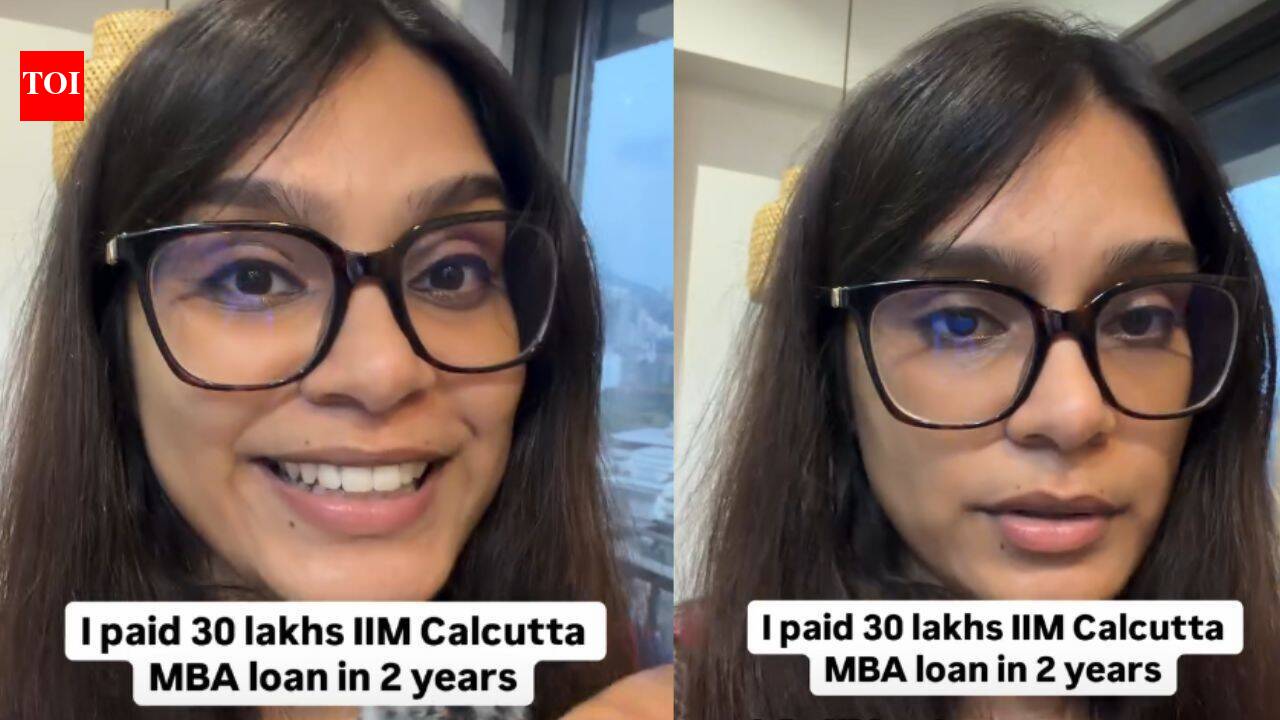
For many students, getting into a prestigious business school is only the beginning of a long financial journey. While an MBA can open doors to promising career opportunities, the education loan taken to fund it can remain a responsibility for years. But Avani Rathore, an alumna of IIM Calcutta, decided to approach her financial commitment differently.She managed to repay her entire Rs 30 lakh education loan within just two years of completing her MBA. Rather than relying entirely on her post-MBA salary, Rathore combined four sources of income, including savings from her previous job, internship earnings, part-time work and her full-time salary.Sharing her repayment journey on Instagram, she explained how small financial contributions made at different stages of her education and career helped her reach her goal. What makes her story particularly interesting is that she did not wait until she started earning a full-time salary to begin managing her debt.The first contribution came before she joined IIM CalcuttaRathore's repayment journey began even before she entered business school. She had worked for two years before pursuing her MBA, during which she managed to build personal savings. Instead of depending entirely on an education loan, she used a portion of the money she had accumulated to cover her course expenses. However, she was careful about the distinction between her readily available savings and her long-term investments.Explaining this in her Instagram post, she said, "Pre-MBA Savings: Before my MBA, I worked for two years. I didn't touch my investments (mutual funds, PPF, etc.) but used my liquid savings for my fee expenses." This gave her a financial cushion at the beginning of her MBA journey while allowing her to keep her investments intact.A BCG internship and part-time job added to her repayment fundHer second source of income came during her summer internship at Boston Consulting Group (BCG). The internship stipend provided an opportunity to set aside additional money towards her education expenses and loan. Rather than treating internship earnings as money available only for personal spending, she used them as another contribution towards reducing her financial burden.The third source came during the second year of her MBA. Rathore had already received a pre-placement offer (PPO), which allowed her to take up part-time work while continuing her studies. This meant she could start earning before formally graduating and joining her full-time role. The additional income helped her make further contributions towards her education loan. Her approach involved using every available earning opportunity instead of waiting for one major salary package to resolve the entire financial commitment.Her full-time salary helped her become debt-freeThe fourth and final source was her salary after completing the MBA. Rathore said that not having dependents gave her the flexibility to dedicate a significant portion of her earnings towards repaying the outstanding loan. She explained, "Post-MBA Salary: Fortunately, I don't have dependents, so I could dedicate a significant portion of my salary towards loan repayment after graduation."By combining money saved before business school with her internship stipend, part-time earnings and post-MBA salary, she managed to clear the Rs 30 lakh education loan within two years. However, Rathore acknowledged that repaying a loan so quickly may not necessarily be the most financially rewarding decision for everyone.Why she chose financial freedom over investing the moneyRathore understood that education loans can sometimes come with relatively favourable interest rates, making it possible for borrowers to continue paying their regular EMIs while investing surplus money elsewhere. She explained, "People might find this not to be a very good financial decision because you get a collateral-free loan at a very good interest rate."She added that borrowers could consider investing their additional money in avenues where the potential returns might be higher than the interest charged on their loans. But her decision was influenced by a different priority. She was planning to leave her job and explore a new professional opportunity. Having an outstanding loan and monthly EMIs was something she did not want to carry into that phase of her life.Explaining her reasoning, she said, "I did not want the headache of a loan because I was going to leave my job and wanted to start something new." She further added, "I just wanted to be better positioned to take further risks in my life." Her decision was therefore less about following a universal financial strategy and more about creating the freedom to make a career change without the pressure of an outstanding education loan.Her story sparks a debate on whether early loan repayment makes senseRathore's experience prompted mixed reactions on social media. While several users congratulated her for clearing such a substantial loan at a young age, others questioned whether repaying it early was the most effective way to manage money. One user commented, "Wow. So sorted and wise decision."Another person, who identified herself as a banker, appreciated her approach, writing, "As a banker, I must say it was a smart decision, since you plan to leave your current job to start something new. It is good to see a youngster who is this sorted out."Rathore's journey highlights that managing an education loan is not always about following a fixed repayment timeline. While investing surplus money may make financial sense in some situations, becoming debt-free can offer peace of mind and greater flexibility to pursue uncertain career opportunities. Her experience also shows how planning ahead, making use of different income sources and staying consistent with savings can help make a large financial commitment more manageable.
IIM Calcutta graduate reveals how she cleared Rs 30 lakh student loan in 2 years
Full Article
Original Source
Read the full article at Timesofindia →KhanList aggregates and links to publicly available news content. We do not host full articles from third-party sources. Always verify important information with original sources.