
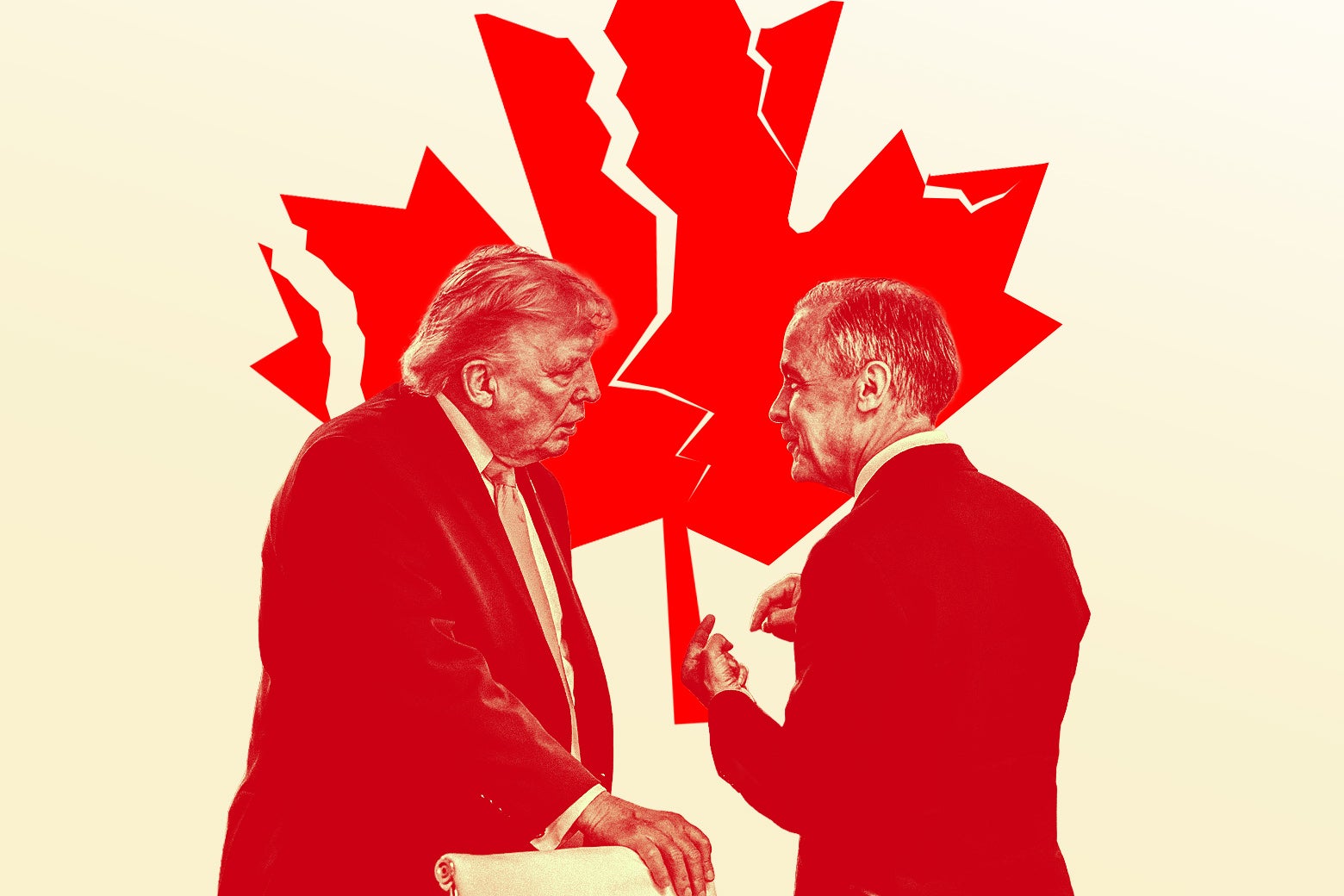
The Slatest If you enjoy Canadian fish, trucks, or home appliances, you’re in trouble. Photo illustration by Slate. Photos by Lentochka/Getty Images Plus and Evelyn Hockstein / POOL / AFP via Getty Images. This story is adapted from the Slatest newsletter. You can sign up here to get it in your inbox every day. Donald Trump’s trade war with Canada is back on in earnest. But if the first go-rounds last year were tragedy—depressing stocks, spiking prices, and rending hearts in both countries—the latest skirmish is starting to look more like farce. On Tuesday morning, Trump threatened to rechristen Lake Ontario (which straddles the U.S.–Canada border) to “Lake America” amid a tiff with the premier of the Canadian province with which the lake currently shares a name. Still, even trade wars waged for silly reasons can have real consequences. Today we’ll explain the latest developments, what they mean for your wallet, and their significance for the future of U.S.–Canada relations. Rewind! Last time you wrote about this, the U.S. and Canada were negotiating new trade terms. What changed? Good memory. Those talks ramped up last month, after the U.S. declined to renew the USMCA, a trade deal that includes the United States, Mexico, and Canada. Trump actually negotiated that deal in his first term, proclaiming it “truly fair and reciprocal,” but he has since demanded changes—hence the new talks with Canada. Those negotiations, though, collapsed late last week ahead of a Trump-imposed deadline. The USMCA remains in force for now, but the aborted talks leave many specifics in flux. Why did the talks fall apart? To answer that question, you have to meet a couple of the other dramatis personae in this particular farce. One of them is Canadian Prime Minister Mark Carney, who pulled his negotiators out of Washington on Friday after it became clear that a deal wasn’t in the offing. Carney did so after consulting with a fellow Canuck named Doug Ford, who leads Ontario, the province Trump insulted this morning. You might remember Ford’s younger brother Rob, the hard-drinking, drug-using, right-wing former Toronto mayor who died in 2016. Trump certainly does: On Monday, he referred to Doug as Rob’s “less charismatic, intelligent, and overall unimpressive brother.” But the elder Ford has clout because Ontario, which borders New York, Pennsylvania, and the Upper Midwest, accounts for the bulk of U.S.-Canadian trade—nearly half a trillion dollars annually as of 2023, which, if Ontario were a country, would make it the U.S.’s third-largest trading partner. Ford, who has called Trump a “dictator,” belongs to a different political party from Carney but has become a major force behind the prime minister’s decision to stand up to the U.S. The unresolved trade issues between the two sides, a list that is almost comical in both its breadth and specificity, suggests why Ford has so much pull. As reported by the New York Times, the hang-ups included U.S. tariffs on Ford F-450s and other heavy trucks produced in Ontario and the province’s ban on American liquor, which its stores stopped stocking last year during an earlier salvo in the trade war. “I deal with many countries, and Canada is easily the most difficult and unreasonable,” Trump groused after the talks collapsed. Ford says Trump can “kiss my ass.” Insults aside, what does all this mean for what I’m going to be paying for things, and which goods is the trade war hitting? Both prices and the number of goods affected are set to rise. (As a reminder, tariffs are additional taxes that businesses pay to import foreign goods, but many of them pass along those costs to their customers in the form of higher prices.) Last week’s talks unfolded under the threat of new U.S. tariffs, which officially took effect at 12 a.m. Saturday in the form of 50 percent import duties on roughly $20 billion worth of Canadian products. Canada officially retaliated on Tuesday, after Trump mused about renaming Lake Ontario, announcing matching tariffs on about 700 U.S.-made products. They include steel, aluminum, clothing, smartphones and other electronics, fish, dishwashers, washing machines, and stoves. In dollar terms, the new tariffs still cover just a small fraction of what the two countries trade each year. But things could continue to spiral. On Monday, Trump pledged even higher tariffs on Canadian cars, trucks, and auto parts starting next year. Ford, meanwhile, has threatened to stop exporting critical minerals to the U.S. or to raise the price of the electricity that Michigan, Minnesota, and New York import from Ontario. OK, but wouldn’t that be bad for Trump? Last I checked, Americans really, really hate higher prices. The U.S. and Canadian economies are so closely linked that the tariffs will inevitably bring mutual pain. As the Times reported Monday, Trump’s latest import duties could cost Canada up to 90,000 jobs. But you’re right that the political toll might be more acute on this side of the border. Canadians largely back Carney’s efforts to stand up to Trump; polls show the prime minister’s approval ratings hovering around 60 percent. Ordinary Canadians have even boycotted U.S. products and avoided taking vacations here in solidarity. Most voters stateside, meanwhile, dislike Trump’s attacks on Canada—he has repeatedly talked about turning it into “the 51st state”—and are already mad at the president over persistent inflation and stubbornly high sticker prices. The midterm elections might prove to be Canada’s ace in the hole. Democrats look poised to capitalize on all the economic discontent, which threatens to sweep Trump’s party out of power in Washington. So why did he start this trade war in the first place?? Great question. Trump has accused Canada of allowing “massive” amounts of illegal fentanyl to flow across the border and of unfairly tariffing American farmers. (In fact, less than 1 percent of U.S. fentanyl seizures so far this year happened at the northern border, and almost all U.S. agricultural exports enter Canada duty-free.) The president is also fixated on America’s trade deficit, which is the dollar figure in goods that the U.S. exports to a particular country minus what it imports. In 2024, the deficit with Canada was $68 billion. “Canada has been ‘Ripping Off’ the U.S.A. for decades,” Trump wrote Tuesday morning. But that figure is driven mostly by U.S. imports of underpriced Canadian crude oil, CNN points out, and it exaggerates the imbalance because the U.S. also exported about $29 billion more in services to Canada than it imported that same year. Anyway, most economists don’t think America’s trade deficits are anything close to an economic emergency. And even if they were, picking a fight with one of our closest allies—geographically as well as geopolitically—seems like the wrong way to go about addressing it. Speaking of: All of this must be taking a toll on the U.S.-Canada relationship overall, no? Trump’s trade war is just one of the things making Canada reevaluate its historical closeness with the U.S. His efforts to undermine bulwarks of the American-led post–World War II international order—including NATO, of which Canada is a founding member—have led Carney to look to Europe and elsewhere for more reliable partners. But alliances can withstand a lot of friction—physical proximity alone probably makes a wholesale U.S.-Canada divorce impossible—and escalation isn’t guaranteed. Trump, Ford, and Carney have all previously backed down when the costs of the trade war threatened to get too high. Canada’s retaliatory tariffs aren’t set to take effect for another two weeks, leaving wiggle room for the two sides to reach a last-minute compromise. Still, one takeaway from the recently scuttled trade talks may be that negotiation can only get you so far with Trump. According to the Times, U.S. negotiators insisted that the president reserves the right to impose more tariffs on Canada in the future even if it did make a deal, prompting Carney to complain that America’s promises are sometimes “written in pencil” these days. Given that, it’s hard to picture the two sides striking a deal that’s durable enough to survive our president’s next fit of pique. And as the saying goes, with friends like these, who needs enemies? Tolga Akdoğan If the 9 to 5 (RIP Dolly Parton) has got you down, my colleagues have some ideas about how to enjoy the rest of your night. They recommend: A challenge to help you recapture a lost art: We’re in the middle of Party Like It’s 1996, Slate’s six-week time-travel challenge (via newsletter) to recapture the serendipity and deeper connection that came with socializing in a pre-smartphone era. This week, we’ve rolled out Challenge No. 3, and it’s going to require you to get a little bit vulnerable with your friends. (One millennial editor over here thinks it’s the hardest challenge of the series.) If you’re just finding out about the challenge now, it’s never too late to join! Anytime you sign up, you’ll trigger the series from the beginning: One challenge will land in your inbox each week for the following six weeks. Games that will indulge your ’90s nostalgia: In honor of Party Like It’s 1996, we’ve rolled out ’90s-themed editions of all of our games for Slate Plus members. You can see if you know more about the ’90s than our resident Gen Xer, play a crossword that includes references to Beanie Babies and Hummel figurines, and more. (If you’re not a member of Plus yet, right now you can get six months for $19.96. You’ll get even more Party Like It’s 1996 perks and unlock unlimited reading and ad-free podcasts.) Some absurd stories about dogs in the workplace: They’re cute. They’re cuddly. They’re everyone’s favorite workplace perk. They’re also often the engines of pure, unadulterated office hell. Alison Green solicited reader anecdotes about how their dogs-at-work policies have played out and considers the issue from all angles. An improvement on the source material: HBO’s new show Lanterns takes a character with an embarrassing history and makes him fascinating. Sam Thielman considers how the series reimagines some of DC’s most ridiculous—and occasionally sublime—comics. OK, that’s it for me today. Enjoy the rest of your evening, and see you tomorrow!
Ignore the Childish Insults. Trump’s Latest Trade War With Canada Will Hurt Us All.
Full Article
Original Source
Read the full article at Slate →KhanList aggregates and links to publicly available news content. We do not host full articles from third-party sources. Always verify important information with original sources.