
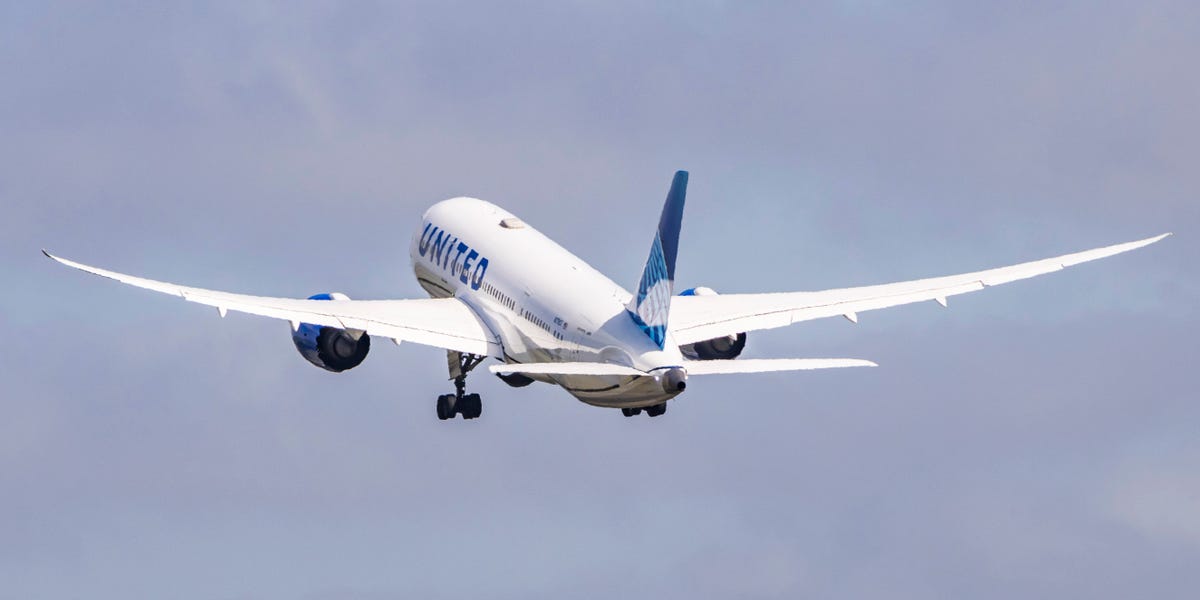
If you're catching a long-haul flight this week, get ready for some serious speed A United Airlines flight went over 760 mph as it crossed the Pacific on Monday. Nicolas Economou/NurPhoto via Getty Images Some international airline passengers are in luck this week as a supercharged jet stream helps flights land over an hour ahead of schedule.Numerous transpacific flights from Asia to the US clocked ground speeds around 750 miles per hour on Monday, according to data from Flightradar24.For example, United Airlines Flight 2, from Singapore to San Francisco, reached a ground speed of 767 miles per hour. That's 200mph faster than the Boeing 787's normal cruising speed, and equivalent to the speed of sound at sea level.Flight 2 touched down in California at 7:50 a.m. — 1 hour and 25 minutes before its scheduled arrival time.While airlines build padding into their timetables to absorb delays, there's still a sizable boost. The total flight time is 26 minutes faster than Sunday's flight, and an hour faster than Saturday's.However, the plane wasn't actually flying supersonic. Ground speed measures how fast it moves relative to the Earth, and this was propelled by the North Pacific jet stream.The North Pacific jet stream has since accelerated, too. It reached 246 miles per hour at typical cruising altitude on Tuesday morning, according to European weather data displayed by Windy.United Airlines Flight 876 from Tokyo reached a ground speed over 785 miles per hour as it crossed the ocean on Tuesday, per Flightradar24.For passengers flying from the US to Europe later in the week, the North Atlantic jet stream is also set to accelerate, with speeds of 200 miles per hour forecast for Saturday. However, the jet stream is further south than usual, below the flagship New York to London route, Guy Gratton, professor of aircraft test and evaluation at Cranfield University in England, told Business Insider.As of Tuesday, the jet stream is ideally positioned for flights from Florida to Spain."They are basically getting 150 miles an hour of free speed, which is absolutely brilliant from their viewpoint," Gratton said.By the weekend, the jet stream is forecast to move further north, boosting flights from Washington, DC, and the Carolinas to northern Europe. And as the jet stream is an ideal place to fly, air traffic control can help re-route airplanes."Things are much more flexible than they used to be, so you're going to see captains and operations departments asking for specific routes to take best advantage of the speed," Gratton said. "Apart from anything else, that keeps the fuel burn down and makes the flights cheaper."It isn't going to be plain sailing for everyone, though.Gratton pointed out that the jet stream is forecast to be split rather than a continuous current."I would think that you probably are going to see more turbulence in those regions where you're crossing the edges of the jet stream," he said. Read next Business Insider tells the innovative stories you want to know Business Insider tells the innovative stories you want to know Business Insider tells the innovative stories you want to know Business Insider tells the innovative stories you want to know Pete Syme is an aviation reporter for Business Insider, based in London.He writes about all things related to the industry, from aviation safety and CEO interviews to route reveals and airplane tours. Pete also uses data for industry analyses and to visualize breaking news events.Before joining Business Insider in 2022, he graduated with an MA in Newspaper Journalism from City, University of London, and a BA in English from the University of Exeter. Aviation Airlines United Airlines More Travel
If you're catching a long-haul flight this week, get ready for some serious speed
Full Article
Original Source
Read the full article at Businessinsider →KhanList aggregates and links to publicly available news content. We do not host full articles from third-party sources. Always verify important information with original sources.