
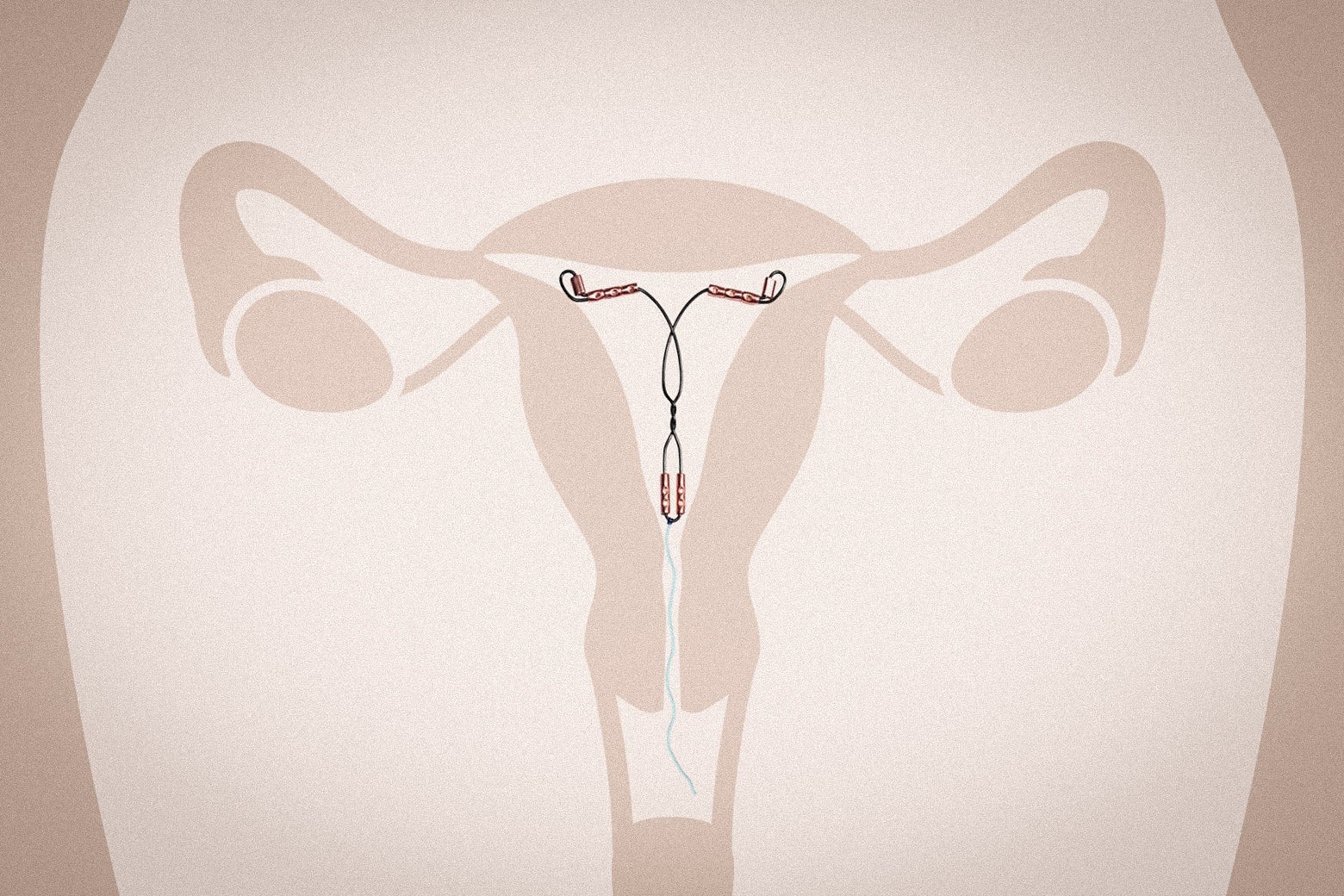
Medical Examiner Finally, a New Kind of Copper IUD There are so few options for long-acting birth control in the U.S. that some women go to Canada to get them. Photo illustration by Slate. Photos by Miudella and Adobe Stock. Sign up for the Slatest to get the most insightful analysis, criticism, and advice out there, delivered to your inbox daily. Vanessa was searching for birth control, but she was coming up short. She’d used a Mirena IUD in her early 20s, but she’d found the device to be uncomfortable—perhaps too large for her uterus. Vanessa also has a genital pain condition that some hormonal contraceptives exacerbate, so she was looking for a nonhormonal option. There were shockingly few available. In fact, because she wanted a longer-acting contraceptive, there was only one: the Paragard copper IUD, a device approved by the Food and Drug Administration in 1984. The Paragard, though, wasn’t right either; it struck her as too large and rigid, its sharp-looking right angles testament to a decades-old design. Would its shape be uncomfortable for her body? It was impossible to say. The research into the side effects of IUDs typically does not leave women with clear answers; they’re often left to troubleshoot for themselves. That’s exactly what Vanessa, who is in her early 30s and lives in California, did. Unsatisfied with the choices available in the States, Vanessa started searching for copper IUDs in Canada, a country that offers four nonhormonal devices, each in different sizes. The asymmetry of available methods regularly pushes American women across borders to get IUDs not offered in the U.S.; afterward, they share tips for clinics and itineraries with one another online. Vanessa wondered if that was a possibility for her. Then, she stumbled into welcome news. She learned that the FDA had recently approved a new copper IUD: the Miudella, the first copper IUD to be introduced in the U.S. in more than 40 years. The FDA approved the Miudella in February 2025, about a year before Vanessa stumbled across the device. The agency initially approved the IUD for up to three years of use; the company behind it has since petitioned the FDA to double its lifespan to up to six years. For women interested in nonhormonal contraception—an increasing share of contraceptive users—the device made a big promise: It would finally give them another option. But as Vanessa soon learned, the existence of the device was one thing. Her ability to get it was another. Two features initially attracted Vanessa to the Miudella. The first was its frame. The Paragard uses a plastic, T-shaped frame; copper wraps around the stem and arms. The stem of the Miudella IUD is shorter, and in the place of plastic, the IUD uses a material called nitinol, a metal alloy that combines nickel and titanium into a thin, flexible wire that twists to resemble the shape of a uterus. Vanessa is a scientist, and she was familiar with how the material is used in other medical devices, with its ability to bend and compress and then flex back into shape, contorting itself through complex physiological cavities. The second feature that impressed Vanessa was the amount of copper the IUD uses, and where the copper was placed: The Miudella employs less than half the copper of Paragard, but the copper itself was concentrated in cuffs on the bottom of the device, which would sit at the entrance to the uterus, and its arms, which would rest near the fallopian tubes. This placement of copper was strategic: If you could position spermicidal copper closer to the critical doors sperm must pass through to fertilize an egg, the idea goes, you can employ a more targeted approach to contraception. And if you reduce the quantity of copper, you will, as the research that’s been done so far suggests, also reduce the side effects associated with that copper, which drive many women like Vanessa away from the device and include heavy bleeding, cramping, and pain. “The Paragard design is an effort to essentially deliver as much copper as possible into the endometrial cavity, where you can mess with sperm,” said David Turok, an OB-GYN and professor at the University of Utah who conducted pharmaceutical-funded clinical studies on Miudella. “The approach with Miudella is to say, Hey, we don’t need all of that.” (So far, the Miudella and Paragard look to be similarly effective; both advertise effectiveness rates of around 99 percent.) Miudella’s novelty comes not just from the design of the device itself but also from the design of its inserter, the narrow tube that holds the IUD as it’s pushed through the cervix and to the upper wall of the uterus. To start, the IUD comes preloaded in the inserter, removing a step for the doctor charged with placing it. Perhaps more importantly, the inserter is thinner—a 3.7 mm diameter to Paragard’s 4.75—with a rounded tip designed to make pushing the tube through the nerve-dense cervix and into the uterus less painful. Many people find the experience of IUD insertion to be gut-twistingly painful, including Vanessa, who remembers the sensation of pain radiating through her body after the placement of Mirena, making it hard to get up from the exam table. Gynecological pain is so often neglected, and it’s a space where even small adjustments can represent an improvement. And so, eager to try the Miudella, Vanessa started calling doctors’ offices to schedule an appointment. She called Planned Parenthood clinics in her state, and across state lines. No one had it. Often, the person on the other side of the line hadn’t heard of the new IUD. As she played a game of telephone with the clinics, Vanessa ran into a complexity inherent to contraceptive research and development, itself a direly underfunded field. It’s one thing to get a medical product approved by the FDA, and a totally different matter to market, sell, and distribute that product across the U.S., getting it into doctors’ offices and, eventually, the bodies of the women who want it. To do the latter, you need sales power and distribution infrastructure, contacts in large hospital systems and insurers, and cash to spend. The Miudella was originally conceived by ContraMed, a small startup that developed and ran initial tests on the device (at the time, the company called it VeraCept). ContraMed and its novel IUD were then acquired by Sebela Pharmaceuticals, a midsize pharmaceutical company focused on gastroenterology and expanding its profile in women’s health. Sebela brought the device through Phase 3 clinical trials and FDA approval. But it wasn’t until earlier this year that Sebela sold the license to distribute and commercialize Miudella—at a price of $27.5 million, with additional future payments based on sales of the device—to the publicly traded pharmaceutical company Organon. Organon knows the market for long-acting reversible contraception well: It also owns the hormonal Nexplanon, the only contraceptive implant approved for use in the U.S., and the NuvaRing, a hormonal vaginal ring. Organon is now working on commercially launching the Miudella before the end of the year, which means that women can expect to start seeing the IUD in their doctors’ offices in the next couple of months, Juan Camilo Arjona Ferreira, Organon’s head of research and development and chief medical officer, told me. Already, the company is training providers to insert and remove the device through a special FDA-required program known as a Risk Evaluation and Mitigation Strategy. Still, once the IUD is commercially available, whether any particular patient can access it will depend on whether her provider has been through training (you can see a list of providers who have here), whether her clinic has stocked the device, and whether her insurance (if she has it) will cover the IUD. Guaranteeing insurance coverage is not an overnight process—while the Affordable Care Act requires the vast majority of insurers to cover at least one product in each contraceptive method category without cost-sharing (contraception is considered a preventive service), insurance companies have to add new products to their formularies one by one. “It’s not going to be available to everybody all at once,” Arjona Ferreira said of the Miudella rollout. Still: that the Miudella will soon be available at all is a reflection of many years of testing and development that culminated in a clinical study that enrolled more than 1,600 participants (including about 1,400 who could get pregnant). This study, which is currently winding down, has followed participants for up to eight years, tracking pain, bleeding, and frequency of intercourse in online surveys and regular visits with researchers; it’s through the lens of this data that we can begin to understand what it’s actually like to use the new IUD. In the first three months after insertion, for instance, 69 percent of participants experienced heavy bleeding, and 28 percent had pelvic discomfort. Bleeding lessened over time—in Months 3 to 6, 25 percent of participants experienced heavy bleeding, and by the fifth year, only 2.5 percent did, meaning that the bleeding and pain that may come along with the device appear to be less severe than that most often experienced with Paragard. A randomized trial that evaluated the Miudella alongside an IUD model functionally equivalent to the Paragard also found that the participants assigned Miudella were more likely to keep using their IUD. I spoke to one woman who enrolled in the Miudella clinical trial in 2018 and used the device for several years; she told me that though her period was initially a little heavier with the device (the copper IUD has an inflammatory effect in the uterus and increases menstrual bleeding and cramping), it evened out over time—overall, she was impressed by the IUD and disappointed when she had to remove it at the end of its lifespan. She had hoped the device would make its way from the clinical trial she participated in to the market much quicker. When it didn’t, she traveled to Canada to get another smaller IUD placed. Vanessa, for her part, has managed to find a provider who said they were working to stock the Miudella as soon as it was available. She scheduled an intake appointment. Health Medicine Research Women
If You Hate Your Birth Control, There’s a New Option That Might Be Worth Considering
Full Article
Original Source
Read the full article at Slate →KhanList aggregates and links to publicly available news content. We do not host full articles from third-party sources. Always verify important information with original sources.