
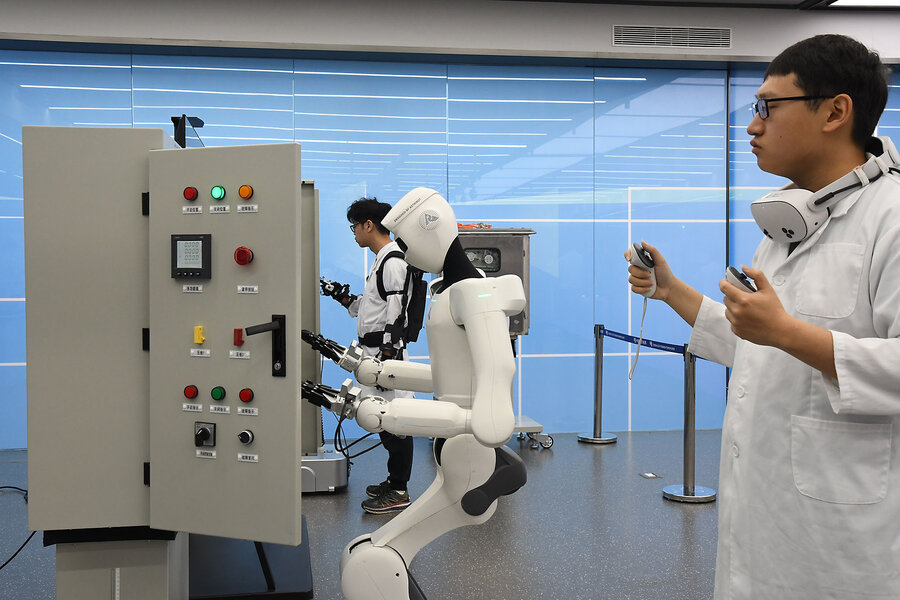
Zhang Jianxin watches shoppers fist-bump with a shiny, gyrating, humanoid robot at his showroom in China’s southern city of Guangzhou.“This is the future,” says Mr. Zhang, a technical director for the top-ranked Chinese robotics firm AgiBot, pointing at the 4-foot-tall mannequin, which is billed as friendly, agile, and intelligent.He then nods his head toward another shelf, holding a pedestrian, floor-scrubbing bot that looks like a wastebasket. “This,” he says, “is right now.” Why We Wrote This Many countries and companies are competing to be the first to achieve “artificial general intelligence,” a theoretical AI that can match or beat humans in any task. China hopes that putting AI in a body – by investing in humanoid robots – will give their developers an edge. China is betting big on humanoid robots, which the nation’s technology leaders see as key agents in the race to artificial general intelligence (AGI) – an AI system with human-level ability to reason and act. AgiBot’s charismatic X2 model is part of that push, and helped the company win more than a dozen gold medals at the World Humanoid Robot Games in Beijing this week.China’s strategy centers on a concept called “embodied AI,” where hardware such as robots, drones, and vehicles are integrated with artificial intelligence. Just as a human’s body facilitates learning, the idea is that these dynamic agents, by interacting with the physical environment, can achieve a more holistic kind of intelligence. In contrast, the United States and Europe are mainly relying upon large language models (LLMs) that draw on vast amounts of text data to try to produce AGI. Ann Scott Tyson/The Christian Science Monitor Zhang Jianxin, a technical director for the top-ranked Chinese robotics firm AgiBot, says humanoid robots are the future, in Guangzhou, China, April 15, 2026. “China believes you can only go so far with artificial intelligence if you are dealing only with text and other abstractions of language,” says William Hannas, lead analyst at the Center for Security and Emerging Technology at Georgetown University and co-author of a recent report on China’s embodied AI policy.China excels in hardwareChina has plenty of humanoid robots to work with. Its estimated 140 manufacturers dominate more than 90% of global sales. Shipments are expected to more than triple to 50,000 units this year, compared with roughly 13,000 last year, according to U.S. financial firm Morgan Stanley.Chinese buyers are snapping up the vast majority of those humanlike robots.“It’s a huge industry in China,” says Mr. Hannas. “They are eons ahead of us.”Still, even in China, humanoid robots have far to go, says Mr. Zhang, whose company shipped more humanoid robots – 9,700 – than any other manufacturer in the first half of this year, according to the Hong Kong-based Counterpoint Research.“We need AI technology improvements,” says Mr. Zhang. “The hardware is good – the software isn’t there yet.”Robots can help with that, too.The need for dataInside the headquarters of UBTech Robotics, one of China’s biggest humanoid robot firms, a silver-and-black mannequin picks up a box, stomps across the floor, and mechanically places the box on a shelf. It’s about 30% as efficient as a human worker, with the goal of reaching 50% this year – and every box helps. Ann Scott Tyson/The Christian Science Monitor Michael Tam, chief brand officer of UBTech, a Chinese humanoid robot manufacturer, introduces the company’s Walker robot, designed to operate in factories, in Shenzhen, China, April 16, 2026. Located in the heart of Shenzhen’s “robot valley” across the border from Hong Kong, UBTech is pioneering the mass production of humanoid robots for industrial use.Michael Tam, chief brand officer, says the company deployed more than 1,000 industry robots in factories last year. This year, the goal is 10,000. Each of those robots will collect much-needed data to design better, faster, more humanlike bots.Today’s data shortage, coupled with high training costs, constitutes “the biggest … bottleneck in the [humanoid robot] industry,” the state-run Xinhua News Agency reported last year.Mr. Tam agrees.“More human robots used in different industries means more data coming in,” he says, adding that physical data gathered by the robots is “crucial” to achieve AGI.“As the best forms of embodied AI, human robots would help collect data,” and that, in turn, would ultimately enable robot “brains” to “understand our real world,” he says.State-backed botsBeijing’s policymakers support this plan. In June, they issued a directive mandating that local authorities and state-owned firms test and incorporate embodied AI in manufacturing, logistics, retail, and other sectors of the economy.The government is also promoting large-scale “data collection factories” to boost AI models. Ann Scott Tyson/The Christian Science Monitor At China Southern Power Grid's Power Operation Data Collection Zone, human workers use remote-control devices to train robots and gather data necessary for the industry to advance, in Guangzhou, China, April 16, 2026. Sprawling facilities are springing up in cities and provinces across China – including Beijing, Shanghai, Wuhan, Tianjin, Anhui, and Fujian – as local governments and manufacturing firms join forces to train humanoid robots. These centers buy the robots, and human workers use controllers, cameras, and other tools to direct them in specific actions. They then sell whatever data they gather back to the manufacturers.It’s different from UBTech’s one-task-at-a-time approach to building more capable machines through clearly defined factory work such as box lifting. But these centers ultimately serve the same purpose: to gather the data necessary to push China toward AGI.China’s focus on humanoid robots and embodied AI still faces obstacles. The U.S. in July banned imports of new humanoid and quadruped (meaning four-legged) robots made in China and other foreign countries, citing national security threats.But the main hurdle is commercial, says Alan Fern, director of the Dynamic Robotics and AI Laboratory and professor of engineering at Oregon State University.Despite China’s significant investments, “there are tons of companies trying to stay alive” and many will likely fail, he says, especially given the risk of overproduction and price wars.So far, the business model for humanoid robots is “based on hope,” says Dr. Fern. But if China’s bots keep marching forward, he says, the effort might pay off.
If you give a bot a body: China’s ‘embodied’ push for AI dominance
Full Article
Original Source
Read the full article at Csmonitor →KhanList aggregates and links to publicly available news content. We do not host full articles from third-party sources. Always verify important information with original sources.