
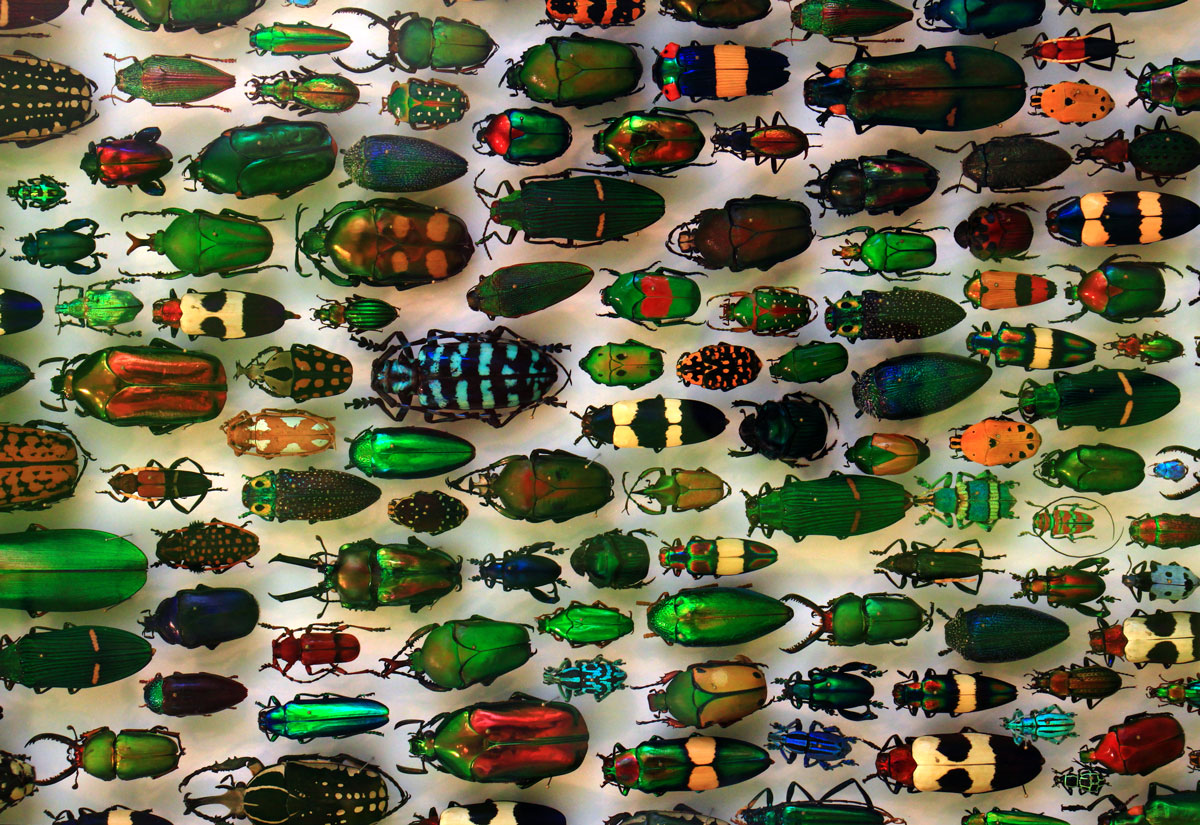
Insects are in steep decline from habitat loss, pesticides, invasive species, and a destabilizing climate, but it’s also hard to quantify what happens after disturbances like the floods we’ve seen lately — unless we begin counting them, a new op-ed argues.The scant research done on this has shown steep declines of up to 93% after flooding events, and this has a huge effect on everything that depends on insects, from plants to grazing animals.“To measure what a flood takes from an insect community, you need to know what was there first,” the author writes. “This is a solvable problem.”This article is a commentary. The views expressed are those of the author, not necessarily of Mongabay. Panchase Protected Forest, in the hills above Nepal’s second city of Pokhara, is known among botanists as an orchid haven. Hundreds of species grow there, many of them found nowhere else in Nepal. I have been working in Panchase for some time now, starting with the insects that live on mistletoes, trying to understand who is there, what they are doing, how they connect to the plants around them. It is slow, careful work and one of the things it has taught me is how little we know, not just about Panchase but about insects in Nepal generally. We do not have a proper picture of what is there. We are still, in many parts of this country, at the very beginning of asking the question. Nobody, for instance, has properly studied the pollinators of Panchase’s orchids. Those relationships exist, they have existed for thousands of years, but they are undocumented. We do not know which insects visit which flowers, which ones are essential, and which are incidental. That work is still ahead of us. Orchids like this large group growing on a tree in Nepal’s Panchase Forest need insects, too. This protected area is home to 142 orchid species from 52 genera. Image courtesy of Kumar Paudel/Greenhood Nepal. I think about this every monsoon season, when the rivers rise and the news fills with the same images: fields gone under, families on rooftops, roads washed away. The death tolls come in. The damage figures follow. And then, a few weeks later, the story moves on. Nobody reports what happened to the insects. Nobody goes back to check. I am a chemical ecologist who works with insects, and I have spent years fascinated by them. So when I watch a flood tear through a landscape, I think about what is being lost in ways we cannot even measure, because we never measured what was there to begin with. The clearest evidence of what floods do to insect communities comes from a study that almost did not happen. In 2015, a once-in-a-century flood hit south-central Oklahoma in the U.S. Researchers at the University of Oklahoma happened to have sampled the local insect and invertebrate community just three months before, in preparation for an unrelated experiment. When they came back afterward, three months later, then six months, then nine, what they found was a near-total collapse: 93% of individuals gone, 60% of species gone. The landscape had not recovered. It had become, in the lead researcher’s own words, a place with one cricket and one spider in every trap. Aerial photograph of flooding at the University of Oklahoma Biological Station with yearlong environmental variables from the surrounding area. For temperature and precipitation, black lines represent monthly averages from 1996 to 2015 with 95% confidence intervals represented by grey areas, red dashed lines represent values from 2015. Image courtesy of Roeder et al 2018. The soil fauna — the organisms that break down organic matter and return nutrients to the earth — had simply vanished. Dead vegetation piled up with nothing left to decompose it. Millipedes and isopods, which do most of that work, were still absent nine months after the event. The boundary between aboveground and belowground invertebrate life had been erased. That study is remarkable not because the findings were striking, but because it had data from before the disaster. That is almost unheard of. To measure what a flood takes from an insect community, you need to know what was there first. The Oklahoma researchers only knew because they happened to be in the right place at the right time. It was not by design. It was luck. The Oklahoma case turns out not to be unusual. A six-year study tracking insect communities across the Dalälven River floodplains in Sweden found the same pattern: nine of 18 insect taxa showed lower emergence during flood weeks, none showed higher, and the losses were never fully recovered between events. Each flood left the community a little poorer than before. From South America, a 20-year data set from a subtropical floodplain tells the same story across every major insect order — dragonflies, mayflies, caddisflies, true bugs — a long, slow decline driven in part by hydrological instability. Closer to home, studies from the Hindu Kush Himalayas show monsoon floods hitting stream macroinvertebrates particularly hard — the aquatic insects that freshwater ecologists rely on as indicators of river health. The geography changes, the result does not. Pleione praecox is a small, epiphytic orchid native to the Himalayas, China, and Southeast Asia. Image courtesy of Orchid Conservation Alliance. For those of us in South Asia, where the rivers connecting Nepal, India, and Bangladesh repeatedly produce some of the world’s most destructive floods, this is not a distant concern. These are our rivers. And we do not know what lives in them, or what we are losing every time they flood. Insects pollinate roughly three-quarters of the world’s major food crops, contributing somewhere between $235 billion and $577 billion of value to global agriculture each year. They decompose organic matter, cycle nutrients, and form the base of food webs for birds, bats, frogs, and fish. When a flood removes them from a landscape, it removes the functions they perform. Those functions do not pause while the community rebuilds. Not all insects come back at the same pace: non-biting midges and aquatic worms recover quickly; mayflies, stoneflies, and caddisflies, the species ecologists use as indicators of clean water, recover slowly if at all. What reassembles after a flood is a simplified, flattened version of what was there before. Now think about what this means in a place like Panchase, or anywhere in the mid-hills of Nepal. We do not have a baseline. We do not know which pollinators visit which orchids, which decomposers live in which soils, which aquatic insects inhabit which streams. When the monsoon floods come through — and they come every year, and increasingly they come harder and faster as the climate shifts — we have no way to measure what is taken. We just know the water rose, and then it fell, and things look a little different afterward, and we move on. Floods are not the only disaster doing this. In Nepal, wildfires have been getting harder to ignore, burning through mid-hill and highland forests in the dry months before the monsoon arrives. What fire does to insect communities is in many ways a mirror of what flooding does: it strips away habitat, kills soil fauna, and breaks the chains of interaction that hold an ecosystem together. And then the rains come. The soil that fire left bare and destabilized has no protection when the water arrives. The invertebrate communities that survived the fire have nowhere to go. We have almost no data on what happens to insects caught in that sequence, fire and then flood in the same landscape within the same year, because we were not watching before either event happened. No matter how tiny or cryptic, insects like this mantis nymph found at a seedling nursery outside Gunung Palung National Park in Indonesian Borneo play a huge role in the global environment. Image courtesy of Timothy Treuer. This is a solvable problem. Documenting insect communities does not require expensive equipment or large teams. It requires patience, consistency, and the decision to begin. You cannot protect what you have not described, and you cannot measure loss without knowing what was there. Across the Hindu Kush Himalayas, that baseline barely exists for insects. We need to be in these forests and rivers before the next disaster, recording what is there, building the foundation that will let us measure what is lost. In Panchase, we are trying to start that work with the mistletoe insects, and eventually with the orchid pollinators that nobody has yet described. It is a small beginning. But it is a beginning. Insects globally are in steep decline, described by researchers as a death by a thousand cuts from habitat loss, pesticides, invasive species, and a destabilizing climate. Floods are one more cut, intensifying as temperatures rise. The Dalälven study found that flooding covering even 40% of the growing season significantly suppresses most insect taxa. For pollinators, floods disrupt overwintering, nest establishment, and early-season foraging, and higher rainfall is already associated with lower native bee abundance at landscape scales. I understand why none of this makes the news. Insects are small. They do not have faces. The death of a rhinoceros in the Kaziranga floods at least registers as a loss people can feel. A 93% collapse in invertebrate abundance registers as nothing, because most people do not know the number was ever 100. But there is a real failure here, beyond public attention. Disaster response frameworks do not include invertebrate monitoring. Post-disaster assessments focus on trees, large animals, crops. The soil fauna, the aquatic insects, the pollinators are not in the ledger, so they are not in the recovery plan. Roads get rebuilt. Fields get replanted. Nobody asks what is left in the soil to make those fields work, or what is left flying to pollinate what grows in them. The orchids of Panchase are still blooming. The insects that pollinate them are still out there, doing their work in a forest that most people will never visit and no one has properly studied. I want to know who they are before the next flood takes them, and we find ourselves, once again, with no way to know what we lost. Prayan Pokharel is a researcher and science educator based in Kathmandu, whose doctoral thesis examined the physiological and ecological implications of toxin sequestration in herbivorous insects. Banner image: A tiny sampling of tropical beetle diversity displayed at the Staatliches Museum für Naturkunde Karlsruhe, Germany. Image by H. Zell/CC 3.0. See related coverage: The women keeping Uttarakhand’s native bees alive ‘You Belong with Me:’ Taylor Swift has a new genus of bug named after her Citations: Roeder, K. A., Roeder, D. V., & Kaspari, M. (2018). Disturbance mediates homogenization of above and belowground invertebrate communities. Environmental Entomology, 47(3), 545-550. doi:10.1093/ee/nvy022 Vinnersten, T. Z. P., Östman, Ö., Schäfer, M. L., & Lundström, J. O. (2014). Insect emergence in relation to floods in wet meadows and swamps in the river Dalälven floodplain. Bulletin of Entomological Research, 104(4), 453-461. doi:10.1017/s0007485314000078 Romero, G. Q., Moi, D. A., Nash, L. N., Antiqueira, P. A. P., Mormul, R. P., & Kratina, P. (2021). Pervasive decline of subtropical aquatic insects over 20 years driven by water transparency, non-native fish and stoichiometric imbalance. Biology Letters, 17(6). doi:10.1098/rsbl.2021.0137 Brewin, P. A., Buckton, S. T., & Ormerod, S. J. (2000). The seasonal dynamics and persistence of stream macroinvertebrates in Nepal: Do monsoon floods represent disturbance? Freshwater Biology, 44(4), 581-594. doi:10.1046/j.1365-2427.2000.00608.x Klein, A.-M., Vaissière, B. E., Cane, J. H., Steffan-Dewenter, I., Cunningham, S. A., Kremen, C., & Tscharntke, T. (2006). Importance of pollinators in changing landscapes for world crops. Proceedings of the Royal Society B: Biological Sciences, 274(1608), 303-313. doi:10.1098/rspb.2006.3721 Lautenbach, S., Seppelt, R., Liebscher, J., & Dormann, C. F. (2012). Spatial and temporal trends of global pollination benefit. PLOS ONE, 7(4), e35954. doi:10.1371/journal.pone.0035954 Bogan, M. T., & Lytle, D. A. (2011). Severe drought drives novel community trajectories in desert stream pools. Freshwater Biology, 56(10), 2070-2081. doi:10.1111/j.1365-2427.2011.02638.x Pokharel, P. (2026). Baseline first for insect conservation in the Hindu Kush Himalaya. Nature Reviews Biodiversity, 2(5), 290-290. doi:10.1038/s44358-026-00158-w Dirzo, R., Young, H. S., Galetti, M., Ceballos, G., Isaac, N. J., & Collen, B. (2014). Defaunation in the Anthropocene. Science, 345(6195), 401-406. doi:10.1126/science.1251817 Goulson, D., Nicholls, E., Botías, C., & Rotheray, E. L. (2015). Bee declines driven by combined stress from parasites, pesticides, and lack of flowers. Science, 347(6229). doi:10.1126/science.1255957 Hamblin, A. L., Youngsteadt, E., & Frank, S. D. (2018). Wild bee abundance declines with urban warming, regardless of floral density. Urban Ecosystems, 21(3), 419-428. doi:10.1007/s11252-018-0731-4 Credits Topics
If we don’t start counting insect populations, we won’t know what we’re losing (commentary)
Full Article
Original Source
Read the full article at News →KhanList aggregates and links to publicly available news content. We do not host full articles from third-party sources. Always verify important information with original sources.