
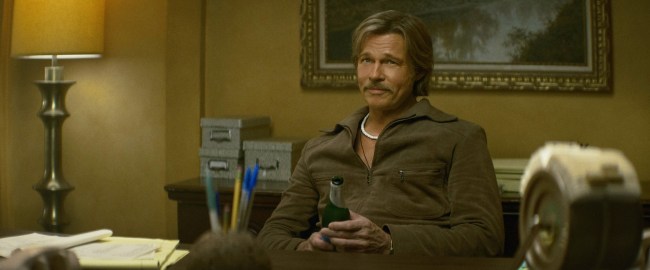
The uproar over the alleged use of generative AI imagery in “The Further Mis-Adventures of Cliff Booth” has taken a familiar path. Early responses to the Netflix film penned by Quentin Tarantino and directed by David Fincher have pointed out egregious examples of generative video artifacts sticking out in key flashback moments in the film — including one shot from the trailer where it certainly looks like a video AI program rendered a wagon the wrong way around. The criticism is of the use of generative AI in principle as a fundamental betrayal of the creative process — but it’s also of Fincher, as a director who, historically, has been meticulous with the level of detail and intention in every single shot of his films. In the early responses to Fincher’s latest, there’s been a lot of surprise and disappointment about this particular filmmaker being caught up in an AI controversy. At first blush, his approach seems at odds with using generative AI video, which relies on regurgitated (and, it bears repeating every time, stolen) data. But Fincher has defended his use of AI to the LA Times as a way to continue to innovate on an art form that is, after all, just over a hundred years old. That defense really shouldn’t be surprising, given Fincher’s history with AI specifically. Although he’s been critical of generative tools in the past, Fincher admitted to using them (never publicly disclosing which) in the 4K remaster of “Se7en,” which the director described as a process of needing to remake the negative in order to battle the ravages of time (and the thousands of tiny scratches that would show up in 4K). “If you could see a 30-year-old negative and what it looks like even when immaculately stored — it was an enormous amount of fixing, just digs and scratches and cinch,” he told EW at the time. That kind of image restoration technology was around long, long before the Anthropic IPO failed to save the stock market, but its level of precision has increased enormously in the past year. There were also sequences in the stored “Se7en,” though, where generative tech filled in gaps from the original. For one example, Fincher talked about a moment where a camera pan overshot the mark and changedh a shot. The performance had been good enough to use a technically flawed take — and, combined wit an unused take, allowed software to generate the missing information and restore the intended image. “It ends up being the most thrillingly stupid fix in the world because if you see it, we didn’t do our jobs. And you probably won’t see it. You probably won’t be aware that it’s happened. But you look at it, and you just think to yourself, ‘It’s so nice that we can fix that kind of stuff today,'” Fincher told Collider about that moment in “Se7en.” By Fincher’s own lights, then, the problem with AI in “The Further Mis-Adventures of Cliff Booth” is that people are painfully aware of it. AI critics might make a distinction between video restoration tools that work on existing projects and those tools being used because they can more quickly and cheaply generate originals that would’ve otherwise needed to be crafted by human hands. Having something AI-generated isn’t necessarily better than nothing when it comes to art, and choosing to AI-generate a Western chase sequence inside of, say, 10 seconds isn’t a solution to all. Still, Fincher knows what he’s doing. This past week, he emphasized to the LA Times that he’s not a Luddite when it comes to film: “We’re talking about a thing that’s a hundred years old, and everyone’s going, ‘Stop. Pencils down. No more iterating. It’s not necessary to have at your fingertips the ability to change the color of that person’s eyes.’ Well, it exists. Should we not use it?” The answer is an emphatic “No!” to some And they can certainly be mad, or disappointed, or disheartened about Fincher’s decision to use AI tools. The one thing they shouldn’t be is surprised.
If There’s Generative AI in ‘The Mis-Adventures of Cliff Booth,’ It’s Not the First Time David Fincher’s Used It
Full Article
Original Source
Read the full article at Indiewire →KhanList aggregates and links to publicly available news content. We do not host full articles from third-party sources. Always verify important information with original sources.