
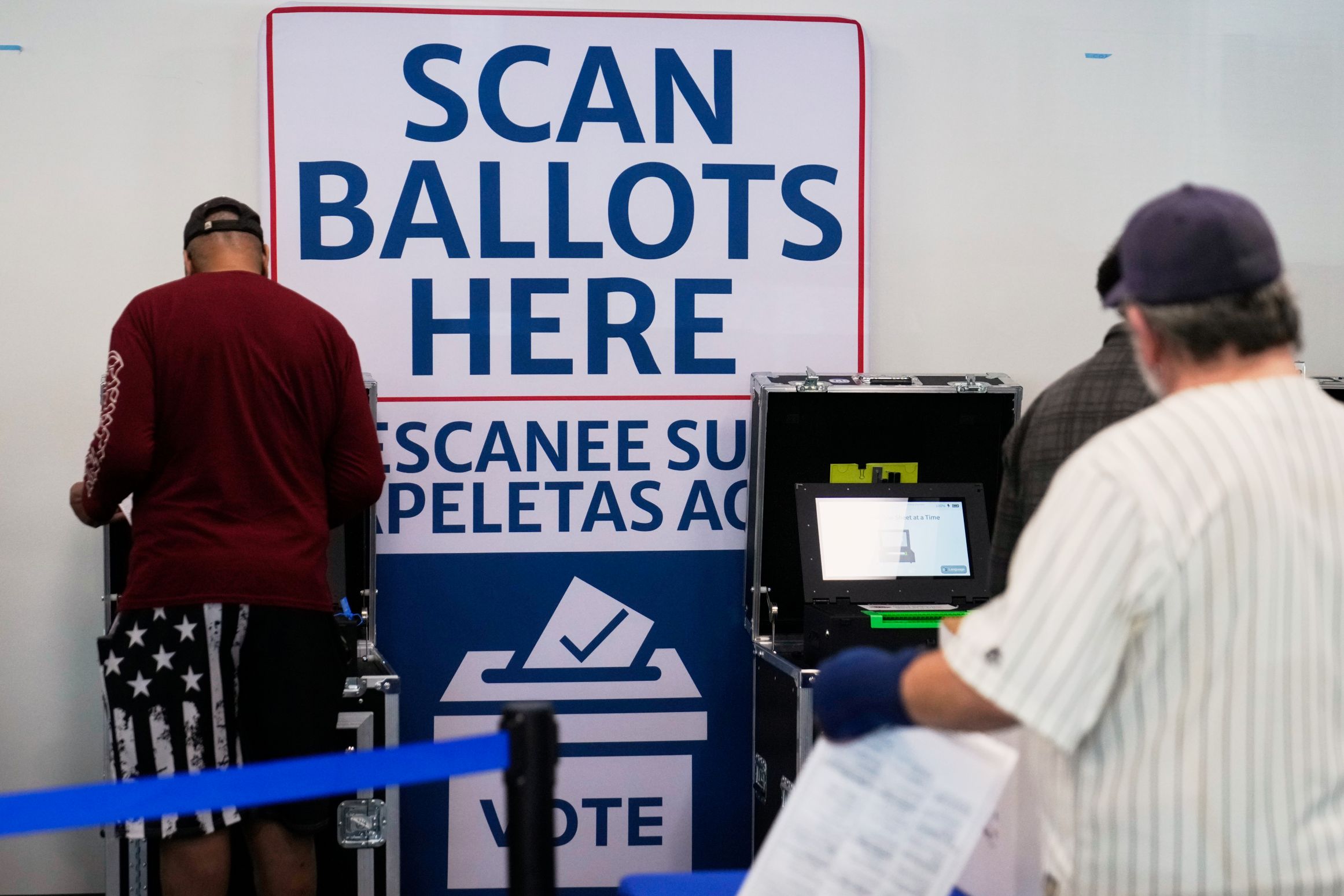
(CN) — Americans are voting Tuesday in an election that is widely expected to give the Democratic Party a say in government again after two years in the political wilderness. But if Democrats do regain power, it’s not clear yet whether they’ll be able to capitalize on the zeitgeist and turn voters’ midterm test drive into a longer-term sale.The Democrats’ chances of recapturing the House of Representatives appear extremely strong. RealClearPolitics gives the Democrats the advantage in 227 seats to the Republicans’ 184, with 24 toss-ups. (Only 218 seats are needed for a majority.) The Cook Political Report shows 222 seats leaning Democratic with 18 toss-ups.“I’d be shocked” if the Democrats didn’t win the House, said David Macdonald, a political scientist at the University of Florida, who described this year as the party’s best midterm environment since 2006.The Senate is closer, but there are eight toss-up races — in Alaska, Iowa, Kansas, Maine, Michigan, Ohio, South Carolina and Texas — and the Democrats only need to win four of them to control the upper chamber.Midterm elections are usually a referendum on the incumbent, and they heavily favor the out-party if the current president is unpopular. But this election is unlike 2006, when President George W. Bush had low approval ratings and chose to disappear, allowing Republican candidates to avoid tying themselves to him. By contrast, “Trump has inserted himself in these races even though he’s electoral poison right now,” said David Niven, who teaches politics at the University of Cincinnati. “He’s made it a referendum on him.”Many Democrats have been content to play along and emphasize opposition to Trump rather than pushing specific new policies — especially since they’re facing an internecine battle between moderates and progressives, and divisive issues such as Medicare for All, Gaza or new taxes could shatter their united front.“Opposition to Trump holds the party together,” said Dante Scala, a University of New Hampshire political science professor.But while politicians on both sides have been happy to make the election about the president, it’s unclear whether voters are.“This election is not about Trump,” said Megan Hamner, a marketing consultant in Charleston, S.C., describing the mood in a city that has become the unlikely epicenter of one of the country’s most pitched Senate battles.“Everyone thinks Trump’s time is over,” she said. “He’s a lame duck.”It’s possible that, after a decade in which an outsized social-media personality transformed American politics into a bare-knuckled reality-TV spectacle — abetted by Democrats who, even when they were in power, kept his drama going with attention-grabbing lawsuits and prosecutions — Americans are tired of hot-button issues and want a return to sober, practical, bread-and-butter politics.“Here in New Hampshire, social issues have disappeared off the agenda,” said Scala. “Four years ago, it was all about abortion and so forth. Not now.”Republican candidates in South Carolina are pushing transgender issues hard in their advertising, but “it’s rubbed everyone the wrong way, including a lot of Republicans,” Hamner said.What are voters concerned about? “The economy, inflation, the cost of living,” Scala said. “How people are feeling about their lives, the future, what their kids are facing. There’s a lot of uncertainty and pessimism.”“People want the chaos to go away,” said Patty McCormack, a retired attorney and independent voter in York, Maine, a state with another fevered Senate contest. “They want adults leading the country.”“Most people are just so over everything,” Hamner said. “They want things to cost less, but they don’t believe either party can help because they’re equally corrupt. A lot of people aren’t voting because they think nothing will happen.”The electorate’s sour mood has been a boon to Democrats, but it’s not clear what the party can do to make disaffected voters happy if it wins — especially since its candidates have talked a lot about affordability but haven’t offered many details on how to make that happen.As for specifics in campaign ads, “I can give you one word: Nope,” said Tom Kirker, a retired schoolteacher in suburban Columbus, Ohio, another Senate battleground. “There’s been nothing substantive.”“There’s no 10-point plan,” McCormack complained.As a result, if Democrats regain power next year, they will arrive with a negative mandate to stop things Trump is doing — tariffs, ICE raids, construction projects — much more than a positive mandate to do things he’s not.Progressives are expected to push for priorities such as wealth taxes, Medicare for All and ending aid to Israel, but Scala says potential leaders Chuck Schumer and Hakeem Jeffries are likely to block them, aiming for moderation with an eye toward the 2028 presidential election as well as retaining newly won seats in red districts.Much depends on the size of any Democratic majority. If a lot of left-wing candidates win but the party ends up with only a narrow margin in the House or Senate, it’s possible that progressives could hold one or both chambers hostage to force their agenda — similar to the Tea Party’s 2013 government shutdown, the Freedom Caucus’s 2023 ouster of Speaker Kevin McCarthy, or the role played by Senators Joe Manchin and Kyrsten Sinema in the Biden administration.But there’s a key difference: “The Tea Party wanted to stop things, and obstruction is a lot easier than doing things,” Shana Gadarian, a political science professor at Syracuse University, said. “It’s much easier to say no than to actually move policy.”One potentially contentious issue is ending the unpopular Iran war. Democrats would need to act carefully, because “whatever Americans think of a conflict, they don’t like to lose,” said Robert Kaufman, a Pepperdine public policy professor and author of four books on foreign policy.Democrats can stop the war funding, but they can’t negotiate what happens with the Strait of Hormuz or Iran’s nuclear ambitions, and they could be seen as responsible if something goes awry.Scala thinks the Democrats have an opening to please swing voters by engaging in constructive negotiations with Republicans looking beyond Trump — on healthcare costs, permitting reform, energy policy and Social Security.But such an approach could alienate an activist wing that is “overwhelmingly oriented to taking on Trump directly,” Niven said.If the Democrats instead use their power vindictively to launch investigations and impeachments, it could be “absolute bloodthirsty chaos,” Kaufman predicted — because while Trump is a lame duck with diminishing power, “he doesn’t understand psychologically or historically that that’s the case.”“This is a president like no other,” said Scala. “Do we really think he’s going quietly? It’s been an incredibly volatile era, so why would the end be any different?”“If the Democrats are smart, they won’t behave like Robespierre,” said Kaufman. “It would be a political loser” that would alienate all the swing voters who chose them this year in the hopes that they would look past Trump and focus instead on policy.McCormack, the independent Maine voter, agreed: “I don’t want the next two years being nothing but hearings. I don’t want to go back to that. Put some adults in there, and do what’s best for the people.”Subscribe to our free newslettersOur weekly newsletter Closing Arguments offers the latest about ongoing trials, major litigation and rulings in courthouses around the U.S. and the world, while the monthly Under the Lights dishes the legal dirt from Hollywood, sports, Big Tech and the arts.Additional Reads
If the Democrats win, what’s next?
Full Article
Original Source
Read the full article at Courthousenews →KhanList aggregates and links to publicly available news content. We do not host full articles from third-party sources. Always verify important information with original sources.