
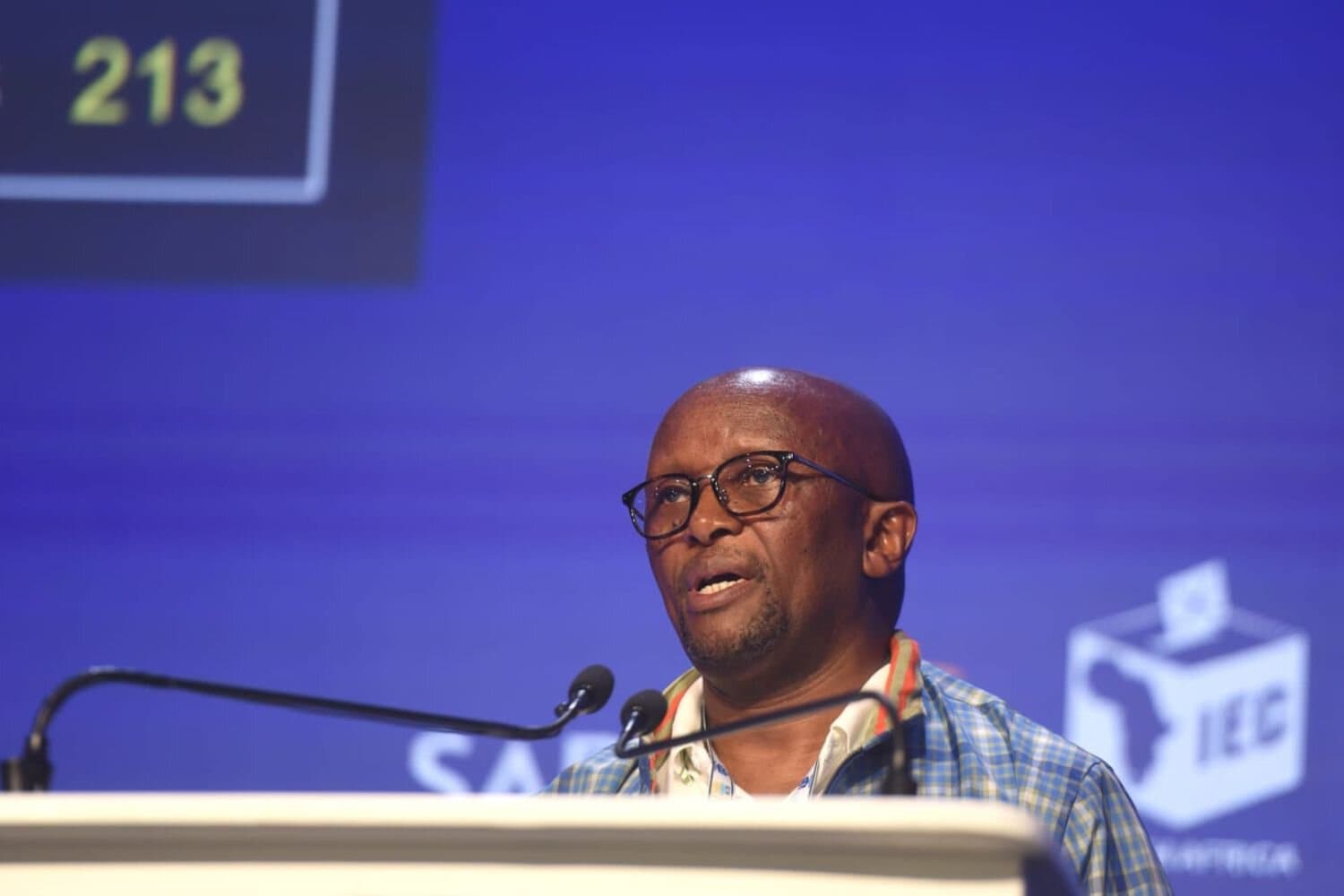
Questions were also raised about the calculation and allocation of council seats. The Electoral Commission of South Africa (IEC) is working around the clock to complete the final stages of the 2026 local government election results, with three provinces still outstanding and two objections lodged by political parties having been upheld. IEC chairperson Mosotho Moepya provided the update during a media briefing at the commission’s Results Operations Centre (ROC) at the Gallagher Convention Centre in Midrand, Gauteng, on Saturday, 7 November. The counting process follows the municipal elections, held on 4 November, with the commission expected to formally announce the outcome on Sunday, 8 November. Two objections upheld as IEC reviews complaints The IEC has received 197 objections relating to the electoral process, with 54 already dismissed and eight withdrawn by the parties that lodged them. Moepya confirmed that two objections had been upheld after the commission determined that they were significant enough to potentially affect the election outcome. The commission will now proceed with the recapturing of the affected results as soon as possible. “The objectors in these instances have either been notified or are receiving that correspondence,” the IEC official told the nation. Moepya also clarified the legal requirements governing objections, reminding political parties that the deadline for submissions was 6pm on Friday. However, late written objections may still be considered where there are grounds for condonation. He explained that Section 65 of the Local Government: Municipal Electoral Act specifically regulates the types of objections that may be considered, and these must concern matters capable of having a material bearing on the election outcome. “Objections envisioned under Section 65 are not synonyms with complaints,” Moepya remarked. Issues involving internal party nominations, ward demarcations and delayed voters’ roll queries do not fall within this framework. “Such an objection must relate to any aspect concerning voting, counting of votes, alleged unlawful interference with or obstruction of election activities or processes in the vicinity of, at or in a voting station; or interference with or influencing, intimidation or obstruction of voters or prospective voters in the vicinity of, at or in a voting station,” Moepya said on Saturday. Several wards remain subject to recounts The commission is also dealing with recounts in a number of municipalities as part of its efforts to verify and finalise the results. The affected areas include wards 57 and 102 in the City of Tshwane, ward 19 in Mangaung, ward 4 in Thaba Chweu and ward 12 in Breede Valley. Moepya said the IEC were actively examining the outstanding matters and working towards reaching decisions as quickly as possible. “This is a process that all of us, as members of the commission, are seized with. “We sitting and considering these things, and seeking to issue our determinations as soon as possible. He cautioned against treating the figures currently appearing on the IEC’s results leaderboard as the final outcome, emphasising that the formal declaration was yet to take place. “The commission will be declaring results tomorrow.” He further explained that the commission retains the authority to amend declared results if an objection is subsequently upheld. Such decisions may also be referred to the Electoral Court in accordance with the applicable legislation. Three provinces yet to complete results processing While six provinces have completed the processing of their election results, the IEC is still working to conclude the process in Gauteng, North West and KwaZulu-Natal (KZN). Moepya confirmed that the Free State, Mpumalanga, Northern Cape, Western Cape, Eastern Cape and Limpopo had completed their results processing. In Gauteng, the outstanding results relate to the City of Johannesburg, Emfuleni and Ekurhuleni municipalities. Rustenburg remains the only municipality in the North West to be finalised, while the results for uMsunduzi and eThekwini are yet to be completed in KZN. Despite the remaining work, the IEC chairperson expressed optimism that the outstanding results would be processed within hours. “As we look at the situation, we think we are likely to finish early this evening or tonight. This is what we are pushing to conclude.” He appealed to political parties and the public to remain patient while the commission completes the remaining verification and administrative processes. IEC to clarify how council seats are allocated Questions were also raised about the calculation and allocation of council seats through the proportional representation (PR) and ward electoral systems. The allocation process, according to Moepya, is governed by legislation and indicated that the commission’s communications team would provide a further explanation to help the public understand how the calculations work. “Every number is then used in the seats calculation,” the IEC official stressed. Moeopya continued: “I do not wish to confuse South Africans and start a little mathematical game on seat calculation when it is fairly well documented in law. “I must also say that it is not the commission that decides how many seats go where. “The process of determining a seat, whether it’s a ward council seat, proportional representation seat or district council seat is fully laid out in the legislation we have.”
IEC races to conclude election results as two objections upheld
Full Article
Original Source
Read the full article at Citizen →KhanList aggregates and links to publicly available news content. We do not host full articles from third-party sources. Always verify important information with original sources.