
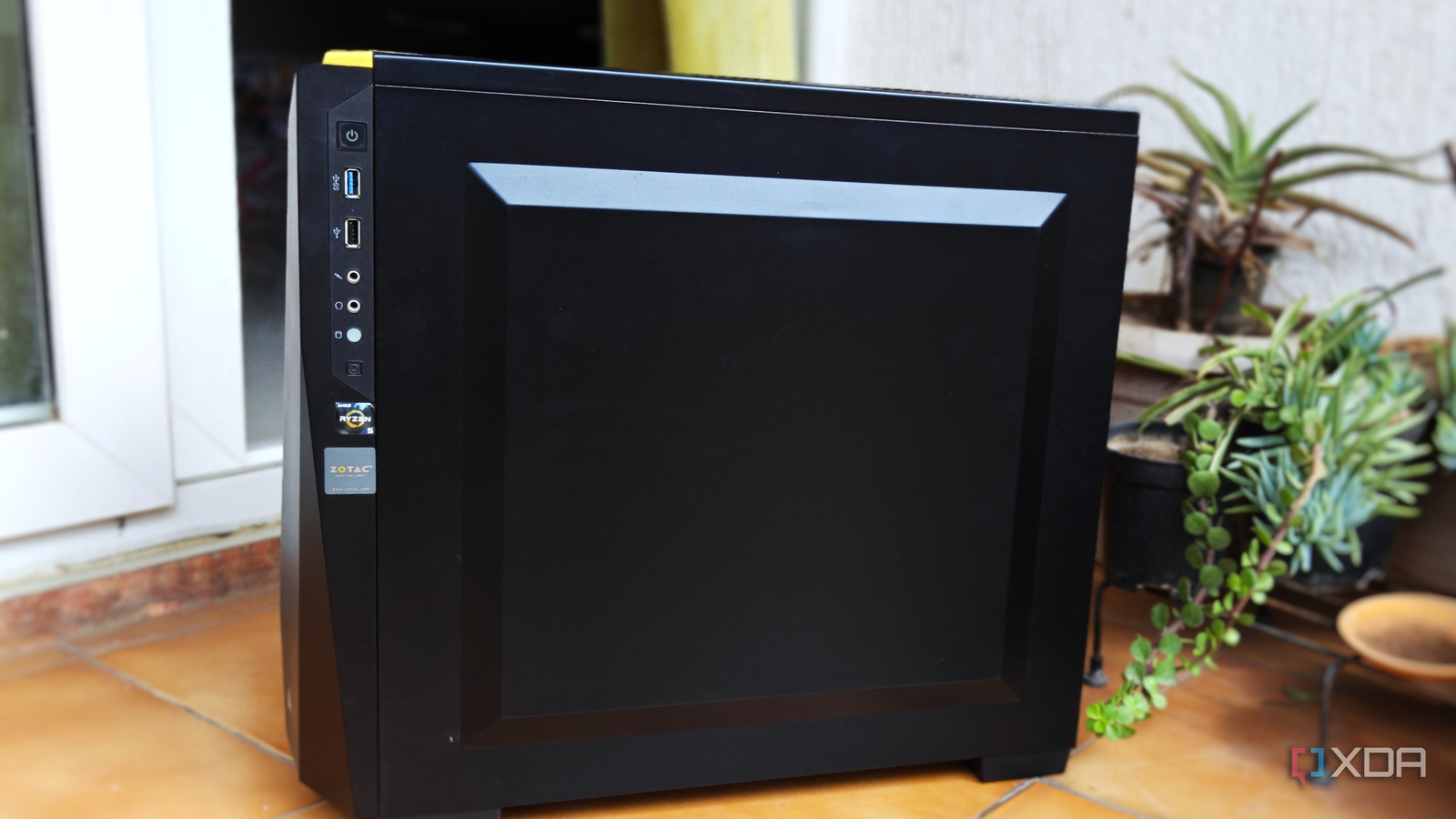
Published Nov 16, 2026, 11:30 AM EST After a 7-year corporate stint, Tanveer found his love for writing and tech too much to resist. An MBA in Marketing and the owner of a PC building business, he writes on PC hardware, technology, and Windows. When not scouring the web for ideas, he can be found building PCs, watching anime, or playing Smash Karts on his RTX 3080 (sigh). Valve's Steam Machine was meant to bring SteamOS into people's living rooms, replicating what the Steam Deck did for handhelds. It was conceptualized as a tiny, affordable PC for your entertainment hub, sitting under your TV and powering your existing Steam library. Everything seemed to be going right until the memory crisis hit, and the Steam Machine launched as a fairly overpriced, underpowered SteamOS PC. Valve had no leverage with memory makers, but I don't have to pay for that. Shelling out over $1,000 for a PC that I can easily beat with a modified office machine is insane. Despite what the Steam Machine can do, I can create the same experience with Bazzite. All I need is an old office PC paired with a pre-owned GPU that's way more powerful than what's inside the Steam Machine. The Steam Machine launched at the worst possible time The original price target was never feasible Credit: Valve First, I want to acknowledge everything the Steam Machine does right. For people who don't want to touch PC building, it offers a ready-to-go console experience in a compact cube. There's no optimization, troubleshooting, or compatibility concerns here, at least not to the extent you'd expect on a custom-built PC. In fact, if you tried to build an equivalent PC with all-new parts, the Steam Machine starts to look like a not-so-bad deal. Valve is not only selling a console, but also the convenience of a PC powered by the familiar SteamOS experience. Your Steam library is already there, and the excellent Steam Controller (in the $1,128 bundle) enhances the experience. However, none of this can change the fact that this "console" starts at $1,049, and it's not even that powerful by modern standards. Consider the semi-custom CPU and GPU inside it. It has a 6-core, 12-thread AMD Zen 4 processor and an RDNA 3 GPU with 8GB of VRAM. These parts are easily bested by anything faster than the Ryzen 5 7600 and Radeon RX 7600. The GPU is the painful reality; the 3-year-old RX 7600 only gives you RTX 3060- or RTX 4060-level performance. Valve's Steam Machine would have launched at around $749 under normal market conditions, but inflated memory costs and no bargaining power with suppliers drove the price up. The tiny cube does offer a decent 16GB DDR5 RAM and 512GB SSD configuration, but the price is just too much to swallow, especially if you consider pre-owned hardware. An old office PC with a used GPU can easily beat the Steam Machine It's not even a challenge I know that comparing new and old parts isn't 100% fair, but when I want the SteamOS console experience on my TV, I'll grab any deal I can. My objective is to beat the Steam Machine's $1,000+ pricing comfortably, while also beating it in performance. I could start by buying a used gaming PC, but I can go even cheaper by looking at old or refurbished office machines that go for around $200 and have decent specs for the price. I found several listings with Ryzen 5 3600 or Ryzen 5 4600G chips, 16GB of DDR4 RAM, and a 256GB or 512GB SSD. Granted, the CPUs here are older and slower than the Steam Machine's Zen 4 chip, but I intend to make up for it with the graphics card. I could add an RX 6800 XT for $200–$250, keep it all-AMD, and get double the GPU performance. However, Bazzite means I don't have to limit myself to AMD hardware. I could go for an RTX 3080 for similar performance and price, and get better DLSS performance. Either GPU draws a lot of power, but an office tower has enough room for cooling. If you still want a cooler GPU, the RX 6700 XT for around $200 is still significantly faster than the Steam Machine GPU. So, for under $500, I could have my DIY Steam Machine ready to rumble at half the price of Valve's offering. Bazzite gives you the SteamOS experience on custom hardware It's a different name, but everything else is the same With the hardware out of the way, does Bazzite compare to Valve's polished SteamOS software? Bazzite is a gaming-first Linux distro based on Fedora that mimics SteamOS where it counts. You can grab a handheld/HTPC image that boots straight into Steam Gaming Mode, or a desktop image that gives you the conventional Linux experience with GNOME/KDE Plasma. The best part about Bazzite is that it works well with almost any GPU. Thanks to bundled proprietary Nvidia drivers and Mesa drivers, hardware compatibility is rarely an issue. Performance is essentially the same as that on SteamOS, since the underlying Proton and Gamescope architecture are the same. Almost all games run perfectly on Linux these days, except, of course, those that demand kernel-level anti-cheat. Setting up Bazzite is quick and simple, and things like controller support and game optimizations are handled in the background; no Linux expertise needed. If you want to put together your own console with all the SteamOS goodness, Bazzite is the best option. You don't need to pay a grand for a Steam Machine With Bazzite and pre-owned hardware, anyone can create their own Steam Machine that's way faster than Valve's "GabeCube." Sure, you may not be able to go as small as the Steam Machine, but plenty of mini-ITX cases can get you far enough. Linux has gotten seriously good at game support, so most of your titles will play seamlessly, often with better performance than on Windows.
I'd rather put Bazzite on a used office PC than pay $1,049 for a Steam Machine
Full Article
Original Source
Read the full article at Xda-developers →KhanList aggregates and links to publicly available news content. We do not host full articles from third-party sources. Always verify important information with original sources.