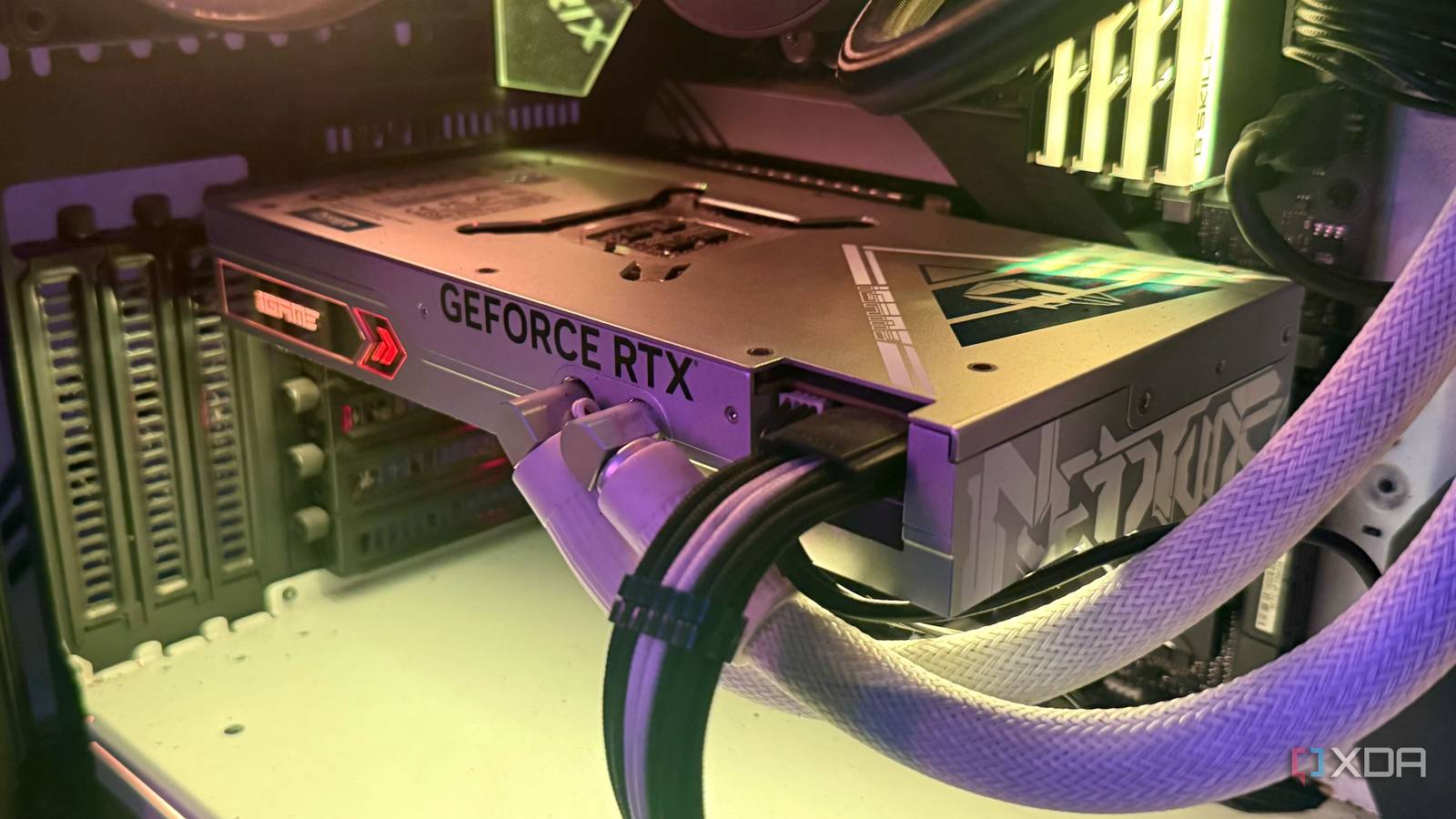
Published Jul 24, 2026, 7:00 PM EDT Hamlin has been in the tech field for over nine years. Since 2017, his work has appeared on MakeUseOf, Android Police, OSXDaily, Beebom, and more. He served as the Senior Editor at Valnet's MakeUseOf for over two years before joining XDA. He uses a high-end gaming rig for desktop use and a MacBook for traveling, but dislikes some of the quirks of macOS. You're more likely to catch him at the gym or on a flight than anywhere else. When I bought the RTX 4090 nearly four years ago, the GPU market was in a much better spot than it is today. You could actually buy graphics cards much closer to MSRP. In fact, I was able to snag a liquid-cooled RTX 4090 for about $2,000, which looks like a steal in hindsight, considering I couldn't find a single listing for under $3,000 today. While that's partly because it's no longer in production, you also can't ignore the impact AI demand has had on GPU prices over the last couple of years. Nowadays, as of writing, you're looking at paying over $1,000 for mid-range GPUs like the RTX 5070 Ti. Higher-end models like the RTX 5080 can cost as much as $1,500, while the flagship RTX 5090 can set you back over $4,000. I'd never pay those prices to upgrade from my RTX 4090, but if I didn't already own a GPU, I wouldn't hesitate to buy a used high-end card like the RTX 4080 Super over a current mid-range option like the RTX 5070 or 5070 Ti. Pricing is one reason, but performance is another factor. Last-gen high-end GPUs still win in benchmarks The RTX 5070 Ti doesn't clearly beat the RTX 4080, RTX 4080 Super is often faster The problem with current Nvidia GPUs is that they're not all that impressive from a raw performance standpoint. And with prices being as high as they are right now, the value proposition just isn't there anymore. You'd expect a new 70 Ti card to outperform the previous generation's 80-class GPU, but that's not the case this time. The RTX 5070 Ti generally lands around RTX 4080 performance rather than clearly surpassing it, despite launching more than two years later on a newer architecture. Depending on the game and resolution, it can match or occasionally beat the RTX 4080, but the RTX 4080 Super usually retains a modest overall advantage. Even the RTX 5080 fails to consistently overtake the RTX 4090 in conventional gaming benchmarks. It improves on the RTX 4080 and RTX 4080 Super, but the generational gain is often modest enough to make the older flagship look remarkably competitive. For the past few generations, 80-class cards have outperformed the previous generation's flagship, but the RTX 5080 changed that. And that says a lot about the RTX 50-series as a whole. If a high-end GPU from four years ago still looks impressive in benchmarks today, it's hard to justify paying over $1,000 for a newer mid-range card. You may as well get a used RTX 4080 instead if you're spending that kind of money anyway. Buying used is the smarter move in today's market Used GPUs have also gotten pricier, but they still offer better value I'm not going to act like you can get a used RTX 4080 for a bargain anymore. The used market has also become more expensive, especially for higher-end cards that are still very much in demand. AI has pushed up prices across the board, and sellers know exactly what these GPUs are worth. But that doesn't mean you can't get a decent deal, especially considering how much newer mid-range GPUs like the RTX 5070 Ti are currently going for. I did some digging on eBay and found RTX 4080 Super listings for under $1,000, while the standard RTX 4080 was available for around $900 or less. Of course, you will have to take precautionary measures to make sure you don't get scammed, but if you can find a reputable seller, I'd still take that instead of paying over $1,100 for a new RTX 5070 Ti. And if you don't want to deal with eBay, you can find a refurbished 4080 Super on Amazon for under $1,100. I know you're almost paying the same price at that point, but at least you're getting the faster GPU without software gimmicks. Multi Frame Generation is the one thing going for newer GPUs But no amount of "fake" frames can replace raw performance Credit: Nvidia If there's one reason to pay more for these newer mid-range cards, it's Multi Frame Generation (MFG). Unlike the RTX 40-series that launched with Frame Generation, MFG can insert up to three additional frames per rendered frame. That can increase the displayed frame rate to nearly four times the base rate in 4X mode, although the actual gain is reduced by processing overhead. And if that's not enough, these cards also support Dynamic Multi Frame Generation, which allows you to set a 6x multiplier for an even bigger FPS jump. MFG is the main reason Nvidia made the absurd claim that the RTX 5070 could match the RTX 4090's performance at CES last year. But here's the thing about frame generation. That FPS boost from inserting generated frames only looks impressive on the FPS counter. The game doesn't feel like you're actually playing at those frame rates because responsiveness is still mostly tied to your base frame rate. So, in fast-paced games, you'll notice that your inputs feel slightly off. And let's not forget the added latency, which makes it a no-go for competitive games. From my experience using Frame Generation on my RTX 4090, it only makes sense in slower single-player titles when your base performance is already solid. I'd assume MFG would only make that responsiveness tradeoff even more noticeable. The Nvidia tax is getting out of hand At the end of the day, you're paying more for a newer GPU with a slightly better software stack. The RTX 50-series cards get MFG, whereas the RTX 40-series is limited to standard 2x frame generation. But other than that, you're still getting everything from DLSS 4.5 support to RTX HDR. And if you really think the lack of MFG is a dealbreaker, you can use DLSS Enabler to get Dynamic MFG to work on an RTX 4080. Honestly, I'd rather save a hundred bucks knowing I'm getting a slightly faster GPU. Nvidia can keep its software gimmicks until it gives us a better generational leap.
I'd rather buy a used RTX 4080 than pay Nvidia's new midrange tax
Full Article
Original Source
Read the full article at Xda-developers →KhanList aggregates and links to publicly available news content. We do not host full articles from third-party sources. Always verify important information with original sources.