
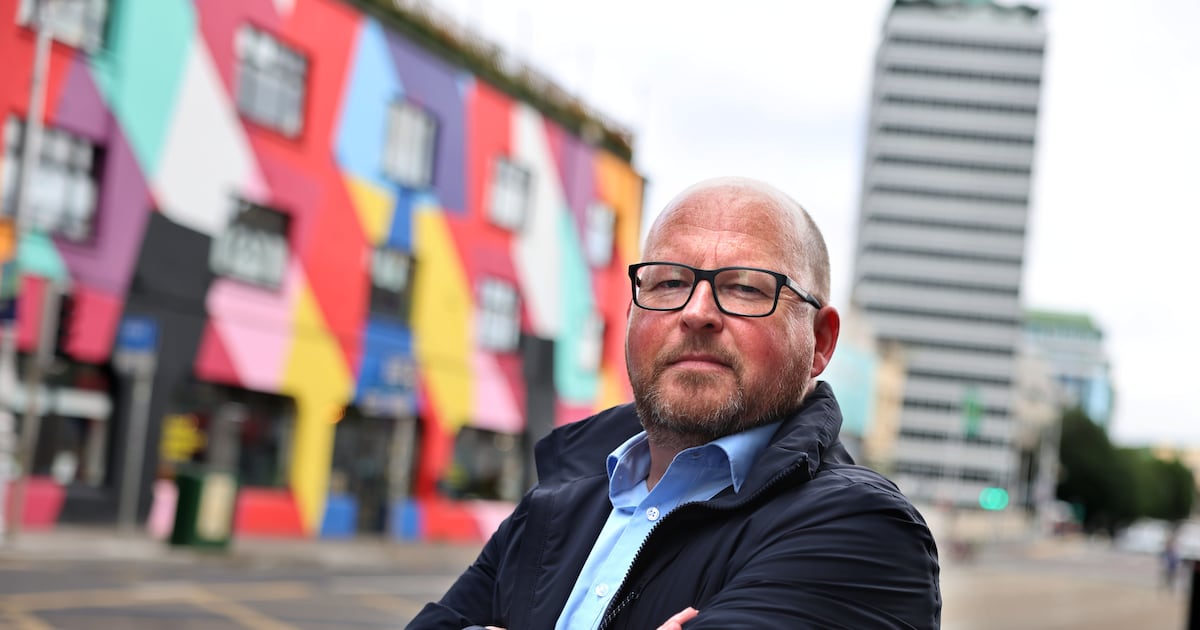
“I’m sort of stuck in the ’90s,” says Owen Reidy not, as critics of the trade union movement might like to think, referencing his politics but rather his taste in music.It was shaped, he says, by sharing a bedroom with his older brother Paul when the pair were growing up in Donegal.“He was five years older so his musical interests hugely influenced me. I remember when we lived in Dunfanaghy, him coming home from Letterkenny one night in 1984 after the Smiths played with a bit of Morrissey’s shirt.”Reidy’s politics were passed on too, though from his grandfather on his mother’s side. Stephen McGonagle was a Derry-born plumber and trade union activist who would go on to serve as the North’s first ombudsman, take a seat in Seanad Éireann and turn down an OBE.READ MORE“He was in the British plumbers’ union, became a union official, joined the National Union of Tailors and Garment Workers, then broke away from that to form his own union, the Clothing Workers’ Union of Northern Ireland. “In the late ’50s and early ’60s he ran for Stormont as an Independent Labour candidate against Eddie McAteer of the Nationalist Party. He was trying to be a unity candidate, to get the urban working class to vote for him.“The nationalists at the time went round with a megaphone telling people to vote for McAteer because the Protestants in such and such an area were voting for McGonagle, ‘so don’t vote for him’.“He came close both times [1958 and 1962] but didn’t make it. Then, after about six years, the Clothing Workers’ Union wasn’t going too well – it was on its own with 6,000 members – so he brought them into the Irish Transport and General Workers’ Union, which became Siptu, of course.” Reidy and his grandfather were close and would fish together in Culdaff, Co Donegal, while talking politics. “I’d be giving out about the Labour Party being in government, saying they weren’t left-wing enough. He’d be telling me you needed to be at the table to influence things.”Stephen McGonagle, third from left, with fellow Labour Party members Frank Prendergast, Mervyn Taylor and leader Dick Spring in 1983. Photograph: Pat Langan The Troubles were a big part of his grandfather’s life and, having become ombudsman, he would carry a gun to defend himself in case of attack because as a Catholic even that job was potentially enough to make him a target.Across the Border in Donegal things were quieter but the Troubles could still come calling, especially if your father was a bank manager.When they knocked on the door of the Reidys, the family lived in Raphoe.Owen’s father, Brian, was the manager of the town’s AIB branch. One evening, men wearing balaclavas burst into the livingroom.“I remember, I was probably about six or seven. I think it was a Wednesday night. Paul was allowed to stay up to watch Brian Moore on Midweek Sports Special. He was a mad Spurs fan. Me and my sister were asleep. “Back in those days each staff member at the bank had a key, and a number of keys were needed to open the vault. I don’t know if they realised that, but they realised it pretty quickly and so they had to hold the family hostage overnight.“The next morning, a guy came to my door, he had one of those parka coats with the fur, a balaclava and I don’t know if it was a shotgun or a rifle. He said: ‘Come with me, son.’”Was he scared? “I was six. I was sitting with my mum and dad. Once they told me everything was okay, I was fine, but I knew it was unnatural, it wasn’t right.“And I remember my mum asking them a few questions, and telling me afterwards she was just relieved that by a process of elimination she knew they were the Provisional IRA, not loyalists because, you know, in the late 1970s ... the Shankill butchers and all that stuff.”The family were taken to the bank and locked into the vault with staff members as the gang helped themselves to the cash, Reidy doesn’t remember how much money they took, but says the scene involved “pillow cases. It was cartoon stuff.”The alarm was raised because the bank didn’t open when it should have and the three Reidy children failed to turn up for school. He remembers the panic among gardaí as they arrived. Eventually they cut through the bars to free everyone.By the end of the day, he recalls, some of those responsible had been arrested while others never were.Owen Reidy, general secretary of the Irish Congress of Trade Unions. Photographs: Dara Mac Dónaill As a child, he recalls, worrying about the £10 he had in an account: would he lose it all? “And there was a lot of drama, excitement too ... We got the day off school, of course.” “No one was mishandled,” he says of the robbery. “No one was harmed. No one was thrown in the boot of a car. There was none of that stuff. I just remember my mother saying, ‘These men are going to be here for a few hours, so just relax’.“Still, when one of them passed a remark to her about us having a nice set-up, she said: ‘Yes, and we’ve worked hard for it’. I remember dad said: ‘Right, Patricia, zip it. Don’t be going there’.”Reidy shrugs off any thoughts of lasting damage: “I’m not some victim of the Troubles here. Far from it. This was just something that happened. None of my family were harmed. I don’t think there was any psychological scars although I do remember how old my father, who was much younger then, looked that night. And they didn’t want to stay in the town afterwards, so we were on the move again.”Moving was a feature of his early life. The bank moved his father every few years and, having been born in Dublin, he spent most of youth living in different parts of Donegal while developing a strong affinity for the city of Derry, where his mother was from, too.Sport was a big part of his life growing up. After his grandfather brought him to see Derry City football team play for the first time, he was hooked. ‘The time’s going to come when we are going to have to use our industrial muscle’— Owen Reidy“I wanted to name my son Killian after Killian Brennan who played for City but that was quickly overruled,” he says with a laugh. Still, his now 19-year-old son is called Cillian, perhaps an indication of Reidy’s negotiating skills. He has a 24-year-old daughter, Aisling[ Unions threaten industrial action as they accuse Government of prioritising businessOpens in new window ]The children grew up in north Co Dublin where he and his family lived for 20 years, and between work and seeing them, often around matches with the local GAA club they played for, he continues to spend a lot of time around the city and its environs, although he now lives with his new partner in Co Fermanagh.The Border still plays a significant part in his life and in his sense of the role the trade unions have on the island of Ireland. “Here’s the thing,” he says. “In the ’70s and ’80s, the trade union movement was one movement. Committees would have had people who were loyalist, nationalist, republican, unionist, communist, none of the above, and they stuck together.“These were people who, on a Saturday or Sunday, had a different tradition, a different outlook on life but when they met on the first Wednesday of every month or whenever it was, they were there as trade unionists and the movement stayed together through the worst of the Troubles as a voice for an alternative way, peace and reconciliation. I don’t think it has got the recognition it deserves for that.”He was never supportive of those who took the path of violence, and regards John Hume as perhaps the greatest hero of the peace process even if “he has been airbrushed out since by the victors”. Reidy does not, he insists, want to “dehumanise” anyone, saying he has no idea what choices he would have made if he had grown up in one part of Belfast or another, or how the lives of some those who went to prison might have gone instead had they been raised in Dublin or Cork. Unions, he believes, will have an important part to play in shaping the next stage of the peace and whatever constitutional changes comes to the North.In Dublin, winning a right to collective bargaining remains Ictu’s most important goal, he says, but he accepts that delivery on the adequate minimum wage is looking less certain than had been hoped a couple of years ago.“Why is the Republic of Ireland the only member state of the European Union where we deny workers the right, if they want to join a union, to access collective bargaining?”He points to UCD research that found high levels of interest among workers, especially young workers, in joining a union but admits prospective members regularly baulk at striking in pursuit of recognition.[ New Ictu general secretary Owen Reidy targets recruitment of young members as priorityOpens in new window ]He notes that fuel protesters achieved concessions in April but “if one of our unions decided to block the airport, they’d be arrested in an hour, and an hour after that there’d be a letter sequestering the union’s funds from the High Court”. Different standards are applied to unionised workers, he says: “But the time’s going to come when we are going to have to use our industrial muscle too.”Having left Donegal to study history and politics in UCD, he moved on to London, where he was reunited with his brother and worked for a time in a record shop.A spell in Madrid teaching English – very badly, he says – and playing music in bars followed, and then his mother cut out and sent him an advertisement from The Irish Times posted by Siptu to recruit officials.His first posting was in Mayo, where he initially shadowed experienced colleagues and learned how things were done. Stints working with members in Aer Lingus followed, then public transport, all of which he recalls fondly.Having risen through the ranks, he made the move a decade ago to Ictu, initially overseeing the Belfast office before taking over from Patricia King as general secretary four years ago. .He harks back to Donegal repeatedly, and speaks of standing in the graveyard on Cruit island and “looking at the gravestones of the Boyles, McGonagles, Sharkeys and O’Donnells”, including that of his uncle Owen McGonagle, after whom he was named, and feeling at home after a youth during which, he says, he sometimes felt “rootless”.And music is still a part of his life. Having played in a band with schoolmates as a teenager and wrestled with writing songs about “love and loss”, he plays with trade union friends now at retirement functions.“I’d often disappear into the study here and play for an hour or two but the dogs are usually the only audience now.”
Ictu boss Owen Reidy: My mum was relieved the Provisional IRA took us hostage in the 1970s, not loyalists
Full Article
Original Source
Read the full article at Irishtimes →KhanList aggregates and links to publicly available news content. We do not host full articles from third-party sources. Always verify important information with original sources.