
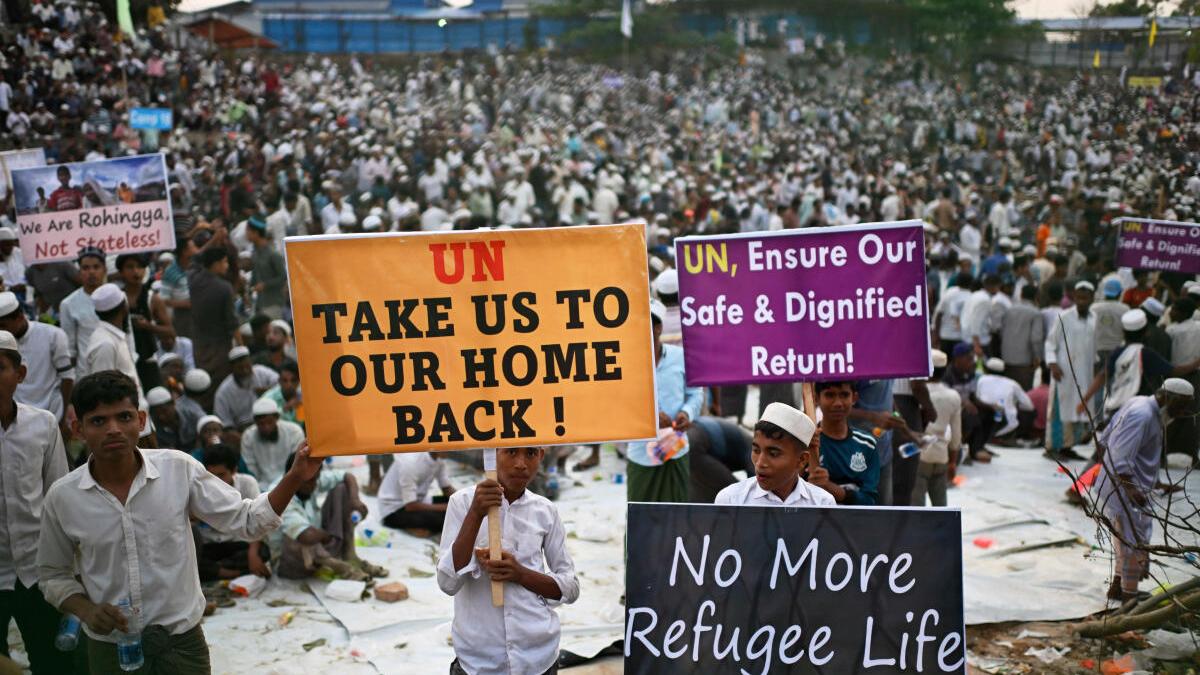
The International Court of Justice (ICJ), based in The Hague, Netherlands, on November 19, 2026, will rule on a landmark case against Myanmar, which is accused of committing genocide against the Rohingya people.Judges at the top UN court (also called the World Court) have for seven years been weighing accusations made by Gambia about whether Myanmar’s treatment of the Rohingya people breached the 1948 UN Genocide Convention. The international community is closely watching the verdict as an archetype for the case filed by South Africa against Israel over its campaign in Gaza.Who are the Rohingya?The Rohingya are a minority ethnic group, largely comprising Muslims, in the predominantly Buddhist Myanmar, formerly referred to as Burma.Most of the Rohingya come from the Rakhine State, also known as Arakan State, in northwest Myanmar. The State borders Bangladesh. They speak a dialect of Bengali, as opposed to the commonly spoken Burmese language. While the Rohingya people have been living in Myanmar for generations, they are not recognised by the country, rendering them effectively stateless. Their movement are also restricted within the Rakhine State.Mass exodus of Rohingya When Burma won Independence from the UK in 1948, the Bengali-speaking Muslim population near the border exceeded that of the Buddhists, leading to secessionist tensions, according to Reuters.In 1962, a coup led to nearly five decades of military rule by the ethnic Burman majority. In 1978, thousands of people fled to Bangladesh to escape a military census of the Rohingya called “Operation Dragon.” In 1991, another wave of refugees fled to Bangladesh where the UN says 300,000 Rohingya now live a stateless existence.From 2025: Rohingya refugees in Bangladesh mark anniversary of Myanmar exodus as conference opensDue to years of harassment beginning in 2012 and exacerbated in 2017, thousands of Rohingya have fled Myanmar, with many attempting to travel in rickety wooden boats to Malaysia, where 14,300 official Rohingya refugees and maybe half as many unregistered ones live. Flaring of sectarian violence in 2012: What happened?Sectarian violence between Rohingyas and Rakhine’s Buddhist natives began flaring up in June 2012, following the rape and murder of a Rakhine woman in a Rohingya-dominated locality, according to a report published in The Hindu. The riots, which were triggered as a result, went on for almost a month with causalities on both the sides.Another round of riots broke out in October 2012, after which the government moved around a million Rohingyas to refugee camps.2017 violence in Myanmar: What happened?The Hindu reported that an armed guerrilla outfit called the Arakan Rohingya Salvation Army (ARSA), previously known as Harakah al-Yaqin, staged a coordinated attack on 30 police posts and an army base in Rakhine state on August 25, 2017. The Army launched a counter attack, killing at least 59 insurgents and 12 security personnel.The Myanmar military, in response to the attack by ARSA, launched “clearance operations” that led to widespread arson, civilian deaths, and reports of Rohingya youths being picked up for interrogation. Timeline of Rohingya ICJ caseNovember 2019: Gambia files a lawsuit against Myanmar at the World Court. It alleges that Myanmar’s crackdown on the Rohingya breached the 1948 UN Genocide Convention. December 2019: The ICJ holds three days of emergency hearings on the issue. Myanmar’s then-leader Aung San Suu Kyi personally leads her country’s legal team and rejects the genocide allegations. She contends that the 2017 event was an operation against armed insurgents. January 2020: The ICJ orders Myanmar to take all measures within its power to prevent all acts prohibited under the Genocide Convention. It also ordered the country to preserve evidence and submit regular compliance reports. July 2022: After Myanmar challenges the World Court’s authority and Gambia’s right to file a case, the ICJ says that both nations are signatories to the Genocide Convention and thus the court has jurisdiction. November 2023: Canada, Denmark, France, Germany, the Netherlands, and the United Kingdom issue a joint declaration wanting to join the case against Myanmar, citing shared interest in upholding the 1948 Genocide Convention. January 2026: ICJ opens its first full hearing of a genocide case in more than a decade over the Rohingya issue. Union Minister Ko Ko Hlaing instead of Aung San Suu Kyi deny the military’s role in genocide. November 2026: ICJ officials announce that judges would deliver their final ruling on November 19, 2026. How many Rohingya live in India?A report published in The Hindu in 2023 noted that in December 2017, the then Minister of State for Home Affairs, Kiren Rijiju, informed Parliament that there are around 40,000 Rohingya in India, of whom around 5,700 are in Jammu and also in Telangana, Punjab, Haryana, Uttar Pradesh, Delhi and Rajasthan. Of these, only 16,000 are said to be registered with the UN refugee agency. The MHA claimed that the exact number is not known as many of them enter the country stealthily.(With inputs from agencies)
ICJ to rule on Rohingya ‘genocide’: Refugee crisis, timeline of the case, and more
Full Article
Original Source
Read the full article at Thehindu →KhanList aggregates and links to publicly available news content. We do not host full articles from third-party sources. Always verify important information with original sources.