
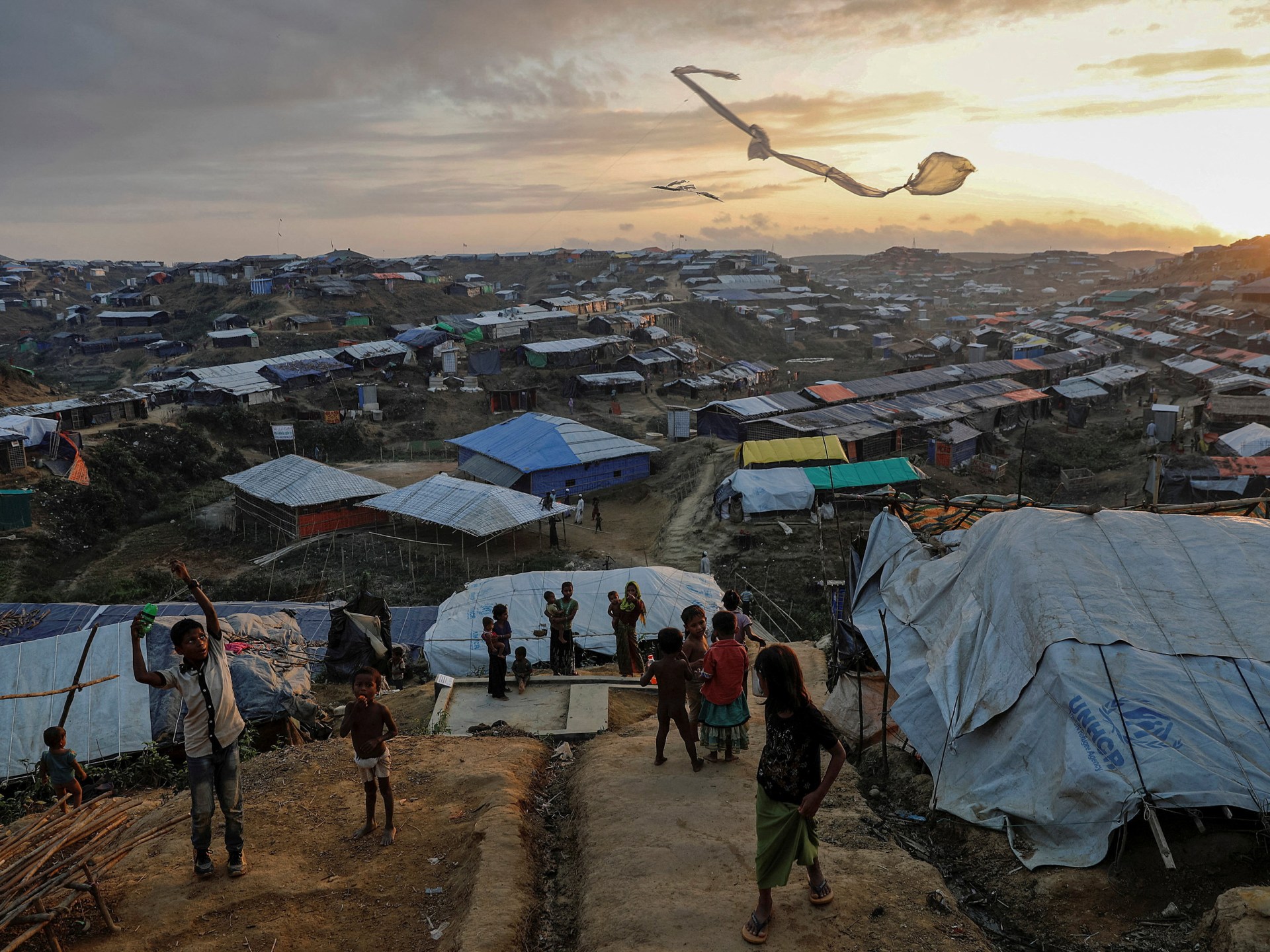
The top court of the United Nations is scheduled to rule on whether Myanmar committed genocide against its Rohingya Muslim minority in a case brought by the West African nation of The Gambia.The International Court of Justice (ICJ) in The Hague is to deliver its verdict on Thursday in what will be its first judgement on the merits of a genocide case in more than a decade.Recommended Stories list of 3 itemslist 1 of 3Malaysia’s welcome for Min Aung Hlaing undermines its stand on justicelist 2 of 3Rohingya dismantle homes amid eviction threat in disputed Kashmir regionlist 3 of 3‘We want to go back’: Rohingya refugees pin hopes on ICJ genocide verdictend of listLegal experts said the ruling could bear on South Africa’s ongoing case accusing Israel of genocide in Gaza, which Israel is contesting.The Gambia accuses Myanmar of seeking to destroy the Rohingya people during a 2017 military crackdown that forced hundreds of thousands to flee. Myanmar, meanwhile, claims it was responding to attacks by fighters from the Arakan Rohingya Salvation Army (ARSA) on police posts.Here’s what we know:What happened to the Rohingya in Myanmar?Myanmar’s military began what it called clearance operations in Rakhine State in October 2016 and a far larger campaign in August 2017 after attacks on police posts by a Rohingya armed group. About 10,000 Rohingya were killed and 740,000 forced to flee to Bangladesh, the UN estimated.UN investigators found that soldiers razed hundreds of villages, carried out mass killings and routinely raped and gang-raped Rohingya women, girls and boys. They said the sexual violence indicated genocidal intent.The military itself has announced convictions in only two cases brought after the violence. However, in one, seven soldiers jailed for killing 10 Rohingya men and boys at Inn Din village were freed after serving less than a year of their 10-year sentences.A Rohingya girl fleeing military operations in Myanmar’s Rakhine State carries her little brother while crossing into Bangladesh on October 17, 2017 [Al Jazeera]In 1982, long before the crackdown, Myanmar excluded the Rohingya from its 135 recognised ethnic groups, calling them immigrant Bengalis despite many families having lived in Myanmar for generations. Nearly all Rohingya have been denied citizenship since then, making them the world’s largest stateless group.Since fighting with the military resumed in 2023, the Arakan Army, an ethnic Rakhine armed group, has taken most of the state. The Office of the UN High Commissioner for Human Rights said in August that both forces have committed widespread and systematic abuses against the Rohingya, accusing the Arakan Army of torture, sexual violence and forced recruitment.A burned Rohingya village near Maungdaw in Myanmar’s northern Rakhine State in November 2017 [File: Wa Lone/Reuters]The UN said those abuses have driven more than 155,000 Rohingya into Bangladesh since early 2024, taking the refugee population there up to about 1.2 million.Nearly all the refugees live in crowded camps in the Cox’s Bazar District, where they are dependent on international aid that has fallen sharply in recent years, particularly since United States President Donald Trump’s administration slashed foreign aid in 2025. Most refugees now receive smaller food rations, and many camp schools have closed. The Office of the UN High Commissioner for Refugees warned that recent arrivals often lack sufficient food, clean water and healthcare.Why did The Gambia take Myanmar to the ICJ?The Gambia said it brought the case after decades of persecution of the Rohingya that culminated in the 2017 operation, which it argued breached the 1948 Genocide Convention.The Muslim-majority nation of 2.5 million people filed the case in November 2019 on behalf of the 57-member Organisation of Islamic Cooperation (OIC). The case was led by Abubacarr Tambadou, then The Gambia’s attorney general and justice minister.In January 2020, the court ordered Myanmar to take emergency measures to prevent genocidal acts.Myanmar initially argued that The Gambia, which was not directly involved in the conflict, could not bring the case. But in 2022, judges ruled that it could because both countries are parties to the convention, under which all signatories are obligated to prevent and punish genocide.Hearings on the merits of the case followed in January this year with seven states – including Canada, France and the United Kingdom – backing The Gambia.Myanmar’s representative Ko Ko Hlaing sits in the courtroom as hearings for the genocide case begin in The Hague, Netherlands, on January 12, 2026 [Piroschka van de Wouw/Reuters]What exactly is the ICJ being asked to decide?The judges must decide whether Myanmar, as a state, committed genocide against the Rohingya, thereby breaching the 1948 Convention on the Prevention and Punishment of the Crime of Genocide.The ICJ passes judgements on state actions. It does not rule on the criminal guilt of individual soldiers or commanders.Under the convention, “genocide” refers to acts such as killing and causing serious harm committed with intent to destroy, wholly or partly, a national, ethnic, racial or religious group.Evidence that a state has committed atrocities is not enough. The court must also find they were carried out with specific intent to destroy a group. Such intent can be shown through direct statements or orders or inferred from a pattern of conduct.The Gambia argued that genocidal intent is the only reasonable inference from Myanmar’s conduct.Myanmar, meanwhile, said it was conducting a legitimate counterterrorism operation against Rohingya fighters, not targeting Rohingya people as a whole.What would a genocide finding mean for the Rohingya?A genocide finding would formally recognise the harm the Rohingya have suffered but may do little in the short term for the more than one million victims of violence and displacement, said Michael Becker, an international law professor at Trinity College Dublin and a former ICJ legal officer.The Gambia wants the court to order Myanmar to ensure displaced Rohingya can return safely to their land, compensate them, and replace or rebuild destroyed homes and property.Becker told Al Jazeera the court may impose those demands only partly or in general terms, leaving Myanmar to decide how to comply with them.Such an outcome would “surely be disappointing” to those who are sceptical that the government would fulfil those demands in good faith, he said.Rohingya refugees protest at a refugee camp to mark the ninth anniversary of their flight from Myanmar in Cox’s Bazar, Bangladesh, on August 25, 2026 [Piyas Biswas/Reuters]“Even if the ICJ were to order far-reaching forms of relief, the political conditions on the ground in Myanmar are not amenable to realising that relief anytime soon,” Becker said.He said a finding would instead have to be used to pressure Myanmar diplomatically.William Schabas, an international law professor at Middlesex University in the UK, said the measures that The Gambia was seeking on behalf of the Rohingya were “robust” even though they fell short of demanding citizenship, which would end their statelessness.“Assuming Myanmar implements the conclusions, this will indeed have significant positive effects on the security, dignity and livelihoods of the Rohingya in Myanmar,” Schabas told Al Jazeera.Rohingya refugee boys walk down a hill at a refugee camp in Cox’s Bazar, Bangladesh, on November 16, 2026 [Mohammad Ponir Hossain/Reuters]What could the ruling mean for future genocide cases?The Myanmar ruling will be the first final judgement out of five genocide cases pending before the ICJ.Becker said the outcome could clarify the court’s longstanding “only reasonable inference” test. Under it, judges infer genocidal intent from a pattern of conduct only if no other reasonable explanation fits.He said the court’s two rulings on the Balkan wars left it unclear whether genocide could be deemed to occur alongside armed conflict, which he said was “an unduly restrictive standard”.Thursday’s judgement could instead treat armed conflict as an alternative explanation for a party’s conduct, rather than an automatic bar to establishing genocidal intent, he said.According to Schabas, the ruling will “have very dramatic effects” on the outcome of the other pending cases, particularly the case against Israel.“In my opinion, the South African case against Israel is much stronger than the case of Gambia against Myanmar. If Gambia wins against Myanmar, we can be confident that South Africa will prevail over Israel,” he said.
ICJ to rule on Rohingya genocide case against Myanmar: What’s at stake?
Full Article
Original Source
Read the full article at Aljazeera →KhanList aggregates and links to publicly available news content. We do not host full articles from third-party sources. Always verify important information with original sources.