
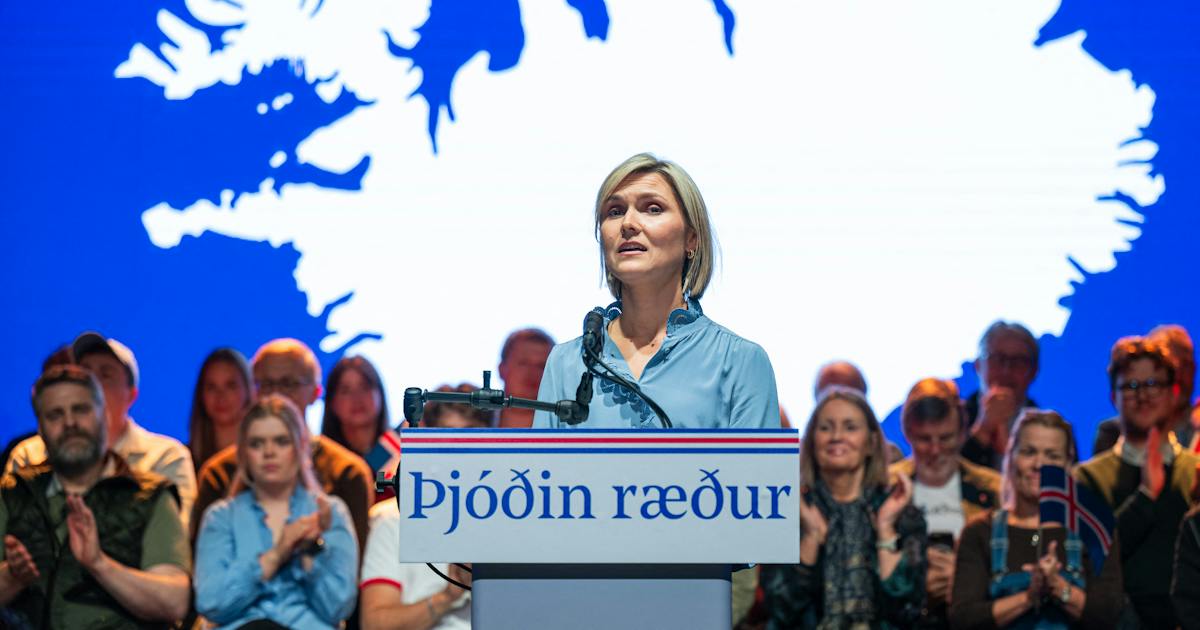
On August 28, roughly a quarter of a million Icelanders took to the polls to register their thoughts on whether Europeans would steal their fish. Well, that wasn’t the question on the ballot. But it proved to be all Icelanders cared about. And as a result, Icelanders may have committed a Brexit-esque act of self-sabotage.For the last three months, the island nation of roughly 400,000 people has played host to a heated referendum campaign on whether to reinitiate talks to join the European Union. Already a member of the European Common Market and the Schengen visa-free travel zone, Iceland has long flirted with the idea of EU membership. In the wake of the 2008 financial crisis, which exposed the vulnerabilities of the microstate’s currency, it launched a formal application to join, only to see talks stall in 2013 with the election of a Euro-skeptic government.But following President Donald Trump’s repeated threats to annex Greenland—which he confused with Iceland in a high-profile speech at Davos—the idea of EU membership was greeted with new enthusiasm.For Europe, Iceland is a valuable prize in the mid-Atlantic. Already aligned on trade and values, it is perfectly positioned to help further project the EU’s influence into increasingly contested Arctic waters. For Iceland, which maintains no standing army of its own, EU membership could replace the security guarantee offered by a struggling NATO alliance, as it faces the existential threat of Trump’s self-interested unilateralism.But almost as soon as the referendum campaign was formally launched in May, these geopolitical considerations largely faded into the background. Instead, a tidal wave of op-eds and social media posts marked by bad faith and paranoia stoked fears that negotiations on membership would inevitably lay Iceland’s prized fishing industry bare to the predation of European megacorps.Fishing is a cornerstone of Icelandic identity; it accounts for roughly 8 percent of the island nation’s gross domestic product. But tear-jerking op-eds eulogizing the freedom of the noble Icelandic fisherman are already too late. Through its free trade agreement with Europe, Iceland already accepts thousands of EU rules and regulations over which it has limited say, as it lacks a seat at the European Council. And since the 1990s, Icelandic governments have progressively sold off the vast majority of its fishing quota to private interests, leaving just a meagre fraction for the small-boat fisheries that sustain the rural, coastal communities that overwhelmingly voted “no” in the referendum.Today, just a handful of massive companies dominate the Icelandic fishing industry—as they do across most major industries on the island.It’s these interests, the Yes campaigners grumble, that were behind the flood of misinformation from corporate-owned media outlets in the lead-up to the vote: claims that EU membership would cost billions of dollars a year (more like $70 million, according to independent estimates) or that Icelandic youth would be conscripted into a European army. “They were worried about sending people to an army that didn’t exist,” Tinatin Akhvlediani, an analyst at the Centre for European Policy Studies, marveled.“Political power lies with the oligarchs,” the Icelandic economist Thorvaldur Gylfason, a campaigner for the Yes side, told me. “Some might say that this is inevitable in a small country, but no. Foreign trade allows countries to free themselves from that.”The EU, meanwhile, in a characteristic self-own, remained aloof, failing to counter even obvious misinformation or offer a glimpse of what benefits membership might bring. For many Europhiles, the campaign elicited a profound sense of déja vu. “You could almost hear the echoes of Brexit, and the whole Brexit playbook was part of it,” Dagur Eggertsson, an Icelandic member of Parliament and former mayor of Reykjavik, told Euronews. Rumors are already circulating of foreign influence and meddling—this time, EU Enlargement Commissioner Marta Kos said, “from east and west.”It’s unlikely the real extent of foreign influence will ever be known. “Iceland lacks the infrastructure to adequately monitor and detect this kind of activity,” Hulda Thórisdóttir, an Icelandic researcher of political misinformation, told me. But the result was clear: a 12-point polling swing over three months, and a nearly 53 percent majority for the No campaign, foreclosing on any chance of negotiations with the EU for at least the next two years—a result all the more galling because a Yes vote would have committed Iceland to absolutely nothing.For those in Brussels who counted on cool Icelandic heads, the result came as a shock—a “warning,” said Sandro Gozi, a member of the European Parliament, that “the EU must change.” But it’s not hard to deduce who will benefit from Iceland closing the door on EU membership for another generation.Iceland’s oligarchs maintain their status quo, doing business with the same politicians already in their pockets. The U.S. can still bully a strategic ally by threatening to crumble the NATO alliance. Russia stalls the momentum for EU enlargement spurred by its invasion of Ukraine. And both countries prevent another prosperous Arctic nation from falling further into the orbit of the rival EU.All this is bad enough. But for leading lights of the reactionary right, it’s also yet more reassuring evidence that the supposed champions of liberalism have yet to rise to their challenge.“Congratulations to Iceland on voting to keep their independence,” Nigel Farage, Britain’s far-right prime minister-in-waiting, posted to X. His French equivalent, convicted criminal and perennial presidential candidate Marine Le Pen, offered similar sentiments. “This vote reminds us that another Europe is possible,” she wrote, “a Europe of free, sovereign nations cooperating voluntarily on matters of common interest.”The losers, of course, are the Icelandic people. Akhvlediani rightly points out that EU institutions are structured to give great power to small countries like Iceland. With a seat on the European Council, Iceland would have an effective veto over the bloc’s foreign policy and security decisions—even with no military to speak of.Unable to see the forest for the trees, Icelanders gave up their chance at disproportionate influence to protect an industry long since sold out by their leaders from a fictitious foreign threat. “The mood was the fear of change … of something new and something different,” Prime Minister Frostadóttir, a supporter of the talks, lamented. “Fear has made people not see the opportunity.”It’s no surprise people are calling it Iceland’s Brexit moment. Thank God there’s still the fish.
Iceland Just Got Played
Full Article
Original Source
Read the full article at Newrepublic →KhanList aggregates and links to publicly available news content. We do not host full articles from third-party sources. Always verify important information with original sources.