
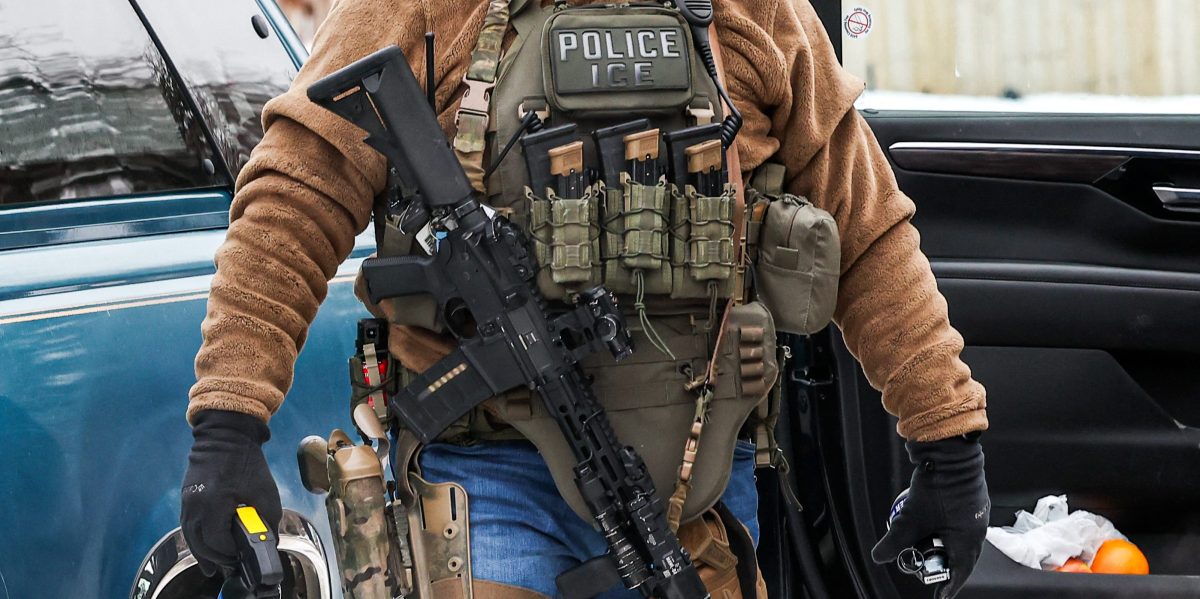
Jose Rosito Roca Estrada and his friends were on their way to work in a van on June 27, when a car in front of them slammed on its brakes, forcing them to crash into it and ricochet backward on the busy highway. Three more cars surrounded theirs, and an estimated 10 to 12 officers poured out. The agents screamed at the men to get out of the vehicle despite traffic whipping by, Roca Estrada and fellow passenger Elvis Manuel Mejia told The Intercept. The stalemate ended with the sound of shattering glass and an asphyxiating cloud of chemicals flooding the car. According to a new federal lawsuit and photos from the scene shared with The Intercept, federal agents smashed the car’s back windows and “sprayed the occupants with pepper spray through the lowered side windows.” Officers then dragged a scared and temporarily blinded Roca Estrada from the car. “I was afraid they might be robbing me,” 24-year-old Roca Estrada told The Intercept through a translator. “They did not identify themselves. I was worried they were kidnapping me because they were asking very personal questions.” “They did not identify themselves. I was worried they were kidnapping me.” The June attack is one of six stories described in a lawsuit brought by several groups — including the American Civil Liberties Union of Virginia, the Washington Lawyers Committee for Civil Rights and Urban Affairs, the Legal Aid Justice Center, and multiple law firms — alleging widespread “unlawful and dangerous” warrantless arrests by immigration officials in Virginia. On behalf of Roca Estrada and other plaintiffs, the groups are suing the Department of Homeland Security, DHS Secretary Markwayne Mullin, Immigration and Customs Enforcement, Acting Director of ICE David Venturella, and ICE D.C. Field Office Director Robert Guadian. They’re asking the court in the Eastern District of Virginia to force DHS to comply with congressional limits on warrantless immigration arrests and prohibit the agency from making immigration arrests without legally required individual assessments. “They have a mandate from the Trump administration … to get creative and make arrests, however they see fit,” said Sophia Gregg, an immigrants’ rights attorney at the ACLU of Virginia. “The agents are ill-trained, and even when they do violate the law, there are no consequences.” Roca Estrada said that the officers demanded to search his pockets, and when he declined, an agent threw him to the ground headfirst and dug his knees into his upper back. He remembered screaming as pain began to radiate through his collarbone. An X-ray reviewed by The Intercept would later confirm it was broken. According to Roca Estrada and the lawsuit, officers began to punch and hit him in the back, eventually twisting his arm to place him in handcuffs and into the vehicle. Roca Estrada said that nurses who examined him after the alleged assault told him that blood had filled his lungs, and the lawsuit notes he was diagnosed with a broken clavicle and a lung injury. At no point, the lawsuit alleges, did officers ask the necessary questions to determine whether Roca Estrada was deportable or whether he was a flight risk. Immigration officers are only supposed to make warrantless immigration arrests if they have determined “probable cause” to believe a person is unlawfully present likely to escape before a warrant can be obtained. But in an effort to meet the Trump administration’s nationwide quota of 3,000 immigration arrests per day, the lawsuit alleges, the Department of Homeland Security has chosen to pursue an unlawful policy and practice of “arrest-first, investigate-later” — leaving a trail of traumatized victims who should have never been arrested in the first place. In the first year of the Trump administration, immigration arrests drastically increased in Virginia. According to the lawsuit, in 2025, ICE made “970 arrests each month in Virginia and Washington, D.C. — nearly five times the average monthly arrest volume in 2024.” Reached by The Intercept, a DHS spokesperson said that agency had “arrested Jose Rosito Roca Estrada, an illegal alien from Guatemala,” using Roca Estrada’s full name even though The Intercept had not provided it, but denied that its officers “fractured a detainee’s collarbone.” The spokesperson did not deny that officials had deployed chemical weapons, saying, “staff relied on their training to gain compliance.” “Claims that agents did not properly identify themselves are FALSE. When our heroic law enforcement officers conduct operations, they clearly identify themselves as law enforcement,” wrote the spokesperson. “At NO time were any of the detainees thrown to the ground during the arrest. Allegations that our officers fractured a detainee’s collarbone during the arrest are FALSE.” Six weeks after Roca Estrada’s arrest, 18-year-old Britney Ramirez Corona was home caring for her 4-year-old sister in Norfolk, Virginia, when she found out ICE had detained her fiancé, his brother, and his brother-in-law. It was another traffic stop, and Ramirez Corona, a U.S. citizen and recent high school graduate, had to go pick up their abandoned car. There, according to the lawsuit, an ICE officer demanded her identification, refused to let her get her wallet, and accused her of lying about who owned the vehicle. They handcuffed and pinned her, the lawsuit alleges — leaving her little sister to cry and wander into a busy road. Eventually, ICE allowed another sister, 15, to come pick up the 4-year-old, then took Ramirez Corona into custody. She sat in “handcuffs, ankle shackles and a waist chain” for hours, according to the lawsuit, until her 15-year-old sister was able to bring her birth certificate — showing she was a natural-born U.S. citizen. The lawsuit argues that Ramirez Corona’s arrest exemplifies an out-of-control trend of warrantless and often nonsensical arrests. Stephen Miller, then homeland security adviser and now the White House chief of staff, directed agents to “just go out there and arrest,” and the department seems to have complied. “More than half of all the people ICE arrested in July 2026 did not have a criminal record,” the plaintiffs note. “And more than 500 people detained by ICE since January 2025 are U.S. citizens — another likely undercount — like Ms. Ramirez Corona.” The same month that Roca Estrada says that federal agents temporarily blinded him, broke his collarbone, and beat him until his lungs filled with blood, Congress approved another $72 billion in funding for Immigration and Customs Enforcement. Immigrant advocacy groups warned ahead of the funding vote that additional money for ICE and President Donald Trump’s brutal immigration crackdown would mean more people would suffer a fate like Roca Estrada’s — or worse. The next month, ICE agents fatally shot Lorenzo Salgado Araujo in Texas and Joan Sebastián Durán Guerrero in Maine, both in their cars. Physicians for Human Rights and the UC Berkeley Human Rights Center documented over 412 incidents of misuse of force by law enforcement agents at immigration protests from June 2025 to May 2026, including the use of chemical irritants like pepper balls and pepper spray — the same family of weapons Roca Estrada and Mejia suspect was set off in their car. In ICE custody, 52 people have died during the first 500 days of the second Trump administration, according to Human Rights Watch, while use-of-force by guards remains largely unknown. “We have received many more reports of violent use of force against people,” said Jeff Migliozzi, the communications director for Freedom for Immigrants, which runs the National Immigration Detention Hotline, referencing hotline numbers from June and July. “The overwhelming forces of intimidation and fear and retaliation, the M.O. of ICE has not changed. But certainly, as more people are detained, there’s more incidents [of violence].” The DHS spokesperson claimed that Roca Estrada and everyone arrested along with him were offered medical care but declined, adding that “one of the detainees indicated that he had a prior shoulder injury.” Roca Estrada tells a very different story. He says he spent the next month tossed between detention centers in Virginia and West Virginia. Because he was not given a sling, Roca Estrada fashioned one for his broken collarbone out of bedsheets. He said he largely went without medical care despite agonizing pain that prevented him from laying down at night. Roca Estrada said it got so bad he nearly fainted, at which point he was taken to a hospital. “After medical personnel offered to document his injuries and consult a forensic physician, officers abruptly removed him from the hospital and returned him to detention,” the lawsuit alleges. “For weeks thereafter, Defendants failed to provide the promised follow-up care.” According to the lawsuit, none of this should have happened because Roca Estrada never should have been detained in the first place. The suit alleges that immigration officers never asked the 24-year-old “about his immigration history, whether he possessed lawful status, where he worked, how long he had lived in Virginia, whom he lived with, whether he had family or community ties in the United States, or similar questions to assess whether he was likely to escape before a warrant could be obtained.” Other stories in the lawsuit follow a similar pattern. Catarina Rebeca Us Lopez, a 24-year-old woman from Guatemala, was detained in Centreville, Virginia, during a traffic stop around 6:00 a.m. with her husband. She alleges that masked officers blocked her car at a traffic light and forced her and her husband from the vehicle. The officers falsely claimed that her husband had a deportation order, according to the lawsuit. But when her husband asked questions about the stop, Us Lopez alleges an agent pepper-sprayed him in the face and threatened to draw their weapons. According to Us Lopez, officers did not “inquire about her immigration status, ask where she lived, inquire about her family, ask about her ties to the community, or otherwise conduct any individualized investigation concerning whether she was lawfully present in the United States or likely to escape before a warrant could be obtained.” Instead, she claims that officers ignored her as she explained that she had work authorization and did not have a deportation order in place, and allegedly mocked her requests for answers and legal assistance. For Roca Estrada, his physical injuries and trauma left him unable to work for a month. While he was detained, he also lost his apartment and had his personal belongings sent back to Guatemala without his consent, according to the lawsuit. “The way that I was arrested … and the immense pain that I had to go through during this whole experience,” said Roca Estrada. “What happened to me was not just.”
ICE Shot Pepper Spray Into a Car in a Traffic Stop, Then Broke a Detainee’s Collarbone
Full Article
Original Source
Read the full article at Theintercept →KhanList aggregates and links to publicly available news content. We do not host full articles from third-party sources. Always verify important information with original sources.